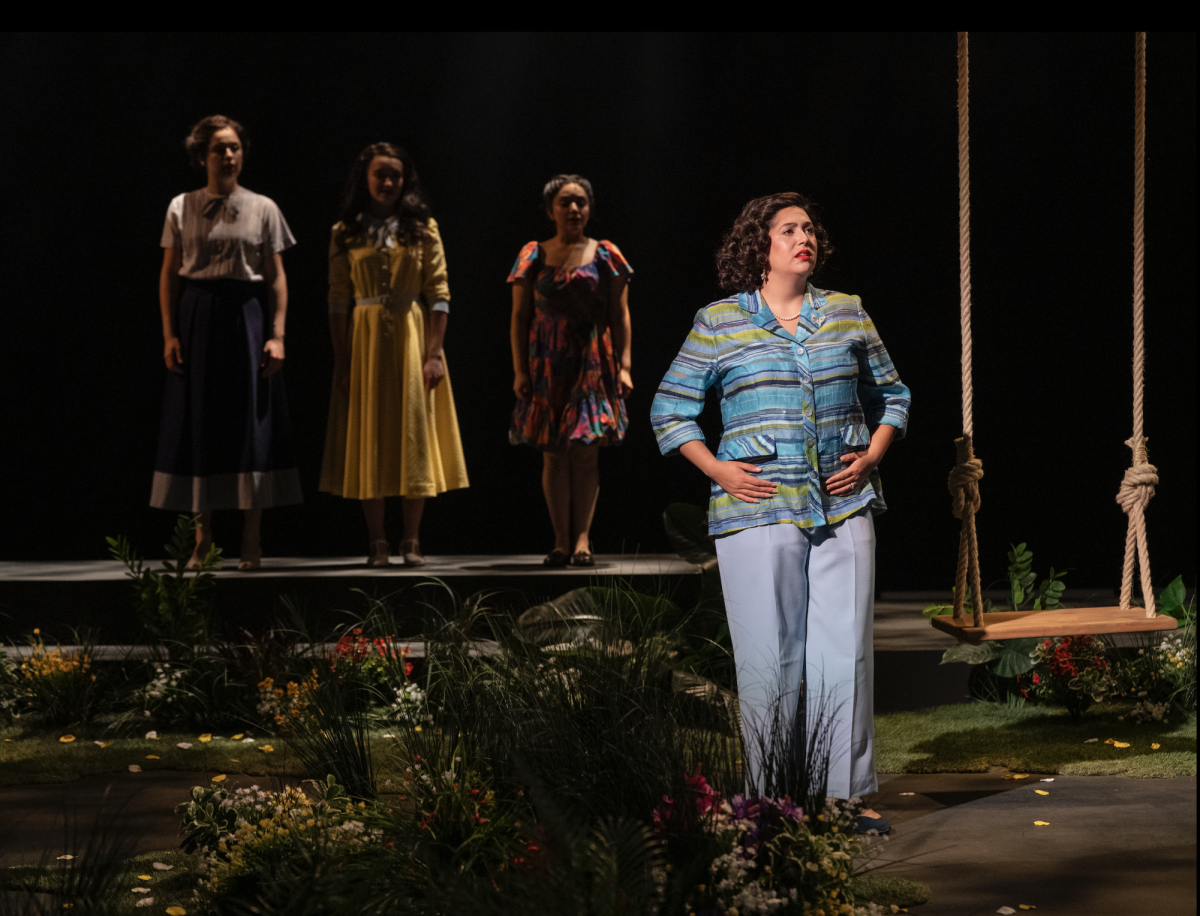
There’s a quiet undercurrent that ripples through “Hamnet,” a searching and contemplative production that opened at Chicago Shakespeare Theater Friday night.
Adapted from Maggie O’Farrell’s bestselling novel and separate from Chloé Zhao’s Oscar-nominated film, the Royal Shakespeare Company production creatively explores the genesis of William Shakespeare’s (Rory Alexander) relationship with his wife, Agnes Hathaway (Kemi-Bo Jacobs), and the devastating loss of their son, Hamnet (Ajani Cabey).
Under the careful directorial vision of former artistic director of the Royal Shakespeare Company Erica Whyman, “Hamnet” presents a unique departure from the glitz and glamour of the Hollywood adaptation. Adapted by playwright Lolita Chakrabarti, the production is as understated as it is moving.
In its dense 2 hours and 30 minutes of run time, “Hamnet” digs deep into the inner turmoil of William and Agnes’ relationship, their reconciliation of heartbreak and marital strain as William becomes a global phenomenon.
Predominantly set in Stratford-upon-Avon, England, William begins the play at age 18: scrappy, misunderstood, yet bursting with ambition and charisma. While initially cautious, Agnes quickly falls under his spell.
The duo is united by abusive relationships with parental figures. William’s father (Nigel Barrett) is rash and overbearing, while Agnes’ mother passed away when she was only four, leaving her to be raised by a controlling and emotionally manipulative caretaker (Nicki Hobday).
Nonetheless, their early days are shaped by passion, intrigue and fascination. Enamored by William’s worldly playwriting ability, Agnes is soon disarmed by his aggressive pursuit of her.
Themes of romanticism and heartbreak take center stage as “Hamnet” explores William and Agnes’ rough beginnings and eventual marriage. Early on, William claims that “only love” is what he espouses to write about in his plays, a reflection of his youthful charm.
Despite William’s fame and novelty, the show mainly spotlights Agnes’ journey through the birth of her three children. Agnes is depicted as somewhat of a fantastical being, capable of hearing the voices of her children well before their births. Haunting whispers from her unborn children foreshadow a grim outcome throughout the first act, as an eerie undertone quietly seeps into the play.
Quite obviously, Shakespeare has a gift that will propel him well beyond the confines and domestic comforts of Stratford. However, for the bulk of the first act, he is an underdog and hopeless romantic.
Act II is set years into the future, as Agnes’ children are adolescents and William is a renowned playwright. Agnes serves as a single mother after William relocates to London to sell gloves and eventually premiere his plays.
Fallout from the tragic loss of their son to the bubonic plague encompasses most of the second act, as William and Agnes’ relationship begins to deteriorate. Though the entire first act had built up to Hamnet’s death, the scene itself is characterized by an eerie tranquility.
Unlike most Shakespeare productions, which are heavily plot-oriented and binge on the extremes, “Hamnet” is characterized by an ongoing stillness and an unnerving sense of calm. Despite not adhering to the iambic pentameter of William’s plays, the dialogue is still rich and literary, and each line seems as delicately crafted as a Shakespearean play. After Hamnet’s death, one line from Agnes will certainly be burned into the memories of anyone lucky enough to see this production. Lashing out at her husband after he returns to London only one week after Hamnet’s death, Agnes exclaims, “You continue as if the weather’s changed.”
Seemingly benign on its surface, Jacob’s blistering delivery carries the weight of years of heartache and betrayal.
A successful cohesion of dynamic performances, colorblind casting, an innovative set design and elegant staging ultimately make “Hamnet” successful.
Its minimalist set of intricately structured wooden platforms is tastefully understated. In a refreshing departure from high-budget spectacle productions that lack substance, “Hamnet” focuses far more heavily on symbolism, substituting flashy production design for literary depth.
Despite its emotional resonance, the play focuses little on its titular character, perhaps to a fault. Hamnet’s death is the centerpiece of Act II, but with little time devoted to getting to know the character, his death resonated less.
While beautifully staged, Act I drags on at points and would benefit from more plot, potentially a flaw in O’Farrell’s narrative. Act II is conceptually stronger, and creatively showcases William and Agnes’ emotional evolution, but ends abruptly and suffers from rushed pacing.
Almost in spite of its subtlety, powerhouse performances from a diverse cast feel Tony-worthy. Jacobs seems to give her entire body, mind and spirit to Agnes. Alexander’s Shakespeare demonstrates an epic transformation from the ambitious teenager to the legendary playwright.
The play will embark on a brief national tour following its Chicago run, with stints in Washington, D.C. and San Francisco next. Viewers who step through the doors of Chicago Shakes are bound to be swept up in the quiet ethereality of “Hamnet,” a play which, like its titular character, is sure to have a rich afterlife.
Email: [email protected]
Related Stories:
— Curtain Call: The Goodman’s ‘Holiday’ presents a poignant meditation on wealth and romance
— Curtain Call: ‘Eureka Day’ hysterically parodies civic discourse in a Bay Area private school