This review contains spoilers.
A well-meaning yet chronically overbearing board of directors. An overworked principal caught in their crosshairs. A passive-aggressive thumbs-up emoji.
These characters comprise TimeLine Theatre Company’s “Eureka Day,” a hilarious adaptation of the Tony-award winning Broadway play that opened Wednesday night in Chicago’s Broadway Playhouse at Water Tower Place.
Written by Jonathan Spector, “Eureka Day” is set in a progressive private elementary school of the same name in Berkeley, California. Simplistic yet hard-hitting, “Eureka Day” holds up a mirror to predominantly white progressive institutions that harm marginalized community members in the pursuit of diversity-oriented goals.
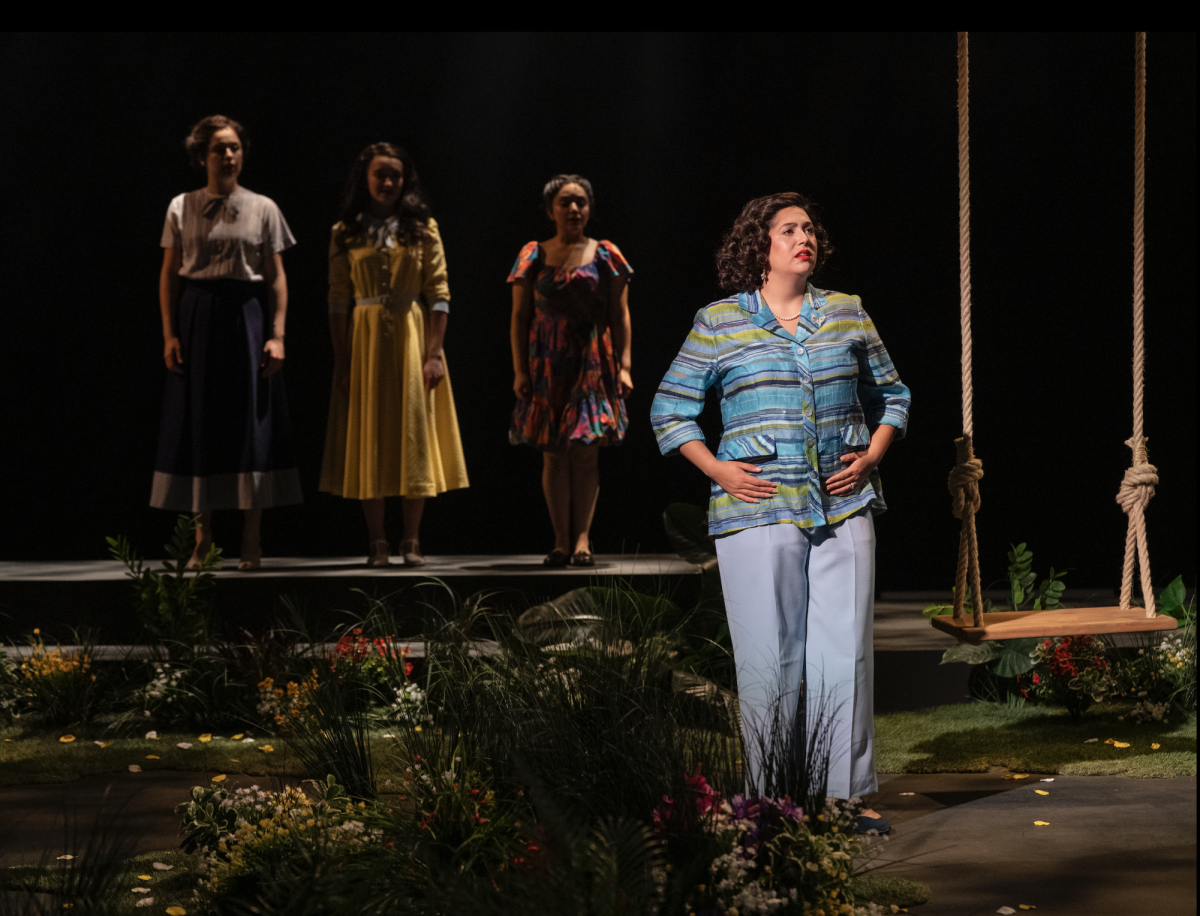
Utilizing the minimalist set of a library common area, the play follows a series of tense meetings between the school’s board of directors after a mumps outbreak sends students into quarantine. The meetings that unfold reveal a stark ideological divide around science and community values among the board.
While some members urge the principal to encourage vaccinations, others worry that mandating vaccines crosses an important boundary in parental autonomy.
In “Eureka Day,” we meet the non-monogamous stay-at-home dad Eli (Jürgen Hooper), who’s amassed a fortune as the tenth employee at Yahoo or Facebook (the company he worked at is debated). Then there’s Eli’s secret girlfriend, Meiko (Aurora Adachi-Winter), a basket case anti-vaxxer whose child contracts mumps.
Longtime board member Suzanne (Rebekah Ward) takes up the most airtime, as she strongly defends parental autonomy over vaccine mandates. Her husband jokes that she did five rounds of IVF so that she wouldn’t have to leave Eureka Day.
Carina (Gabrielle Lott-Rogers) is “Eureka Day’s” voice of reason. As the only Black character, Carina is perpetually interrupted and condescended to, even as the sole board member who talks like a normal human.
Finally, there’s Don (PJ Powers), a principal stretched to his limit directing a chorus of adult children. Deeply meditative at times and hysterical at others, “Eureka Day” questions what we owe to one another as members of a community.
The play’s first scene aptly contextualizes its amusing tone. It opens on the board debating the term “transracial adoptee” appearing on a dropdown menu of a draft applicant demographic form. Suzanne is quick to condemn the term, decrying its connotations.
“The term itself is not offensive,” Meiko suggests in her opening line.
“Not to put words into your mouth,” Suzanne says, objecting to the connotations of the term.
Meiko responds: “I find the best way to not put words into someone’s mouth is to not put words into someone’s mouth.”
Eli passionately jumps in, interrupting Carina, and ponders, “I wonder if there’s a better way to frame this conversation.”
The production’s carefully crafted dialogue critiques diversity and inclusion-oriented language. In doing so, it exposes that white people can often adopt this language to discredit the voices of characters of color.
The most enthralling scene occurs shortly after the mumps outbreak. The board is hunched around a MacBook for a virtual town hall, or as they call it, a “community-activated conversation.” A screen behind them projects a Zoom chat box, where parents exchange petty insults and air grievances with the school administration.
When the board brings on a pediatrician parent to encourage vaccinations, the chat spins into chaos, with other parents drowning out her mannered recommendations.
With the resounding scientific evidence proving the safety of immunizations, it is easy to discredit anti-vaxxers and even cast judgment on their intelligence. In a world where vaccine disinformation is being instigated by the executive branch, “Eureka Day” is careful to avoid this tendency, exposing that misinformation spares no singular demographic.
As a graduate of a Bay Area independent school, “Eureka Day’s” depiction of how some of these schools discuss contentious political issues felt all too familiar. Very similar to the private school I attended, Eureka Day deeply upholds the notion of an elusive “community,” while undercutting the people who exist at its margins.
Bristling at the term “private school,” Suzanne tells Carina: “I like to think of us as a community school.”
Some of these micro-aggressions are more ambiguous, like when Carina brings fresh scones to a board meeting, and Suzanne comments that the school doesn’t approve of disposable paper plates — arguing further when Carina tells her they’re biodegradable.
Others are more tangible, like when Suzanne falsely implies that Carina’s son is on financial aid or when Eli and Don unconsciously interrupt her at every waking moment.
The play is complemented by stunning performances from Lott-Rogers and Ward as Carina and Suzanne, respectively. The parts were originated on Broadway by veteran stage actress Amber Gray and “Breaking Bad” star Jessica Hecht, but Lott-Rogers and Ward closely rival the two.
Suzanne is easy to degrade, with her argumentative comments and excessive weaponization of diversity-oriented language. However, she holds a secret that compensates for some of her flaws.
Eli, while pathologically annoying, is also a brilliant father. Meiko, a kindhearted mother, is aching to get it right.
While I’ve seen the show on Broadway and in the Bay Area, only miles away from where it takes place, Wednesday night was by far my favorite viewing. Raw, timely and expertly tailored to our times, “Eureka Day” is a sermon for anyone who looks at the world and thinks, “Oh, dear.”
Email: [email protected]
Related Stories:
— ‘Shucked’ musical commits to ear-resistible and a-maize-ing absurdity
— A guide to theater in Evanston and Chicago
— NU alumni star in the national tour of ‘The Play That Goes Wrong’