This article contains spoilers.
Actress and director Olivia Wilde has long been fascinated by the precarity of human relationships. Through her 2019 high school drama “Booksmart” and her 2022 film “Don’t Worry Darling,” Wilde has placed themes like betrayal, codependency and reconciliation center stage.
Her new film “The Invite,” which will be released nationwide on July 10, is no different thematically. However, this time, Wilde decided to shoot the movie entirely on film — a production style that has largely been replaced by digital cinematography — to promote creative synergy among the cast.
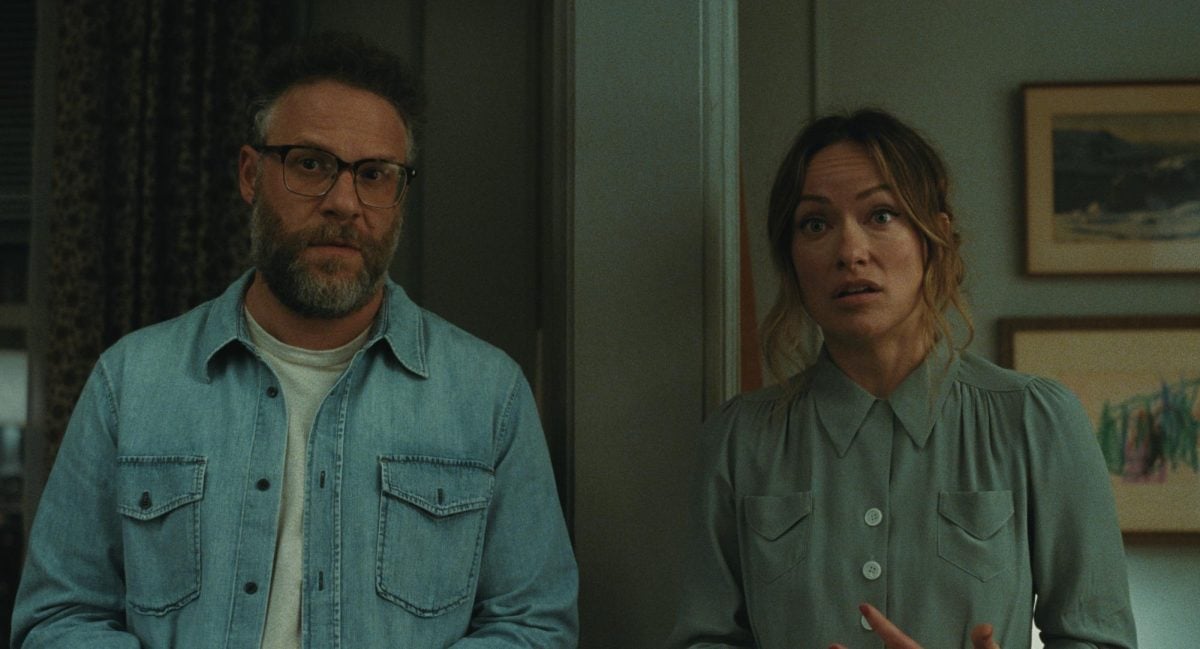
Written by Rashida Jones and Will McCormack, “The Invite” takes place over the course of one eventful night in San Francisco, when husband and wife Joe (Seth Rogen) and Angela (Wilde) have their eccentric upstairs neighbors Hawk (Edward Norton) and Piña (Penélope Cruz) over for dinner.
“The Invite” opens with a heated argument between Joe and Angela, after Joe shares his irritation with Angela for inviting the neighbors over.
When Hawk and Piña arrive, they invite Joe and Angela to have a communal sexual experience with them but are soon put off by the lingering tension between the couple. Throughout “The Invite,” themes of sexuality, marriage and heartbreak arise.
In early May, Wilde sat down with reporters from The Daily, University of Chicago’s Chicago Maroon and Loyola University Chicago’s The Loyola Phoenix for a conversation about the film.
This interview has been lightly edited for brevity and clarity.
The Daily: Despite its thematic heaviness, “The Invite” is a profoundly funny movie, from the sense of awkwardness when Piña and Hawk arrive, to Joe and Angela’s shared fascination with their sex parties. Why was it important to strike a balance between comedy and heavier themes like divorce and marital conflict?
Wilde: I don’t know about you, but I always find that the funniest movies have heartbreak embedded within them. There’s an emotional core that you really feel the pulls of joy and despair. And I think that you look at the great, late Rob Reiner; that was always so present in his work. And I think every comedy that has really hit home for me has been one that is so funny because it also just feels so human.
This movie is obviously a love letter to so many of the movies that made us want to do this. And it’s heavily influenced by Mike Nichols and specifically “Who’s Afraid of Virginia Woolf?” which was also a play to begin with. So this is all based on a play originally, which you can really feel, I think, when you watch it.
When people tell me they watch the movie and they laugh really hard and they cry, that is so exciting, because it feels like, “Oh, we’ve taken you on this journey while keeping you in a single space,” and that was definitely the goal.
The Loyola Phoenix: All three of your films have their own distinct identity. What do you think is the through line? What is the Olivia Wilde trademark?
Wilde: I think I’m most interested in relationships, and I think what the three have in common is they’re about a moment of combustion within a relationship and a turning point. So in “Booksmart,” it was about the evolution of the most intense first love of your life, this platonic friendship that’s so powerful, hitting this point of shifting into something that feels like a fracture that affects us for the rest of our lives. It’s something I think we can all really connect with.
“Don’t Worry Darling” was about betrayal. (“The Invite”) is about a point in a relationship when people are forced to really reevaluate who they want to be and the choices they’ve made and take responsibility for their own happiness. But the common denominator is relationships.
The Daily: There’s a sense of quiet resolution and subtle intimacy at the end of the film, where Joe begins playing the piano for the first time in years and Angela is sitting beside him with her head on his shoulder. Was there any kind of intended indication that they would eventually repair their marriage? And what kind of message do you hope audiences will take away from that final scene?
Wilde: The most interesting thing for me is that audiences are split 50-50 about the ending, whether they stay together or not. We had a screening a couple nights ago in Boston, and we did a poll, and it was literally 50% of the audience. It was so interesting because that keeps happening. I don’t want to answer the question for people, because I like to hear how people respond to it. The ambiguity was intentional.
I will say the question I hope people ask themselves when they leave is, “What is the conversation that needs to happen in a relationship to allow for people to really know each other and themselves? And are you holding back on a conversation that could lead to rupture or repair?” And the acceptance of the fact that sometimes ending a relationship is the healthiest thing for that relationship.
Email: [email protected]
Related Stories:
— Q&A: ‘Ginny & Georgia’ stars Brianne Howey and Antonia Gentry reflect on the series’ third season
— ‘You, Me & Tuscany’ stars, producer, director discuss the upcoming romantic comedy
— Q&A: ‘Yellowjackets’ and ‘Companion’ actress Sophie Thatcher talks Evanston upbringing, career