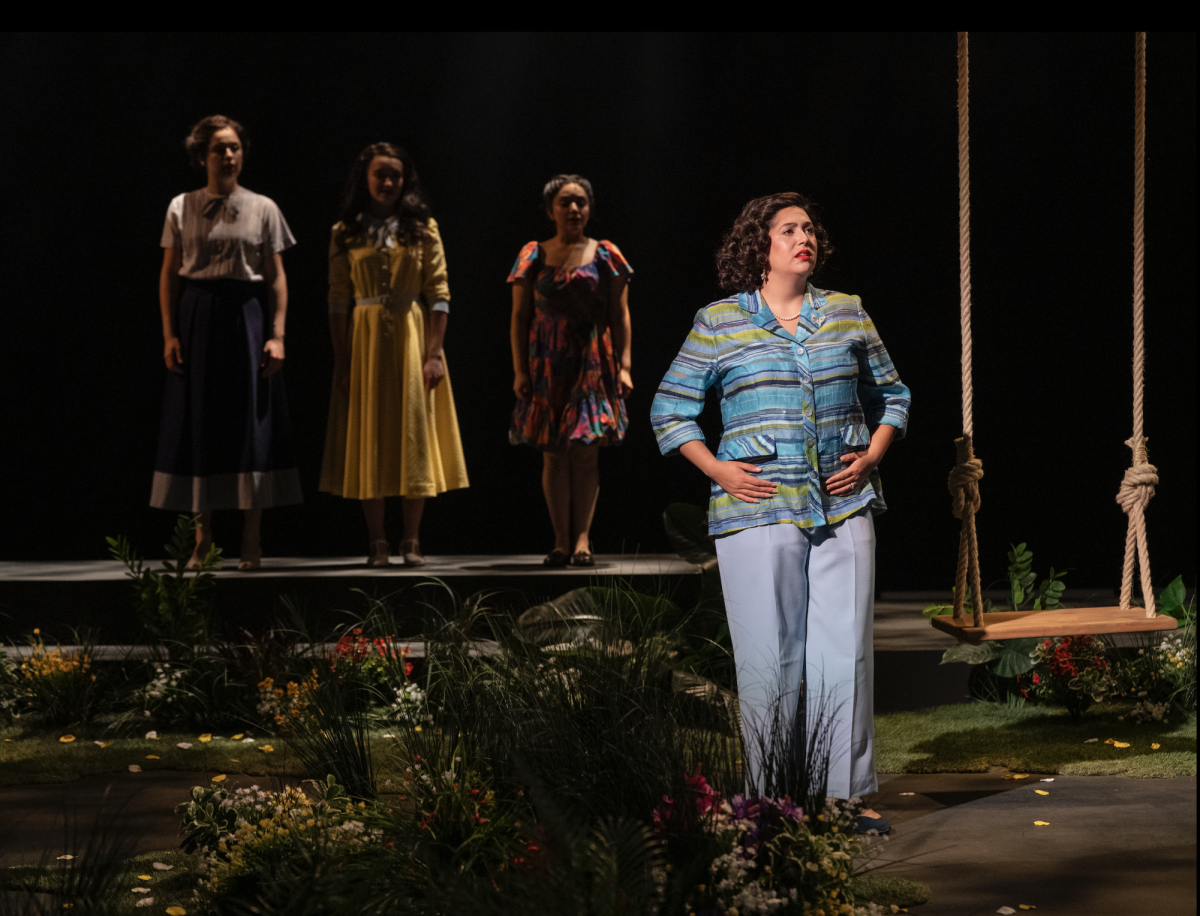
“In the Time of the Butterflies” performed its final show Saturday before a packed audience in the Virginia Wadsworth Wirtz Center for the Performing Arts.
Communication junior Lux Vargas, who played the lead role of Dedé Mirabal, said the show was a meaningful representation of Latin American history.
“Having been born to Cuban and Chilean parents, who grew up in their own respective dictatorial regimes, and getting to tell this story about another woman who survived that experience and is trying to let the story live on so that future generations can learn from it — that is really what resonates with me,” Vargas said.
Based on the novel of the same name by Julia Alvarez, “In the Time of the Butterflies” tells the story of the Mirabal sisters — Dedé, Minerva, Patria and María Teresa — who played a pivotal role in the resistance movement against Rafael Trujillo, the former president and dictator of the Dominican Republic.
The play, directed by Mariana Parejo Molinares, recounts the sisters’ acts of bravery, love and perseverance amid the intense political instability of the Trujillo regime. An older version of Dedé, the second eldest sister, recounts the lives of her three siblings starting from their childhood and ending with their assassinations at the hands of the government on Nov. 25, 1960.
This production featured the largest Latino cast in Wirtz history, said Communication sophomore Clarisa Gómez Rodríguez, who played Minerva Mirabal. Gómez Rodríguez, who is originally from Venezuela, added that the play’s depiction of the history of the Dominican Republic reflects the histories of many other Latin American countries.
“(‘In the Time of the Butterflies’) resonates so much with what’s happening in Venezuela right now, but also with the histories of so many different Latin American countries and dictatorships that have happened and this history of oppression that exists in Latin America,” Gómez Rodríguez said.
Many in the cast identified with this shared understanding of revolution across Latin America, said Weinberg junior Alexa Núñez Magaña, who played the youngest Mirabal sister, María Teresa.
For Núñez Magaña, being able to share the stage with a full Latino cast was a stand out part of the experience.
“It’s amazing that we got to have a space like this where all us Latinos were able to exist and tell our stories,” Núñez Magaña said. “Being able to share that story as Latinos in a time where the (federal) administration has been very against Latinos is extremely powerful.”
The show also highlighted the range that exists among revolutionaries, Núñez Magaña said. Each sister undergoes her own transformation in order to align with the revolution. While Minerva was the first sister to join the underground resistance group, María Teresa was more intent on enjoying her childhood before growing into the revolution.
In portraying María Teresa, Núñez Magaña said her character was uniquely inspirational in demonstrating that femininity and cheerfulness are not anti-revolutionary.
“It’s important to remember that revolution is not entirely tragic,” Núñez Magaña said. “There are moments of cheerfulness and joy, and those are the moments we are fighting for.”
In preparation for their roles, Gómez Rodríguez said she and the rest of the cast engaged in thorough research to develop a strong familiarity with Dominican history. It was important to the cast to honor the lives of the Mirabal sisters, she said.
In addition to reading the source material by Alvarez, Vargas said she devoted much of her creative process to reviewing news clippings and interviews about the sisters and reading Dedé Mirabal’s memoir in order to better embody her character.
“In the Time of the Butterflies” was also a personal story for some of the actors. Communication sophomore Juno Azuz Zacher said the show grapples with identity for younger members of the Latin American diaspora. Azuz Zacher played the role of an American writer who feels at odds with her cultural heritage after returning to the Dominican Republic to hear Dedé’s story.
“A lot of people who are Latino can relate to the American woman feeling like an outsider, being an immigrant, not feeling like you belong anymore to your home country,” Azuz Zacher said. “This character is just me.”
In the play, Azuz Zacher performs a monologue detailing the challenges many younger members of the Latin American community face in feeling grounded in their heritage. Having emigrated from Mexico at a young age, Azuz Zacher said she identified closely with her character’s inner conflict and shared the burden of keeping the stories of previous generations alive.
Throughout the production, cast members also bonded over their shared and unique cultural experiences, Vargas said.
“We all have such different experiences and connections to our culture and to our Latinidad,” Vargas said. “Getting to teach each other and exchange our cultures with each other has been the most memorable part of the experience.”
For audience member and Weinberg first-year Nathanio Scott, “In the Time of the Butterflies” was a powerful depiction of history. The show was Scott’s first time attending a Wirtz production, and he said he was enthralled by the ways in which the acting and set captured the granularities of everyday life during the Trujillo dictatorship.
“I had a friend who said (the show) makes him cry every single time, so I really wanted to come out and see it,” Scott said. “It’s really powerful. All the characters feel extremely real.”
One of the play’s main themes is the importance of keeping history alive with each passing generation. Vargas underscored the importance of celebrating Latin American history and culture through storytelling.
“Latinos have a place here,” Vargas said. “Our art and our voices and our stories matter.”
Email: [email protected]
Related Stories:
— Curtain Call: Bienen’s ‘La Rondine’ is an entertaining rom-com with deeper subtext
— First-years bring Camp Half-Blood to Harris Hall with Freshman Musical