This review contains spoilers.
Birdwatching, or birding, is a hobby that doesn’t end. It’s not like tennis, with matches and sets, or woodworking, where you can look back on a finished project with pride.
Instead, it is all about the experience of waiting and watching and the conversations had in the meantime. This is what Anna Ouyang Moench’s “Birds of North America” at A Red Orchid Theatre hones in on.
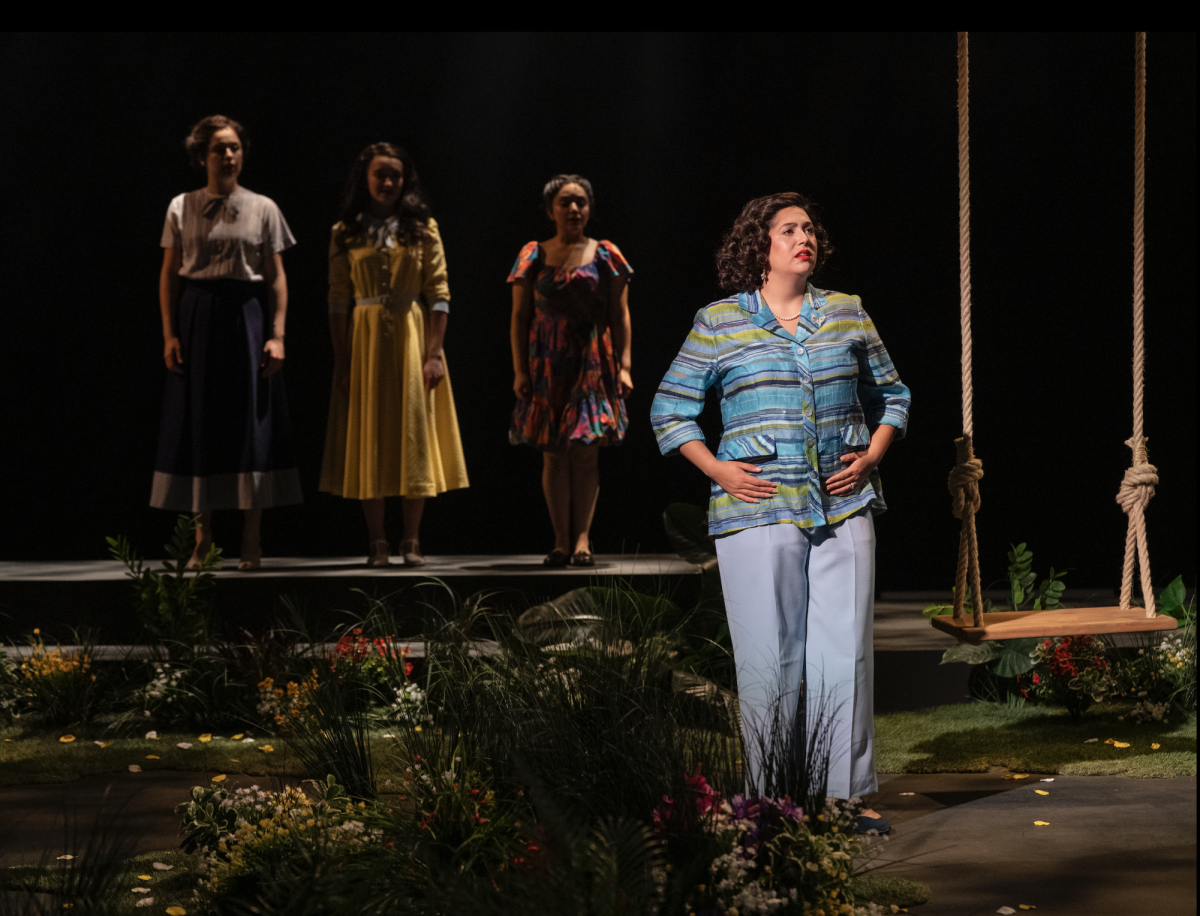
The small stage is beautifully decorated to capture an ordinary suburban backyard in Baltimore. Fake foliage, turf and a tomato plant bring in the natural world. Little details, like the rusted shovels leaning against the wall or the worn coats on hooks, sell that it has been the family home for decades.
The show follows two characters: John (John Judd), an older, liberal scientific researcher and his daughter, struggling novelist Caitlyn (Cassidy Slaughter-Mason). The show takes place on John’s back porch in his suburban Maryland home and jumps through time, shown through slight costume changes and the actors leaving the stage.
But the meat and heart of the play is not birdwatching at all — though the characters do lots of it. Instead, the play focuses on discussions about the things that happen far from this back porch, like Caitlyn’s job copy editing a right-wing site for the money, her boyfriend and husbands, Caitlyn’s attempt to start a family, John’s failed scientific research and, most importantly, climate change.
It’s a beautiful and intimate portrait of a relationship and hobby that cannot seem to escape the pressures of the real world. Just like the birds change their migration patterns because of warmer temperatures, John and Caitlyn must find a new way to adapt and find a way to relate every time the audience sees them.
In just 90 minutes, “Birds of North America” covers an expansive number of political topics. The show never shies away from getting in the politically charged weeds, whether it be the ethics of working for a fossil fuel company or the carbon emissions of airline travel.
These are topics that feel like you could devote an entire show to, but are only given a few rushed minutes in “Birds of North America.” These moments are often moving, like when Caitlyn ruminates on her miscarriage or the two fight about John’s retirement.
However, with the dim of the lights and a subtle costume change, the show jumps to another time.
Caitlyn and John’s fights are passionate and interesting to watch, but getting to them often feels inorganic. Their interactions quickly escalate from discussing to all-out yelling, which is overdone to the point that it gets repetitive. While the changes feel abrupt at times, the characters themselves feel wholly lived in.
Judd creates a character that could be anyone in the audience’s older aunt, uncle or grandparent. He rants about things big and small, struggles to console his daughter at times, has a meticulous life list of birds and constantly worries about the environment.
The familiarity and comedy Judd brings to the character are heartwarming to watch and he instantly falls into a reliable paternal cadence. Through his tone and facial expression, he captures the pains of trying to love someone radically different from you.
Slaughter-Mason as Caitlyn doesn’t have the same organic feel, but instead it feels like she is watching and being entertained by her father the same way the audience is. When she gasps or laughs at something outlandish or harsh he says, it seems to give the audience permission to do the same — and relate to her fully.
Birdwatching, though, is what brings Caitlyn and John together. No matter how big the last fight they had, they break the silence to point out the cardinals, hawks and sparrows they see.
The set and tone of the show perfectly capture the idea of the mundane. Sometimes the magic of theater is escapism, transporting viewers to magical places or times long ago.
“Birds of North America” reminds us that sometimes inside a tiny theater, the magic instead is reflecting the perfectly ordinary: the relationships that fulfill and drain us, the hobbies we use to distract us and the places we keep coming back to.
Email: [email protected]
Related Stories:
— The Dolphin Show debuts ‘Footloose’ for its 83rd annual production
— Curtain Call: ‘Eureka Day’ hysterically parodies civic discourse in a Bay Area private school
— Cosmia Opera Collective’s ‘Green Room’ finds freedom amid captivity