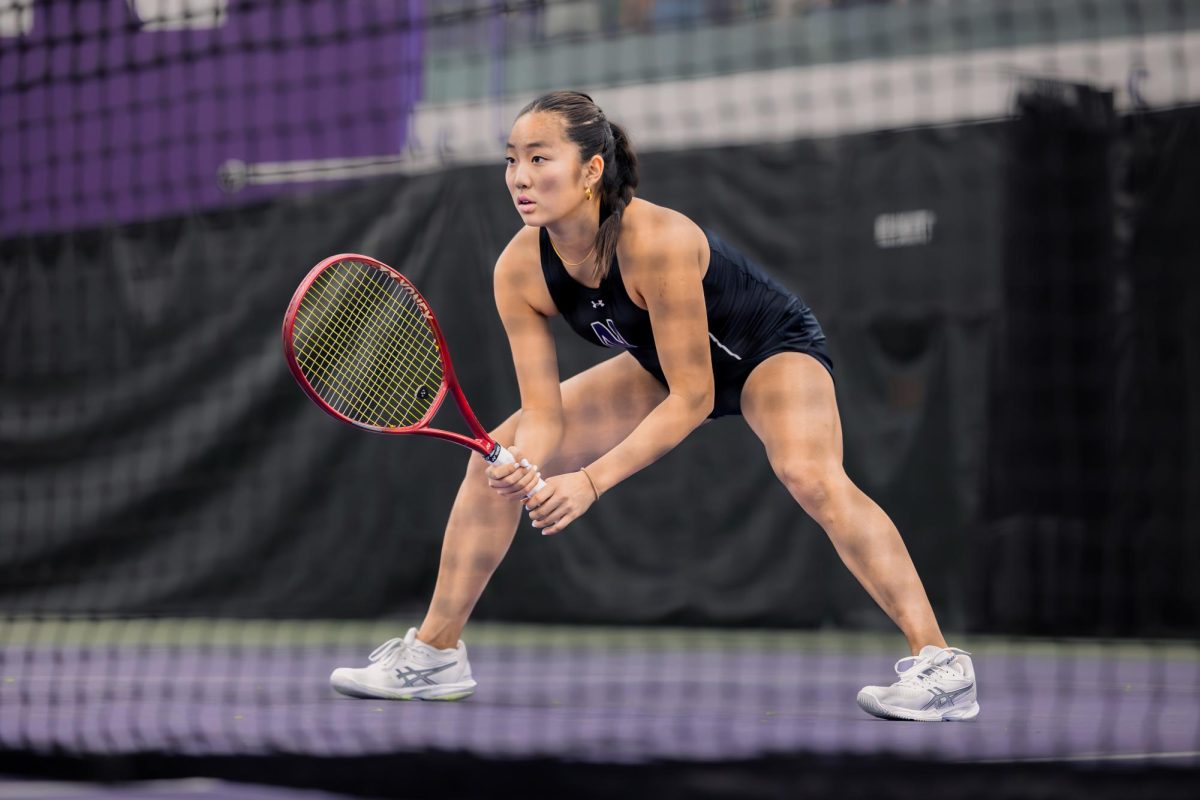
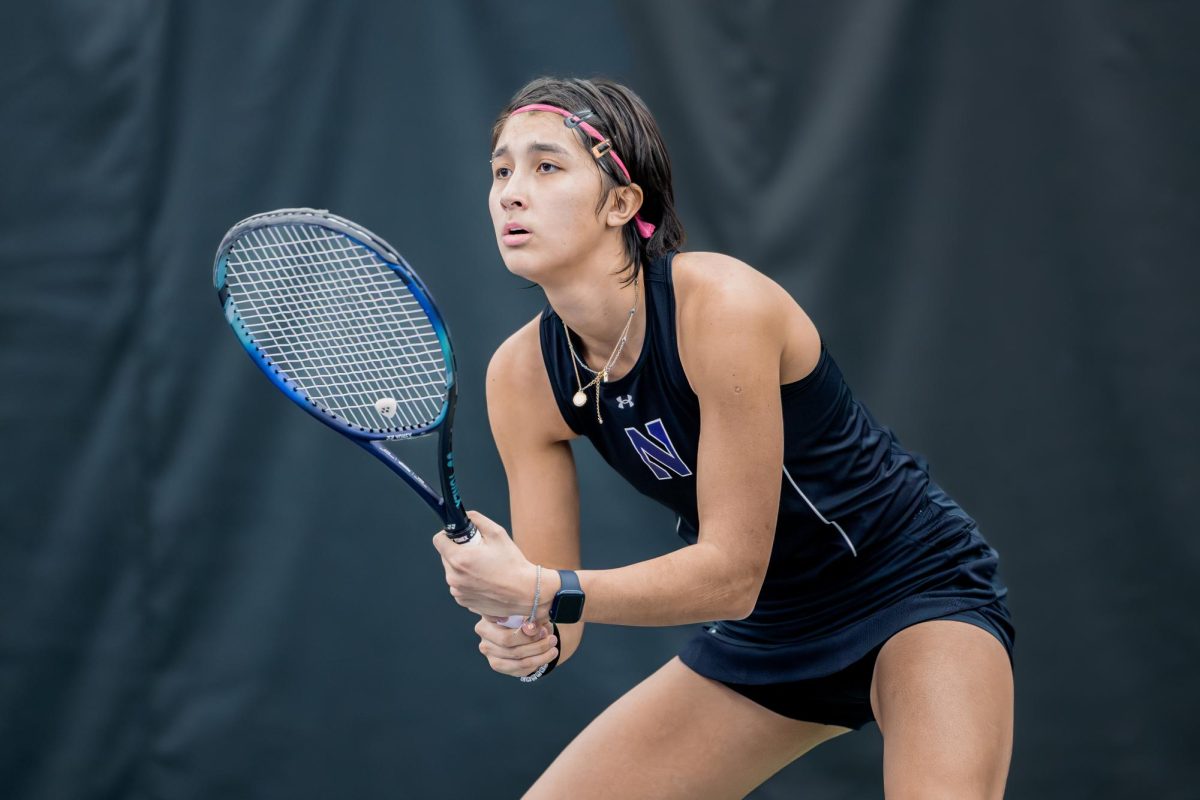
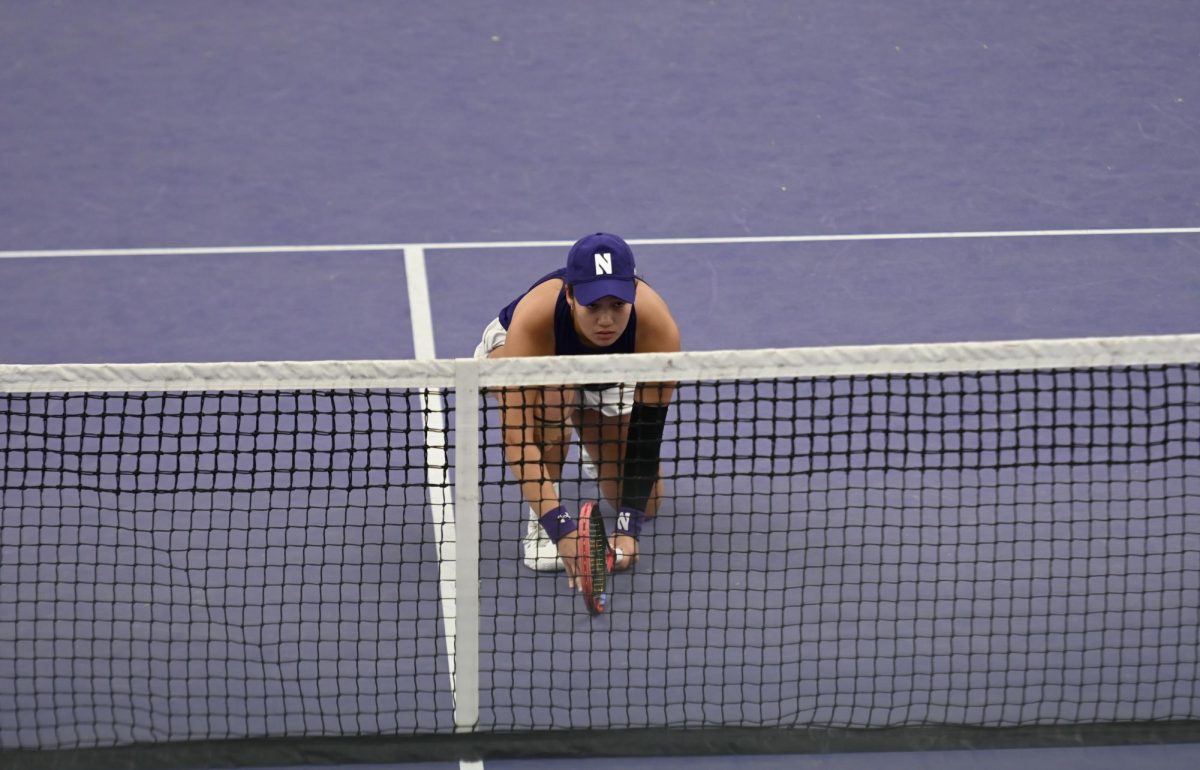
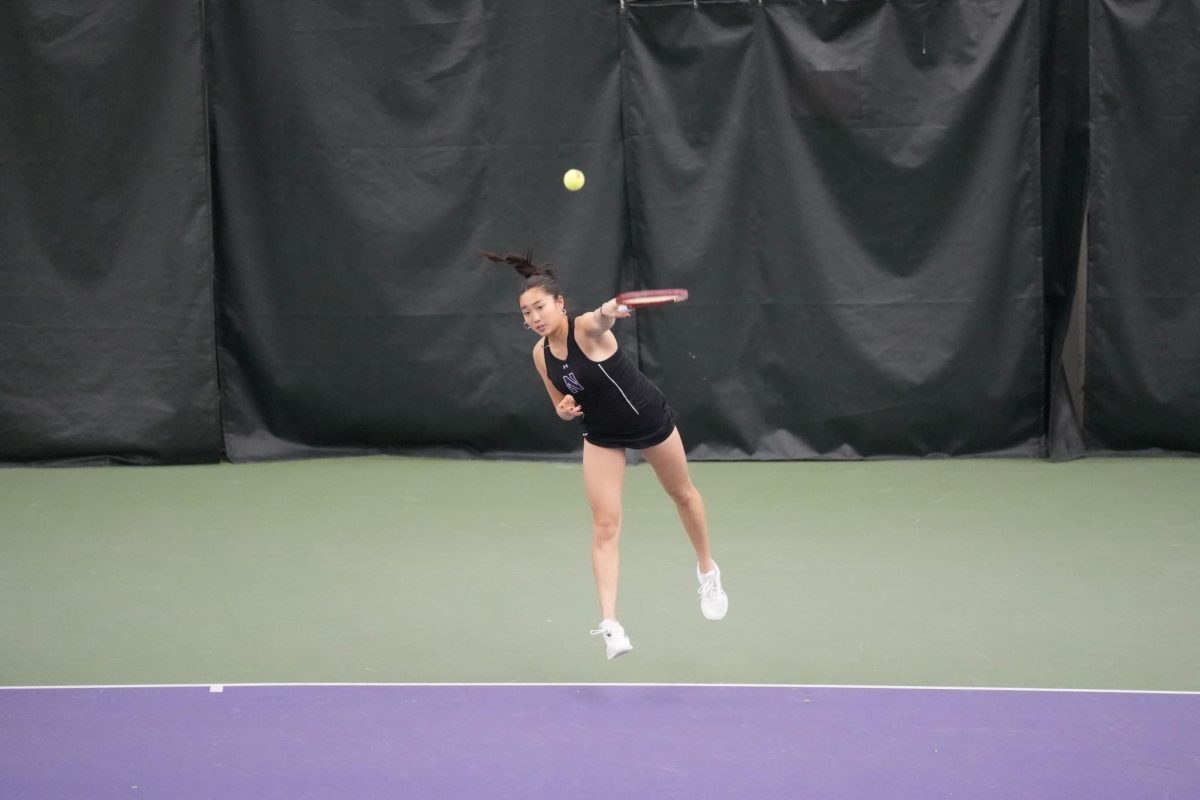
On Friday morning, No. 5 LSU and No. 14 Tennessee took to Northwestern’s Combe Tennis Center for the opening match of the ITA Women’s National Team Indoor Championships, one of the premier events of the college tennis season.
But, for two of the teams’ most high-profile players, the radiant sun of Orlando beckoned instead.
That afternoon, LSU sophomore Kayla Cross and Tennessee freshman Katrina Scott both competed for professional ranking points in quarterfinal matches at a W50 tournament held over a thousand miles from their teammates, leaving their respective college rosters shorthanded.
For some coaches and college tennis fans watching on from Evanston, Cross and Scott’s absences marked a watershed moment in the sport’s drift toward professionalism.
“There’s no football players who are saying, ‘Yeah, I’m going to go and play two Canadian Football League games,’” North Carolina State coach Simon Earnshaw said after his squad fell in a Saturday quarterfinal to Auburn. “There’s nobody that’s going to play Triple A baseball for a couple of weeks during the baseball season.”
The start of ITA Indoors came at the culmination of a hectic month for college tennis, and for college sports more broadly. With name, image and likeness payments more widespread than ever and universities now paying athletes directly through the revenue-sharing arrangement outlined in the recently concluded House v. NCAA settlement, players who previously earned money playing professional sports have begun to test the limits of the NCAA’s eligibility rules.
Contested cases in men’s basketball have attracted substantial attention, including that of Alabama’s Charles Bediako, who on Monday was ruled ineligible after playing five games under a temporary restraining order. College tennis has encountered similar situations, yet its eligibility landscape is further complicated by the fluid and internationally integrated nature of professional competition.
While several of the nation’s top women’s programs were in Evanston for ITA Indoors, The Daily spoke to five coaches about their views on the state of eligibility regulations and the balancing act of players furthering their professional careers while on a college roster.
Opinions among the coaches varied significantly, but they each agreed on one item: Nobody knows the rules.
“I’m just rolling with it,” said Tennessee coach Alison Ojeda after the Volunteers were ultimately ousted by LSU on Friday. “I’m gonna trust that they know what they’re doing, and I’m not somebody to challenge a system.”
“If you’re willing to threaten them”
Unlike some American sports, college tennis is not the primary stepping stone to the very highest levels of the professional game. At this year’s Australian Open, just nine of the 128 players in the women’s singles draw came from the U.S. college tennis system.
But, for some young players who fail to crack the pro tour, the suddenly lucrative world of collegiate athletics has become preferable to the mentally exhausting and financially burdensome globe-hopping of ITF tennis.
“(In) tennis, if you want to play at a really high level, then you’re gonna spend a lot of money,” Ojeda said.
Players who do not initially enroll in college within six months of their high school graduation or their 20th birthday, whichever comes first, begin losing eligibility each year they compete in organized tennis.
However, some players can skirt this rule through a process known as a federation exemption, according to John Parsons, host of the college tennis podcast No-Ad, No Problem. If a player’s national federation writes a letter explaining that they have been playing on tour with the goal of qualifying for national team competitions like the Davis Cup or Billie Jean King Cup, the NCAA often grants special dispensation for the player to maintain eligibility.
“Anecdotally, this feels like a pretty straightforward process that a lot of schools and coaches are leveraging,” Parsons said. “And it feels like a fairly non-stringent approval process.”
The college tennis dual season kicks off in January, with schools competing head-to-head after individual competition in the fall. Yet, even as dual play got underway last month, top teams across the nation continued to bolster their rosters with new, and mostly older, talent.
At ITA Kickoff Weekend, the qualifying event for the Indoor Championships, 26-year-old Emily Seibold of Germany made her debut for Florida, notching a win over then-ITA No. 29 Gabriella Broadfoot of NC State. She abruptly left the team roughly a week later for reasons Parsons speculated were unrelated to eligibility.
On January 31, SMU added two Europeans to the top of its lineup: 23-year-old Gina Feistel of Poland, who played the 2022 season in college at Belmont, and 21-year-old Amelie Van Impe of Belgium.
Even in the week leading up to ITA Indoors, Texas A&M announced the addition of Ilinca Amariei, a 23-year-old from Romania.
Perhaps the most eye-catching signing of the month was Scott, the 21-year-old who once rose as high as No. 149 in the WTA Rankings before committing to Tennessee on January 20. She is yet to suit up for the Vols.
On the matter of how exactly each of these players gained eligibility, the coaches who spoke to The Daily were unclear.
Asked after the Tennessee match if he understood the state of eligibility rules, LSU coach Taylor Fogleman said, “I think my simple answer, not being in the compliance department, is probably no.”
NU coach Claire Pollard was even more succinct in her answer to that question on Thursday, responding: “I don’t. I don’t.”
Auburn coach Jordan Szabo echoed that sentiment, saying that even as an avid recruiter, he didn’t know where to start with outreach.
“I’ve actually got a meeting set with my compliance when I get back,” Szabo said Saturday. “It’s like, how old is too old? Because I want to know, do I need to be messaging kids 24 or (2)5 years old?”
Earnshaw, meanwhile, saw a direct correlation between the tactics of each school’s compliance department and their success rate in eligibility cases.
“It’s almost like you’re guessing sometimes,” Earnshaw said. “It’s definitely if you have a very well-informed compliance, or you have very aggressive compliance, or, unfortunately, these days, it seems, if you’re willing to threaten them.”
Earnshaw added that he thought schools with more cautious approaches were naive about their competitors’ attitudes.
“I don’t think that the more progressive schools are really thinking that way — I think they think we all work together,” he said. “It seems to be the SEC in particular. They’re very conservative in their nature, so they just kind of draw a line in the sand. And I think they just say, ‘Fine, we’re just going to do this and come and get us if you want to, but we got more money in the bank than you, so therefore we’re going to win.’”
Eligibility for me, not for thee
As hordes of older recruits pour into college tennis, two 20-year-olds watched from a distance in the Saturday quarterfinal clash between No. 4 Auburn and No. 9 NC State. One was a freshman and the other a sophomore transfer; both had not been cleared to represent their schools at ITA Indoors.
While neither situation is entirely analogous to the federation exemption cases, both Szabo and Earnshaw took issue with what they viewed as a double standard in the NCAA’s handling of eligibility applications.
Auburn freshman Isabella Kruger arrived from South Africa and was described as a “true freshman” in her signing announcement last May. However, she has not yet played for the Tigers, having been denied eligibility for the year.
“You see some of these girls, 23, (2)4, (2)5, (2)6, year-old get immediately eligible,” Szabo said. “We’ve got a young girl on our team who is ineligible, Isabella Kruger, she has to sit this year, and she just finished high school not long ago.”
According to Parsons, however, Kruger’s situation is likely more about academic eligibility than age or professionalism.
“My understanding of the Kruger situation is that it is not a federation exemption issue; it is an academic track record issue,” Parsons said. “That could be a number of things where your high school transcripts don’t have you as a strong enough academic student athlete, maybe it’s a GPA issue, you’re able to get into the school, but you’re not meeting NCAA requirements for eligibility.”
On the other side of the court, NC State sophomore Amelie Smejkalova is sitting out after transferring from Clemson between the fall and spring seasons.
The NCAA does not typically allow players to represent more than one institution within the same academic year, but Earnshaw said Smejkalova transferred for “very, very good reason, legally.” NC State applied for a waiver based on extenuating circumstances, but had it denied at 10 a.m. on Friday morning, an hour after the tournament kicked off, according to Earnshaw.
“I don’t know how the hell the NCAA turned it down,” Earnshaw said. “I think if we had a lawyer at the court of law, we’d never lose that one.”
The Wolfpack skipper assigned some of the blame for Smejkalova’s unsuccessful application to the onslaught of legal action directed at the NCAA, making the organization risk-averse. He also cast doubt on the validity of other waiver requests that arrive on the NCAA’s desk.
“The issue is, a lot of people put in crappy waiver requests that are fabricated, and so it makes the bar so high you almost can’t clear it,” Earnshaw said. “And the NCAA don’t want to risk making decisions right now, because they just get sued left, right and center. So basically, you end up with a stalemate.”
Earnshaw said he would appeal the Smejkalova decision, and expected they would have a better chance in front of a body that is “not under any duress that they’re going to get sued.”
In the match itself, Auburn won a tight doubles point, then cruised to a 4-1 victory with the help of three straight-sets singles victories. NC State’s lone point came at the No. 5 singles spot via 22-year-old Romanian freshman Lavinia Tanasie.
“At the end of the day, we’re all playing by the same rules; it just seems like, why are some kids eligible and some kids not?” Szabo said.
College tennis at a Crossroads
By the time it became apparent that Cross and Scott would not be pulling out of their Orlando event in time for ITA Indoors, the college tennis world was on high alert.
Parsons posted on X, calling the incident “a stunning and embarrassing development for college tennis.”
Former Georgia men’s tennis coach Manuel Diaz chimed in, “Either you’re ALL in or ALL out. Some programs are making a joke out of this situation, and it hurts college tennis.”
For Fogleman and Ojeda, Friday’s match was business as usual, even as both acknowledged the inconvenience of the situation.
“There are situations where points and everything else need to get made to qualify for grand slams and stuff like that,” Fogleman said. “It’s certainly not the easiest situation to navigate. Certainly support Kayla very, very much, and hopefully she does incredibly well today.”
Asked if there was a chance Cross would rejoin the team later in the event, Fogleman answered in the affirmative but said he hoped not, as a successful week for Cross would likely allow her to achieve her ranking goals for the rest of the semester.
“We have a wonderful travel agency,” Fogleman added on the scenario of a Cross defeat. “I’m sure she’ll be on the next flight up here.”
Sure enough, after Cross succumbed in her Saturday semifinal, she arrived in Evanston in time for LSU’s Sunday consolation match, winning at the No. 2 singles spot.
Scott went one step further, reaching the Orlando final before falling in straight sets. It was her second professional event in two weeks since signing for Tennessee, and she never made it to Combe for ITA Indoors.
“Luckily, we work for an athletic director who’s eager to just give things a try,” Ojeda said of Scott’s recruiting process. “And as long as he’s good with us doing that, that’s exactly what we did, and it worked out. She’s got a year of eligibility, and so yeah, we’ll roll with it.”
Asked about the Scott and Cross no-shows, Szabo drew a distinction between allowing players to compete professionally in the fall and spring seasons.
“In the spring, we’re all about Auburn,” Szabo said. “The fall is individuals. You can represent yourself, and I’m all about that. I want every girl to be a pro player.”
Scott’s case also raised complex questions about the last vestiges of amateurism rules in college tennis.
Players who enroll in college after previously earning money on the professional tour are allowed to keep their winnings up to the point of their demonstrated expenses, plus an additional $10,000. Expenses include spending related to travel, coaching and lodging, and the NCAA can force players to donate excess profit above the $10,000 to charity.
Actively enrolled players may earn a maximum of $10,000 per year in post-expense prize money.
Scott arrives at Tennessee with an unusual level of WTA success, having previously reached the world’s top 150 and earned $471,781 in career prize money, according to the WTA website. Yet, Ojeda said Scott’s expenses lined up to allow her to gain eligibility.
“Even though she’s made as much prize money as she has, it’s cost all that money as well,” Ojeda said. “At that level, when you get to 150 in the world, you’re traveling with a full-time coach, you’re traveling with a fitness person, you’ve got a team around you. So there’s loads of expenses.”
In March 2024, North Carolina’s Reese Brantmeier filed a class-action lawsuit against the NCAA seeking to overturn the $10,000 post-expense limit on prize money, pointing to the proliferation of name, image and likeness deals, which have rendered amateurism regulations hollow.
Pollard said she would accept the lifting of prize-money restrictions, but was far more concerned about older players taking away scholarship opportunities from college-aged players interested in an education.
“I’d like to just see an age restriction,” Pollard said. “I don’t really mind how much money they’ve earned, how much experience they have. I’d like to see people have to come to school within a year of graduation, and then if they don’t, I’d like them to sit on the front end and not on the back end. And I think then if someone’s willing to sit on the front end, then they’re really serious about playing.”
The Wildcats came into the weekend with a young squad relative to the field, starting two freshmen and two sophomores in their singles lineup. Both freshmen arrived from Europe: French 18-year-old Margot Phanthala and British 19-year-old Marelie Raath were each thrown straight into the fire.
NU went 0-3 on the weekend, earning just two points in the process. The gap between the ’Cats and the sport’s elite programs was on full display, demonstrating the potential pitfalls of Pollard’s emphasis on long-term development.
But for NU’s 28th-year boss, only time will tell as to whether the influx of players dropping down from the WTA Tour will make a serious dent in the college game.
“Let’s see how much those players enjoy college,” Pollard said. “Maybe they love it. Maybe they’re so grateful to get off the tour and come and play. Or maybe they won’t be as up for a dual match in the Combe Tennis Center, because I know we certainly will be.”
Email: [email protected]
Related Stories:
— Women’s Tennis: Northwestern triumphs over UIC in home opener