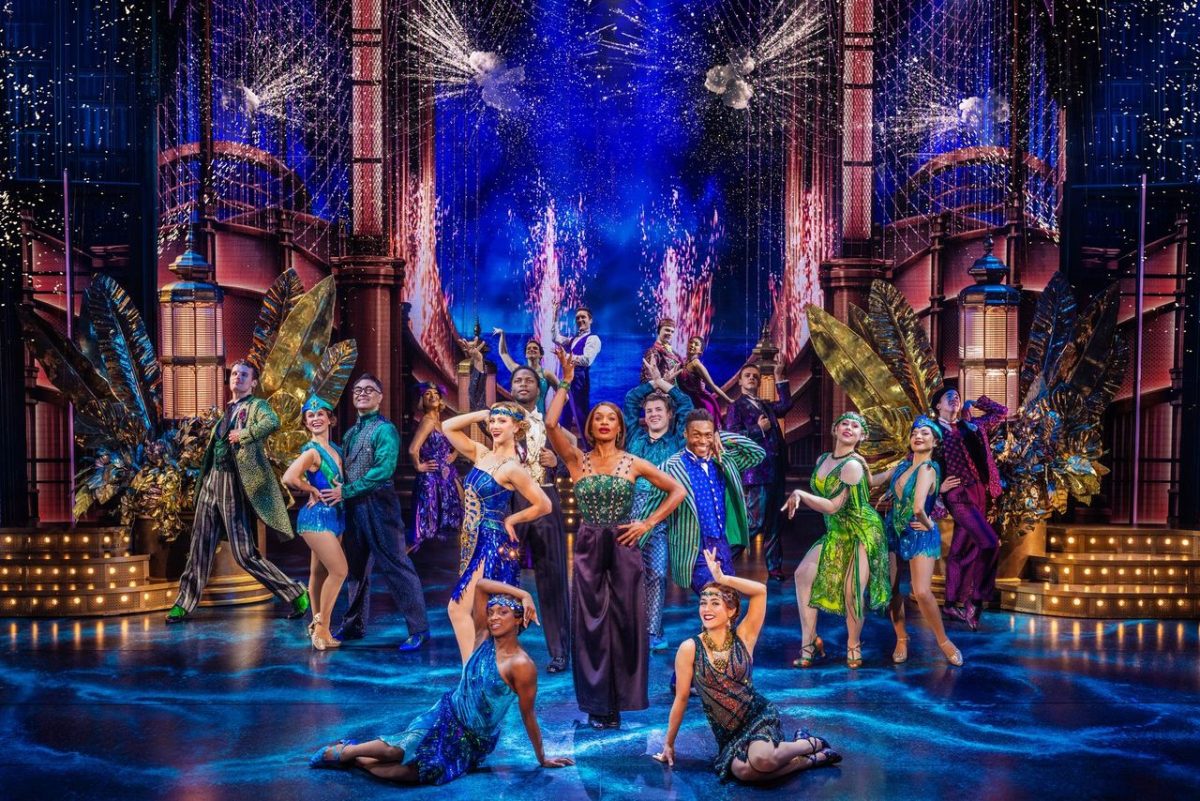
There is a generational obsession with F. Scott Fitzgerald’s “The Great Gatsby” and its colorful depiction of the Jazz Age, a critical inflection point in American history. To this day, the groundbreaking 1925 novel is still shoved down the throats of high schoolers across the country. Beyond academia, it’s so ingrained in our pop culture that it’s been adapted into film four times.
It should thus be no surprise that, following multiple film adaptations, the novel is now the source material for a campy 2024 Broadway musical adaptation, whose touring production opened on Broadway in Chicago’s Cadillac Palace Theatre on April 22.
The two-and-a-half-hour musical follows protagonist Nick Carraway (Joshua Grosso), who relocated to the fictional West Egg in Long Island following a traumatic deployment in World War I. His next door neighbor is the enigmatic Jay Gatsby (Jake David Smith), the long-lost lover of his cousin Daisy (Senzel Ahmady), who is trapped in a loveless marriage with the brutish Tom Buchanan (Will Branner).
Directed by Marc Bruni, the musical is visually stunning and complemented by sensational performances from the principal cast, but it unfortunately lacks the emotional depth of its source material.
In a chaotic opening number, Nick and the dynamic ensemble sing about the excesses and ecstasy of Gatsby’s parties. Donning flapper dresses and gold suits, they dance passionately to Dominique Kelley’s jazz-inspired choreography.
Heightening the novelty of its titular character, “New Money” is a rousing spectacle. Throughout the number, Jordan Baker (Leanne Robinson) — an amateur golfer and Daisy’s only friend — recounts the extravagance of a typical Gatsby party. Meanwhile, ensemble members quip about some of their host’s lore — “I heard he killed a man” is one story that circulates. However cartoonish the number may be lyrically, “New Money” is a bonafide banger, and Robinson is a vocal powerhouse, oozing charisma throughout the song.
Though thematically a heavy novel, Gatsby’s chronic obsession with Daisy occupies so much of the musical’s emotional tenor that it smothers other themes. Shortly after his entrance, Gatsby sings “For Her,” a ballad pleading Nick to help coax Daisy back into his life. In the second act, suspended on a raised platform, Gatsby sings “Past is Catching Up to Me,” a vocally demanding solo about his love affair with Daisy coming full circle. Unfortunately, Smith’s Gatsby was disappointingly uncharismatic and lacked the full-body performance necessary for such a demanding role. Though Smith’s angelic tenor was temporarily distracting, the emotional impact of Gatsby’s character was blunted.
Conversely, Ahmady brought the intensity of Daisy to life in an emotionally demanding performance. Entering the stage on a white futon and covering her face with a worn copy of Life magazine, Daisy radiates a bubbly presence, peppering her cousin Nick with questions: “Tell me: did you go east by train, did you stop in Chicago, do they miss me?”
Most English students will be turned off by the shallowness of this production. “The Great Gatsby’s” canonical themes of forbidden love, extreme wealth and unchecked infidelity are central to the novel’s impact. Regrettably, the Broadway production only scratches at the surface of this tension, perhaps attempting to make the musical commercially marketable enough to sustain a years-long run. The musical also chaotically depicts the illicit way Gatsby accrued his wealth and his shady relationship with Meyer Wolfsheim (Edward Staudenmayer), a gangster who operates various illegal schemes.
In another failure of directorial vision, the production only partially commits to the 1920s style. Gatsby speaks in a gimmicky old-timey American accent, while other characters use contemporary accents and vernacular. Moreover, the character of Nick is an afterthought, rarely appearing alone onstage. This lack of depth is hardly an indictment on Grosso, however, who makes the most of the role.
To its credit, the musical does make use of the character Myrtle Wilson (Lila Coogan), Tom’s secret lover, who’s married to gas station owner George Wilson (Tally Sessions). Unlike other roles, Myrtle is not underwritten, and the musical seizes the chance to explore the night-and-day split screen between her and Tom’s social classes. It’s also refreshing that the character belting a culminating showstopper is not Daisy or Gatsby, but Myrtle herself, newly pregnant and venturing solo to The Plaza Hotel at night.
While “The Great Gatsby” musical is hardly a work of art, the production nonetheless has enough redeeming qualities that it remains an enjoyable night at the theater. Numbers like “My Green Light,” the culminating song in act one where Daisy and Gatsby are reunited, are beautiful enough to induce goosebumps in any viewer. The song is passionate and gorgeously arranged, yet refreshingly unonstentatious.
“The Great Gatsby” musical isn’t the only adaptation of the classic novel to yield diminishing returns. Director Baz Luhrmann’s star-studded 2013 film adaptation was far more garish and overdone. Still, it would be a better use of one’s time and money to stay home and re-read the novel.
Email: [email protected]
Related Stories:
— Curtain Call: ‘Eureka Day’ hysterically parodies civic discourse in a Bay Area private school
— Curtain Call: ‘The Brief, Wondrous Life of Oscar Wao’ at the Goodman struggles to find its footing