This article contains mentions of sexual assault.
Though the title of the play may suggest otherwise, the Goodman Theatre’s production of August Wilson’s seminal “Ma Rainey’s Black Bottom” deals little with its intrepid titular character. Instead, the supporting characters do the heavy lifting, recounting stories rife with trauma, religion and racism in the dingy basement of a recording studio.
Directed by Chuck Smith, a veteran of the Chicago theater scene, the performance opened Monday night to positive reception. Set in 1920s Chicago, the play methodically explores themes of racism and white supremacy.
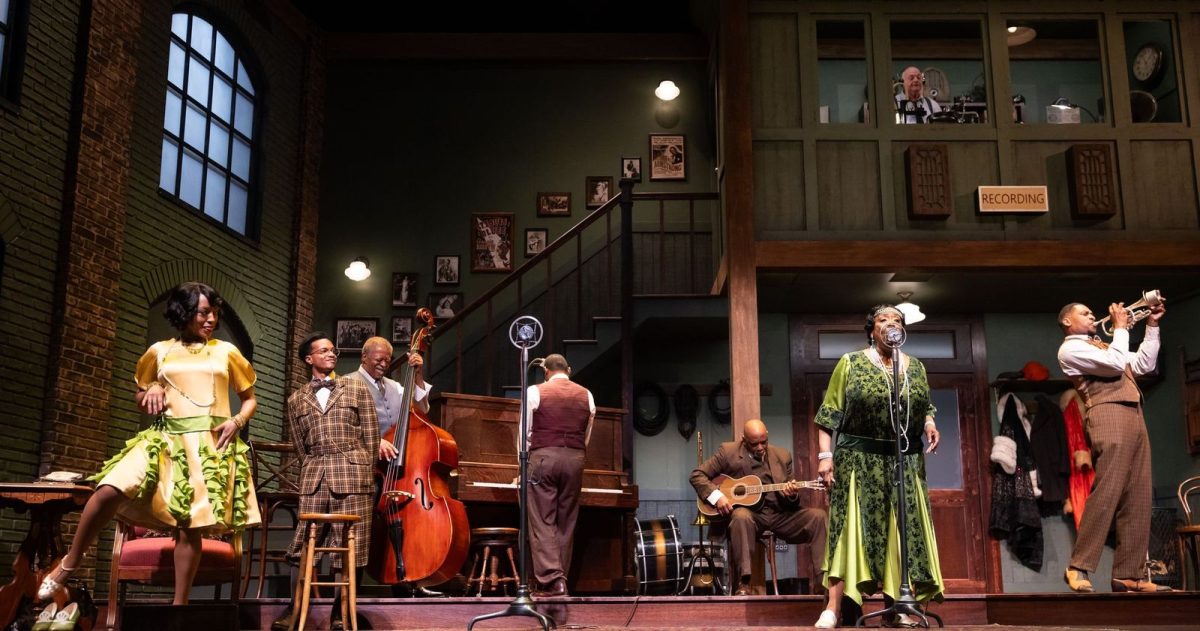
“Ma Rainey’s Black Bottom” opens on the backing musicians of the play’s titular band. Scattered throughout the basement of the studio, the band gears up to record Ma Rainey’s new blues album. In her typical fashion, Ma Rainey (E. Faye Butler) shows up an hour late. During her absence, the audience is offered a window into the lives of her band members.
Through stories of racism and petty arguments about creative direction, the band members take center stage, livening Wilson’s dense script by bickering and trading jabs prior to Ma Rainey’s arrival. In one instance, they debate the spelling of the word “music.” In another, they argue at length about which adaptation of the song to record.
The character who stole the most laughs was the charismatic Levee (NU alum Al’Jaleel McGhee, Communication ’22), an ambitious trumpeter who longs to transition the group toward jazz and improvisation. His goals for the group starkly contrast those of the other band members, who wish to retain Ma Rainey’s scripted version.
In the beginning of the first act, instances of petty racism permeate the script, situating the play within a grim context. Throughout Act 1, Ma Rainey’s white manager refers to her adult band members as boys, a common occurrence in the antebellum period. In a separate moment, Ma Rainey’s managers take the new cut of the song Levee writes, before rejecting its improvisational premise. More extreme instances of white supremacy loom larger.
After his fellow band members mock his obsequious interactions with the white managers and staff at Ma Rainey’s record label, Levee bristles at their teasing, proceeding to launch into a harrowing account of his mother being gang raped by a band of white men in his early childhood. Battling tears, Levee later reveals that the white men murdered his father and branded him with a scar on his chest after he sought revenge for Levee’s mother.
“You all just back up and leave Levee alone about the white man,” Levee tells them. “I can smile and say yessir to whoever I please.”
Somewhat paradoxically, the no-nonsense Ma Rainey provides the thematically driven play with much-needed comic relief. Arriving an hour later after allegedly attacking a cab driver in broad daylight, she refuses to sing without drinking a Coca-Cola first.
Wilson’s plays have been fertile ground for directors, spawning Broadway revivals and regional theater productions across the U.S. However, the thematic complexity in “Ma Rainey’s Black Bottom” allows little room for directorial error. To successfully recreate a play that deals so heavily in symbolism, where plot is substituted with characters recounting memories from the past, is a task that requires strong creative precision.
Luckily, Smith handles that task with the responsibility and jurisdiction capable only of a seasoned director of his stature. Despite its two-and-a-half-hour runtime, no aspect of the play feels belabored, a testament to Smith’s powerful direction, fantastic acting from the entire cast and an elaborate set that instantly immerses the audience into the recording studio.
Smith also masterfully situates “Ma Rainey’s Black Bottom” at the intersection of drama and comedy, accentuating the comic elements of the script that may be overlooked in a traditional Wilson restaging. In the first act, Smith focuses on Levee’s fixation with his new shoes and generates fresh humor through Ma Rainey’s various antics. The use of physical comedy in this production is a powerful device, juxtaposing white supremacy with bursts of lightheartedness. The intellectual depth of this production makes it Broadway-worthy.
Standout performances from Butler and McGhee compliment the show’s powerful script. Butler is a force to be reckoned with as Ma Rainey, bursting with authority through a larger-than-life stage presence. McGhee’s haunting performance would easily make him a Tony Award contender if this production were to open on Broadway.
“Ma Rainey’s Black Bottom” quickly courted critical acclaim, with the Chicago Sun-Times declaring it “near perfection” and the Chicago Tribune hailing McGhee’s sensational performance. After witnessing the vast artistry on display at the Goodman Monday night, I am delighted to add to that praise.
Through rich and moving commentary on American race relations, the Goodman’s revival of “Ma Rainey’s Black Bottom” is a sermon for the ages.
Email: [email protected]
X: @gabejournalist
Related Stories:
— Curtain Call: ‘The Brief, Wondrous Life of Oscar Wao’ at the Goodman struggles to find its footing
— Curtain Call: The Goodman’s ‘Holiday’ presents a poignant meditation on wealth and romance