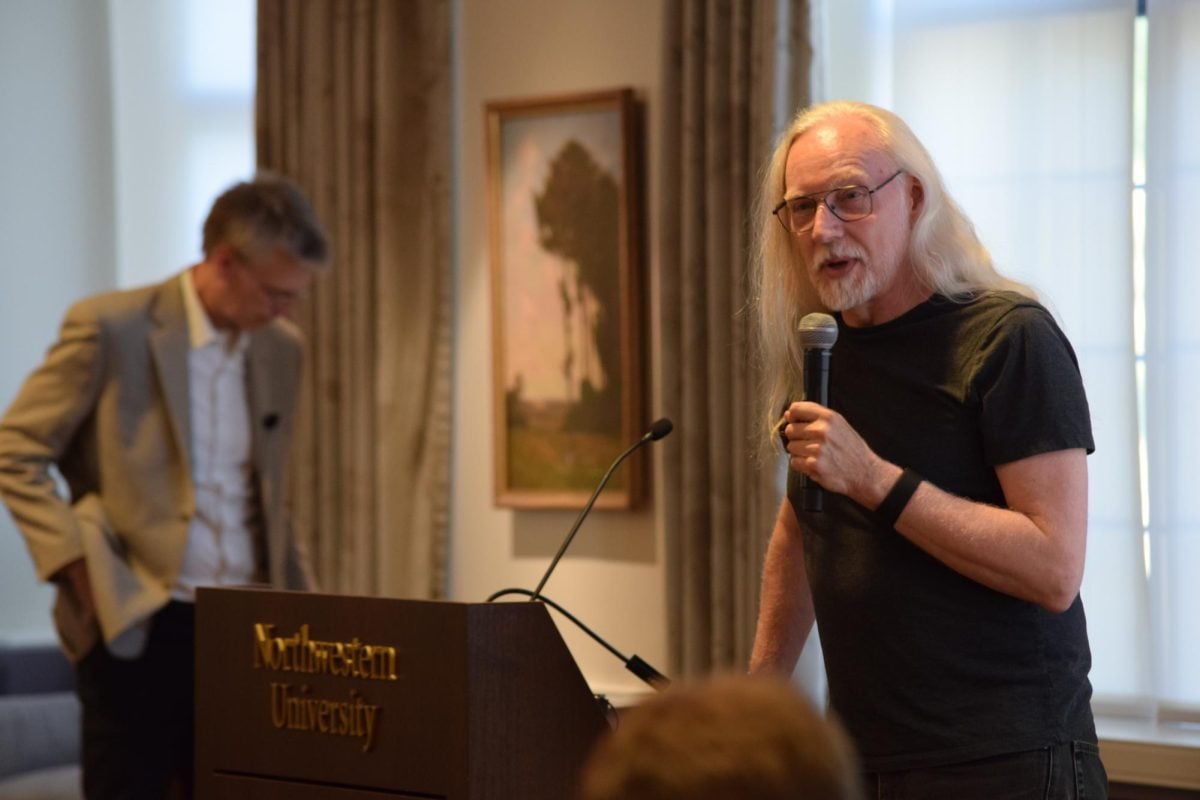
English Prof. James Hodge teaches courses at Northwestern about film and digital media studies.
He is the author of “Sensations of History: Animation and New Media Art,” which talks about the relationship between digital media and history. He earned his Ph.D. from the University of Chicago and joined NU in 2013.
The Daily spoke with Hodge about exploring film through an English lens, the skills that students learn from it and technology.
This interview has been lightly edited for brevity and clarity.
The Daily: English is traditionally associated with novels, poetry and written works. Why do you teach film through the lens of literature?
Hodge: Historically, film has lived very happily in English departments across the country and around the world. Especially in non-R1 universities, smaller universities that have less faculty, film tends to live within English. English has just been a sort of happy, big tent. It often works as an incubator for a number of different fields. Black Studies (was supported by English departments) in the ’60s and then rapidly became its own thing. … With film studies, it has gone into its own department. You have Radio/TV/Film, which is a long-standing department here at Northwestern through the (School) of Communication. There’s a long history there with the history of teaching speech and communication that makes that department pretty unique.
Why do I teach film here? I was always interested in narrative, and English is really a great place for thinking about narrative. Narrative is probably the number one reason that film lives happily in English departments. Thinking about narrative in a novel or an epic poem is pretty different than thinking about it in a feature-length film, but you can see how there’s a sort of family resemblance, right? It’s more of a gentle hop from one island over to the other, rather than leaping across a big chasm. Narrative is the big link.
But for me, I’m really interested in the tools of formal film analysis, which were largely developed in concert with the same sorts of techniques in English literary analysis. A lot of the ways of looking at texts that we have and thinking about composition or thinking about tone or thinking about rhythm are questions that are asked and pitched in different ways in literature than they are in cinema, but they have a common ancestor. That allows me to talk to people in film, which is great. In a lot of my professional life, I’m talking less to folks in literary studies than I am to folks in cinema studies and media studies, although English is where I live here.
The Daily: What skills do you believe students develop by studying film? What do you hope students gain from taking the classes that you teach, specifically?
Hodge: I hope that students learn skills of being able to look closely and understand why a film is making them feel something of what they’re feeling. I hope that they can feel this one, so that they can take these skills and go into the wider world and defend themselves from all the media saturation that’s constantly hailing us, which often feels quite overwhelming. In a less antagonistic fashion, I hope that this deepens people’s ability to talk with each other, to promote understanding and appreciation of these great works. Third, it’s really fun.
I hope that students have an enhanced sense of their own enjoyment and a sense of openness to new kinds of things, and that students pick up on what I’m trying to sell, which is there’s so many great and wonderful things, you can’t exhaust them. Go see new things. Go out into the world. Go meet people. Go see things that you don’t even know what they’re about.
The way I start that conversation is through really popular stuff. … You see some reference to “The Wizard of Oz,” or you see some reference to “Psycho” or to “Star Wars,” and you’re like, “Oh, okay.” Now, there’s connective tissue, right? Now, you’re part of a bigger conversation. I always find that moments of feeling myself in those bigger conversations, and sometimes just the feeling, it’s great.

The Daily: You’ve talked about how people are attached to their phones, and you have a “no technology” policy in the classroom. Why do you have this policy?
Hodge: I’ve tried different things in the past, including allowing laptops, and it’s always been a failure. I can give students as much information as I can about the evidence suggests that if you study this way, this will be the case, and it’s never heeded. (In) my experience TA-ing way back at the University of Chicago, the TAs would sit in the back, I would see people shopping on their laptops. I would see Amazon open or whatever, it was probably like Friendster back then. That was discouraging.
I disallow technology, not because I want to prevent students from doing things. I want them to be as present as possible to the material, to me, to each other, but mostly to themselves. I want you to have control of your own mind. What I see the real danger with these machines — and I love them too, and I study them, and I use them, and I’m in this world too — is the incredible saturation of our lives by the presence of these technologies. We don’t turn them off, we don’t put them away. You probably have a cell phone on your person right now. It’s in your bag, if it’s not in your pocket. I want you to be able to be present to yourself. I’m not trying to shame anyone by saying, “Don’t bring your computer to class.” I’m trying to make the class more possible, at least. I’m trying to make what I feel to be the best version of the class, to be the most possible for everyone.
The Daily: If you could live inside the world of one movie, which would you choose and why?
Hodge: I would live in the world of “Pee-wee’s Big Adventure” by Tim Burton, 1985, a riff on the Italian neorealist classic “Bicycle Thieves.” Pee-wee is a strange performer, and he’s sort of a man-child. One of the bits of the movie is everyone acts like it’s normal to be like him. I love this world where someone who’s very much not normal by any conventional measure is just part of things and is just accepted. I love this world where weirdos are a part of the normal working of things.
Liam Barrett contributed reporting.
Email: [email protected]
Email: [email protected]
X: @YoniZacks
Bluesky: @ywzreports.bsky.social
Related Stories:
— Q&A: Medill Prof. Jim DeRogatis reflects on career, music criticism
— Q&A: Prof. Almaz Mesghina discusses faculty excellence in diversity and equity award