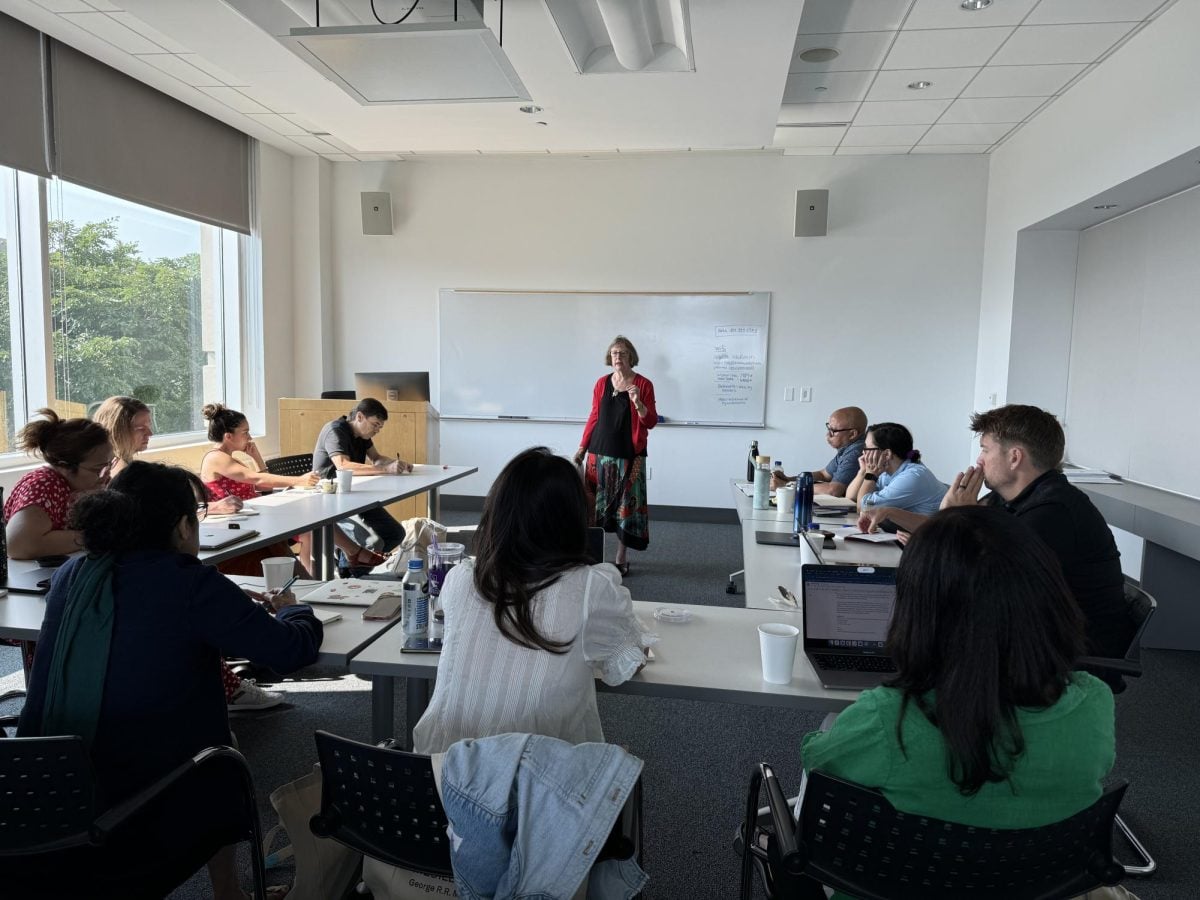
A recent study from Pritzker Prof. Chika Okafor found that minorities receive disproportionately fewer jobs through referrals due to their smaller social group, a term Okafor coined as “social network discrimination,” even with color-blind hiring policies.
Okafor’s study drew from real-world data to estimate that the minimum difference in expected wages due to social network discrimination is at least 3.2%, a statistic caused only by the smaller group size. It did not include other factors such as discrimination and prejudice.
The study was published in the August 2025 edition of The Journal of Law & Economics.
The Daily sat down with Okafor to discuss the study and its widespread implications.
This interview has been edited for brevity and clarity.
The Daily: What initially led you to investigate the phenomenon of social network discrimination, especially given the existing economic models of discrimination?
Okafor: I felt that there was an oversimplification of how people thought about which opportunities were fair or what were the best ways of determining who gets what opportunities in our society. So I wanted to ask whether or not the debate in the dialogue was accurate and how it was portraying some of the nuanced or complicated questions.
The Daily: Your model assumes equal ability, equal initial employment and equal network structure. What was the importance of making this initial assumption of equality, and what does it reveal about the underlying mechanisms of inequality?
Okafor: I was trying to simplify the phenomenon I was trying to see. Basically what I wanted to do was cut off from the vision of the goal that many people on the political left and on the political right are seeking. Many on the political left talk about matters of equity, equality and so I set everything equal to the majority and the minority group. Currently, many on the political right discuss wanting to promote greater colorblind policies, so I set everything such that employers were using fully colorblind hiring policies.
I found that, over time, the minority group will receive disproportionately fewer economic and social opportunities, all else equal in colorblind settings, simply because their social group is smaller. What this shows is that even if you were to create a world that many on both sides view as (fair), there would still be disadvantages from belonging to the smaller, closer group, (demonstrating) that color blindness in itself does not create a true meritocracy.
The Daily: What are the practical applications of this in companies, and what strategies could they consider to mitigate this social network discrimination?
Okafor: Part of the research I’m hoping to explore is, what are the ways we respond to social network discrimination? I don’t have a comprehensive answer right now, but I mentioned some of the initial insights that are coming up. One of the things that I’m finding is that social network discrimination is closely tied to the concept of homophily, which is a phenomenon documented in sociology research. Basically it means that “birds of feather flock together,” that we’re more likely to form social groups with other people who share the same characteristics.
In a setting in which everything is equal between the majority and the minority group, the minority group has disproportionately fewer opportunities. If the minority group has a stronger homophily than the majority group, or if they have more social ties, then that can start to mitigate social network discrimination.
I suspect there are a variety of other things that can be done to mitigate social network discrimination, such as lawfully and fairly confronting race, instead of ignoring it when it comes to how we think about different policies.
The Daily: Does this have implications outside of referral applications to companies?
Okafor: The underlying conclusion likely applies to just about any setting where opportunities are distributed based on social networks, whether it’s in hiring with regard to referrals, whether it’s in professional schools where networking can lead to learning common information on what you need to know, whether it’s on college campuses where friends would tell you about what path to take, what not to take or about internship opportunities to apply to, postgraduate options.
In all of these settings, what is driving the differences is that there are fewer social connections that the minority group possesses if everything else is equalized. Though the model focused on referral-based hiring, it’s easy to extend that to just any setting in which the social opportunities, the economic opportunity that people enjoy, are determined in part or in full based on the social network and the social connections you may have.
Correction: A previous version of this story misquoted several of Okafor’s responses. The Daily regrets these errors.
Email: [email protected]
Related Stories:
— Northwestern’s Lurie Cancer Center focuses on integrating patient care within scientific research
— NU chem professors experiment on and develop novel materials and research