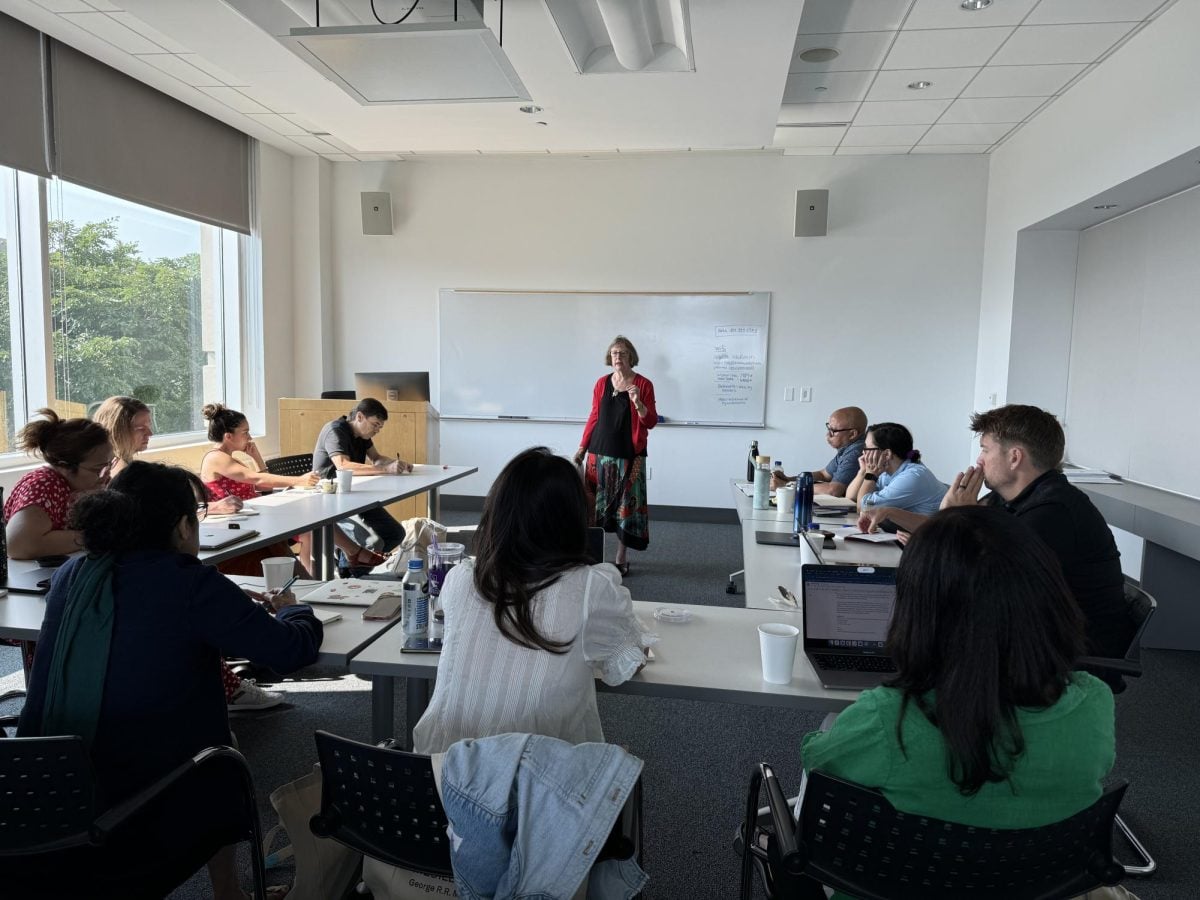
McCormick Prof. John Rogers was giving a guest lecture on flexible electronic systems at the University of Pennsylvania when his career faced a turning point. After the presentation, two neuroscientists approached him about medical applications for his engineering work.
Until that point, Rogers had focused his career on physical chemistry and electronic systems. When the neuroscientists approached him about repurposing his technology for brain-interfacing, he realized it could also be used for skin-mount medical applications.
Since then, he has continued to teach materials sciences but also added biomedical engineering to his repertoire. Rogers currently directs Northwestern’s Querrey Simpson Institute for Bioelectronics and heads the eponymous Rogers Research Group.
The Feinberg School of Medicine’s research podcast series recently recognized the Rogers Research Group for its work creating the world’s smallest pacemaker, electrical skin mounts for gas flux detection, skin-mounted sensors for breast milk consumption and many more projects that tackle pressing medical issues.
“We run a large research group, so we have probably 30 (to) 40 projects going on at any given time,” Rogers said.
The lab’s most widely-recognized achievement is the world’s smallest pacemaker project. The innovation — an injectable millimeter-wide machine that patches onto the heart and breaks down after use — offers a minimally-invasive way to regulate heart activity.
For his research, Rogers was also recently elected as a fellow to the Royal Society, one of the most prestigious science societies in Europe. He is one of only three scientists in the world to be recognized by all three of the National Academies of Sciences, Engineering and Medicine in the United States, as well as the Royal Society.
“I think it’s as much a recognition of a long history of fantastic students coming through the group and doing great work and coming up with good ideas, and then us working with collaborators,” Rogers said.
Other members of the lab, such as Mingyu Zhou, a second-year Ph.D. candidate in biomedical engineering, said the lab was collaborative and that Rogers was dedicated to supporting students.
“We are a huge lab, and John is super busy,” Zhou said. “He’s traveling to conferences all the time, but when he’s on site, his office door is always open. I can always just go in and talk with him about some challenges that (are) currently happening.”
Zhou is currently working on small, affordable sweat-sensing devices that can detect various target molecules to diagnose certain medical conditions, such as cystic fibrosis. These sweat monitors could serve as alternatives to more expensive diagnostic tests and equipment such as blood or urine analysis machines, Zhou said.
Another goal, Zhou said, is to track sweat electrolyte levels during exercise, which will allow existing partner organizations like Gatorade to tailor specific solutions to individual athletes.
Liangsong Zeng, a second-year Ph.D. candidate in mechanical engineering who is working on the world’s smallest pacemaker project, also emphasized the collaborative nature of the research group.
“You can also reach out to (Rogers) through email, and he will give very fast feedback, maybe in 10 minutes after he reads the email,” Zeng said. “He’s really supportive and can provide a lot of insightful suggestions to your projects.”
Rogers consistently manages a large group of graduate and undergraduate students, clinical collaborators across medical institutions like Lurie Children’s Hospital and Prentice Women’s Hospital, and other startups for biomedical devices. Still, Rogers always finds a way to provide avenues to support his colleagues in all sorts of interdisciplinary sciences, said McCormick sophomore Alex Hou, who works on the pacemaker project.
“There’s a lot of people in the lab, and you can learn a lot from them,” Hou said. “And there always seems to be some sort of collaboration, or at least camaraderie, that I observe between lab members.”
The collaborative spirit, combined with the vast expertise covered by various members of the lab, allows the Rogers research group to tackle so many interdisciplinary projects.
Despite the existing projects that span fields of biomedical engineering, materials sciences, electrical engineering, neuroscience and more, the Rogers Research Group aims to continue producing new innovations to address clinical needs, Rogers said.
“It’s not just (an) ivory tower kind of academic research where the endpoint is a paper that you put in a scientific journal,” Rogers said. “It’s really about doing things from a scientific standpoint, but around science questions whose answers lead to technologies that are meaningful to how we care for patients.”
Email: [email protected]
Related Stories:
— NU chem professors experiment on and develop novel materials and research
— Biosensor research at Northwestern detects water contaminants in Chicagoland area