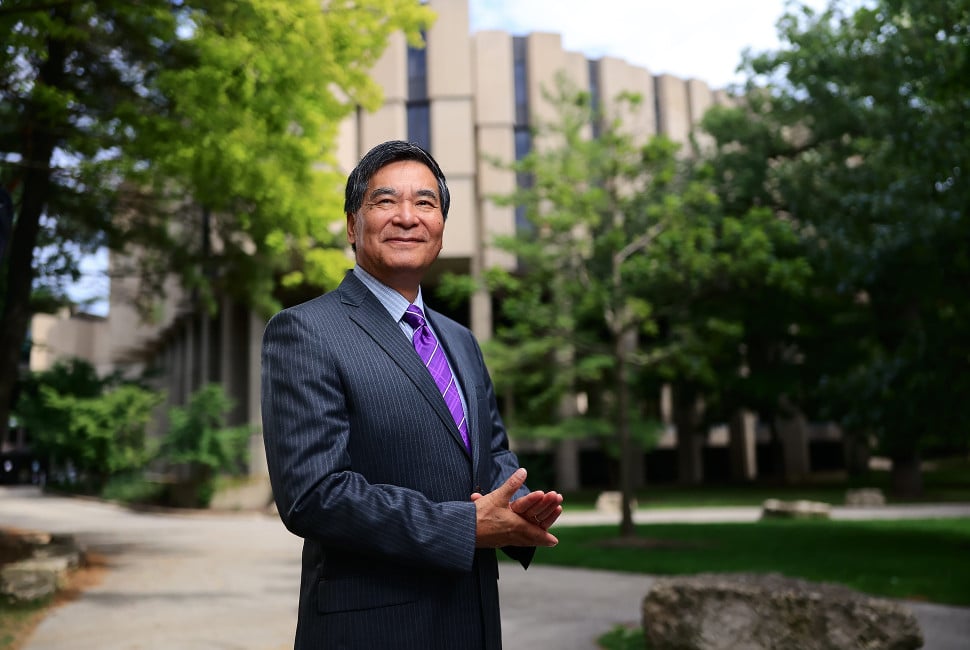
As Purdue President Mung Chiang steps into his role as the next president of Northwestern, STEM faculty at NU expressed optimism about his engineering expertise and cautioned about how past leadership translates to the University.
While NU’s three most recent presidents –– Morton Schapiro, Michael Schill and Henry Bienen –– are from non-STEM fields, Chiang comes from an electrical and computer engineering background.
McCormick Prof. Aggelos Katsaggelos said he co-authored four papers with Chiang, who was a Princeton University professor at the time.
“Chiang was a person that (was) extremely bright and exceptional mind, and somebody that was a rising star that was going to go places,” Katsaggelos said.
In Chiang’s career, he has published more than 450 papers and holds 26 U.S. patents.
In an interview with The Daily, Chiang said he does not believe that the Presidential Search Committee or the Board of Trustees focused on his engineering background when assessing his candidacy.
“My original degree is from engineering, but that was a long time ago,” Chiang said. “My job is not to serve one discipline, but comprehensively all disciplines and every member of the Wildcats family.”
Faculty express optimism that Chiang will bring successful Purdue initiatives to NU
Chiang expanded Purdue’s research to more than $1 billion in sponsored research expenditures. He also increased industry collaborations, including $3.9 billion in investments to build a SK Hynix semiconductor advanced packaging facility at Purdue.
Katsaggelos said Chiang’s successful track record at Purdue is a promising indicator for NU’s future.
“He’s a seasoned president. He has done the job,” Katsaggelos said. “He was dean of engineering, then president, so he is expected to hit the ground running.”
McCormick Prof. David Zaretsky,the assistant chair of the electrical and computer engineering department, described the “quick evolution” of Purdue’s engineering program as admirable. Zaretsky said NU requires many levels of committees to take action and hopefully, Chiang can bring the “agility” of Purdue to NU.
The ability to bring in corporate engagement is valuable for the University, Zaretsky said, both for research and for students looking for future employment. Zaretsky added that Chiang’s knowledge of industry and academia makes him well positioned to align the University’s goals with the future direction of technology.
“A lot of it comes from the top down, and so it’s really important to, from that perspective, have somebody who’s very thoughtful and can see what’s coming down the pipeline and direct all of our efforts towards different agendas cohesively,” Zaretsky said.
Faculty share concerns about lack of humanities, liberal arts investment in presidential priorities
While Chiang grew Purdue’s STEM initiatives, Purdue curriculum and instruction Prof. Stephanie Masta said Chiang lacked investment in liberal arts and humanities education.
Resources at Purdue were put toward engineering and artificial intelligence, Masta said. One outcome, Masta said, was decreased graduate enrollment in Purdue’s College of Education, mostly due to funding limits.
Given Chiang’s demonstrated STEM investment priorities at Purdue, Masta called the switch to NU an “interesting” move.
“Northwestern is an institution known for its humanities programs, for its liberal arts programs. There’s a strong culture around that,” Masta said. “I’m presuming that what’s going to be most interesting to witness, or maybe challenging, is how President Chiang thinks about institutional resources and where he wants to put those resources at.”
McCormick Prof. Luís Amaral said he views Chiang’s appointment with optimism and an open mind. However, he echoed Masta’s concerns about Chiang’s leadership priorities.
When reading about Chiang’s leadership at Purdue, Amaral said Chiang liked to be viewed as a “man of the people” but primarily responded to the Board of Trustees, rather than all members of the University. At NU, Amaral said he hopes for a president that listens to the needs of the community.
“The Board (of Trustees) seems to like to hire ‘yes men,’ people that do what they tell them, and so my hope is that they failed, that they actually got someone that will not be a ‘yes man’ to them, and it will be someone that believes in shared governance,” Amaral said.
The strength of the humanities and social sciences hold an equal role in excellence at NU, Amaral said, and potential overprioritization of engineering is a concern.
Even so, Amaral said Chiang’s performance at Purdue is not a direct predictor of his priorities at this University.
“Faculty has to be very vigilant,” Amaral said.
Faculty hope Chiang’s engineering background brings technical understanding to leadership
McCormick Prof. Randall Berry, the chair of the electrical and computer engineering department, said he is excited to see an individual from a technical background in the role.
“Historically it’s not been the norm to see an engineer selected as the president of Northwestern, and I’m sure any faculty would be happy to see someone from their area in that role,” Berry said.
Amaral said Schapiro and Schill required a learning period to understand the needs and costs of engineering and science research enterprises.
He said that managing federal funding regulations requires talented staff, and partnerships require investments from the University.
“There are some things that need to be done to maintain a university at the forefront in research in (engineering and science) areas,” Amaral said. “So, I don’t think that will be an issue at all. I have no doubts that he has a very deep understanding of that.”
Feinberg Prof. Laura Miller, a Research Affairs Committee member for the Faculty Senate, said she hopes Chiang’s engineering background will give him a more direct understanding of Faculty Senate concerns, including artificial intelligence and the safety and security of intellectual property.
To set informed presidential priorities, Miller said she hopes Chiang will uphold his commitment to “listen and learn” about NU’s culture and community in order to understand the needs of the University.
“That’s probably the most important thing, to listen to the faculty, to the students, to the staff, so then he can set the priorities that he thinks are the most important,” Miller said.
Email: [email protected]
Related Stories:
— Evanston residents react to Mung Chiang as Northwestern’s new president
— Northwestern faculty express hopes, worries after Mung Chiang announced as president-elect
— ‘Silence is complicity’: Purdue students, faculty share experiences with Mung Chiang