Walk into many Medill offices and one can find artifacts from recent history collected across journalism careers: a fragment of the fallen Berlin Wall, decades-old international press passes, a signed certificate from the Basketball Hall of Fame. Each object carries a story that reflects the experiences of Medill faculty, who have spent decades documenting some of the world’s most influential figures and defining moments.
While their decades of reporting have prepped them with sage wisdom, they’ve also led to some lasting memories that are more than just educational — from interviewing former U.S. President Barack Obama to sitting seaside with Morgan Freeman.
Reporting on one of the GOATs
The golden era of basketball — the 1980s and 1990s — is marked by the legacy of Michael Jordan in the Chicago Bulls, and Medill professors J.A. Adande (Medill ’92) and Melissa Isaacson witnessed it front row.
Both prominent sports reporters during this period, they each had several personal interactions with the six-time NBA champion at the height of his career.
Adande, a longtime sports journalist with bylines in ESPN, The Washington Post and the Chicago Sun-Times, received the Curt Gowdy Print Media Award from the Naismith Memorial Basketball Hall of Fame in 2024 for his contributions in basketball journalism.
A lifelong Jordan fan, Adande said he plastered posters of the five-time MVP up on his wall and frequently rocked Air Jordans growing up.
He recalled his first interaction as a reporter with Jordan during the Chicago Bulls’ training camp in 1991, anticipating Jordan’s 6’6” presence each time the door swung open.
“He walked right by me, … and I felt my pen move, and I looked, and I realized I had scratched his T-shirt with my pen,” Adande said. “There was a little ink mark. Fortunately, he didn’t notice it.”
Years later, Adande’s last exchange with Jordan as a reporter came as the player wrapped up his last season with the Washington Wizards. Rather than pepper Jordan with post-game questions, Adande challenged him with trivia.
“He was, all of a sudden, a lot friendlier … because now I was speaking his language — his language is competition and challenge,” Adande said. “I cracked the code on how to deal with MJ.”
The 2020 miniseries “The Last Dance,” which focused on Jordan and the Chicago Bulls’ 1990s run, featured both Adande and Isaacson.
For Isaacson, who spent more than 30 years as a sportswriter, covering the Bulls through their championship seasons remains one of the highlights of her career, she said.
“It was a glorious time,” she said. “The opportunity to watch Michael Jordan on a daily basis and document that time was just tremendous.”
Isaacson was pregnant at the time, which she said brought her closer to players who had kids, especially Jordan, who was protective of her.
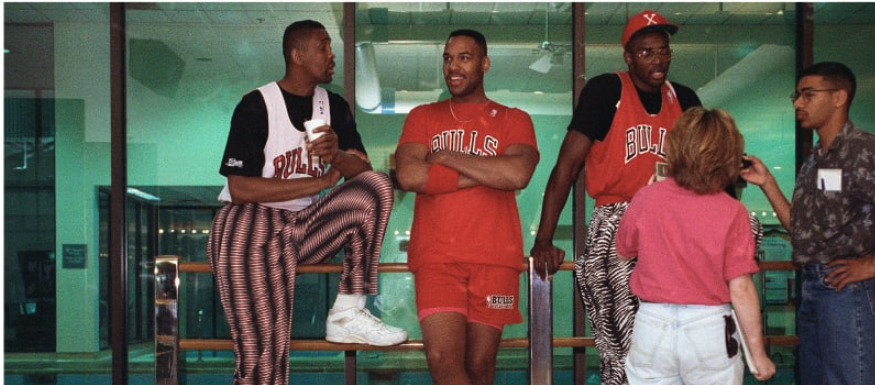
“He would pat my stomach for good luck; he would part the seas of people standing around me,” she said. “He was always wondering how I was doing.”
Her pregnancy even led to an unusual locker-room moment 10 minutes before a game against the Cleveland Cavaliers, when Bulls players Ron Harper and B.J. Armstrong staged a mock childbirth demonstration using a basketball.
Harper, who was a parent, was trying to demonstrate natural childbirth to Armstrong and Isaacson.
“All of a sudden, B.J. is on the training table, and Harper’s showing him how to (give birth),” she said.
Being a female sports journalist in the male-dominated field was difficult, including restricted locker-room access and pressure to fit into the environment, Isaacson said. At the same time, she said those experiences allowed her to have more personal conversations with players about their families and have them “let their hair down.”
Firsthand witnesses to world history
From the fall of the Berlin Wall to Barack Obama’s rise to the presidency, Medill Prof. Peter Slevin has reported from more than 50 countries, documenting turning points in real time and the people determined to shape them.
He described his time reporting in Eastern Europe and the Soviet Union as “a magic carpet ride,” especially because he witnessed the excitement of ordinary citizens as they talked about the change they were seeing and making.
“They hadn’t been allowed to speak freely in all of these countries,” Slevin said. “To be an American reporter listening to them talk so excitedly and so optimistically was fabulous.”
His published works aren’t the only evidence of his endeavors. From writing about these historical events on scene, he has taken souvenirs back to his office in Evanston — including a piece of the Berlin Wall and barbed wire that sit in his office.
His biography of Michelle Obama, titled “Michelle Obama: A Life,” took him longer than any article. Slevin was inspired by her story while covering her for The Washington Post during Barack Obama’s first presidential campaign, and he spent four years learning about her.
“I thought she deserves to be at the center of her own story, ” he said.
From all his research and interviews, Slevin said one of his main takeaways was seeing how Michelle Obama still calls herself “the little Black girl from the South Side of Chicago,” and how that influenced the way she sees politics.
As a veteran political journalist, Slevin not only teaches classes on U.S. politics but also continues to write about them in publications like The New Yorker.
This month, he wrote a feature on Barack Obama and what the former president has done since he left the White House. In writing the article, Slevin said he spent months interviewing people, including Barack Obama himself, about the current political state of the country.
“More and more with the world on fire and Donald Trump and his administration running roughshod, I kept hearing people saying, ‘Where is Obama, and why isn’t he coming to the rescue?’” Slevin said. “We decided, let’s find out, let’s hear from him.”
The biggest takeaway, Slevin said, was Barack Obama’s own perception of his duty in current politics: While he still believes he has a role, his moment as the leader has passed, and the country needs a newer, younger generation of politicians to offer solutions.
Bringing Hollywood to Evanston
Along with sports and political reporting stars, Medill has its share of entertainment journalists who bring memories of interactions with celebrities and famous figures across industries.

Before Medill Dean Charles Whitaker oversaw the journalism school, he spent 11 years as a reporter and senior editor for Ebony Magazine.
Though the industry has changed significantly in the modern era, back in his day, he said it was common for reporters to spend a lot of time with celebrities in their natural habitat for stories.
One notable memory from his career, Whitaker said, was writing a profile on Morgan Freeman, who only allowed interviews if they served as crew members on the sailboat he was living on. To get the interview, Whitaker and the photographer lied to Freeman about knowing how to sail and sailed around the Caribbean for a week with the Academy Award-winning actor.
“We got there, and it was really clear immediately that we had no idea (how to sail),” he said.
At first, Whitaker said Freeman was cranky because Whitaker and his photographer “were useless as sailors on his sailboat,” but eventually, he warmed up and started talking for the interview.
Whitaker said one of his favorite parts about reporting was meeting famous writers and directors, including the likes of James Baldwin, Alice Walker, August Wilson and Spike Lee.
“Ebony was the kind of place where anyone who’s anyone in Black America — if not anyone who’s anyone in America — would stop by to talk,” he said.
As a “huge James Baldwin fan,” Whitaker said talking to him about what it meant to be a writer and storyteller was one of his career highlights.
Medill Prof. Natalie Moore, who worked at WBEZ as a reporter and editor for 17 years, said she remembers interviewing actor Jeremy Allen White — not only because she was a fan of “The Bear” but because she discovered she had COVID-19 after the interview.
“I was not feeling well, and when you’re hosting, you’re a performance artist,” she said. “It doesn’t matter what kind of day you’re having; you have to step into this role.”
Moore said she doesn’t get starstruck when interacting with celebrities as a reporter, no matter if it’s former presidential candidate and Vice President Kamala Harris or Michelle Obama. Instead, she said she cares more about being professional and the logistics, such as if they’re going to be late, if they have enough time and what their handlers are going to be like.
Paying their experience forward
Despite the unique opportunities fieldwork provides, many professors find new purpose in the classroom.
Being a woman in sports was not without its challenges, but Isaacson said seeing her students and the women in Northwestern’s student media makes her proud of how far the profession has come.
Others say that being a teacher, in a way, scratches a similar itch that being a journalist always did.
“I found that teaching is in some ways like reporting,” Slevin said. “You’re identifying complicated issues, trying to figure out how to explain them in interesting ways. It’s fundamentally a creative act, just the way journalism is.”
For Adande, teaching is an opportunity to give back to their own undergraduate environment, maintaining their ties to the Medill family in a new way.
Whitaker never planned to teach or become dean, he said, but his journey to doing so was “serendipitous.”
“As much as I love being a writer and reporter, there’s nothing more rewarding than seeing young people achieve those dreams,” he said.
Email: [email protected]
X: @ina_choe
Related Stories:
— Q&A: Medill Prof. Jim DeRogatis reflects on career, music criticism