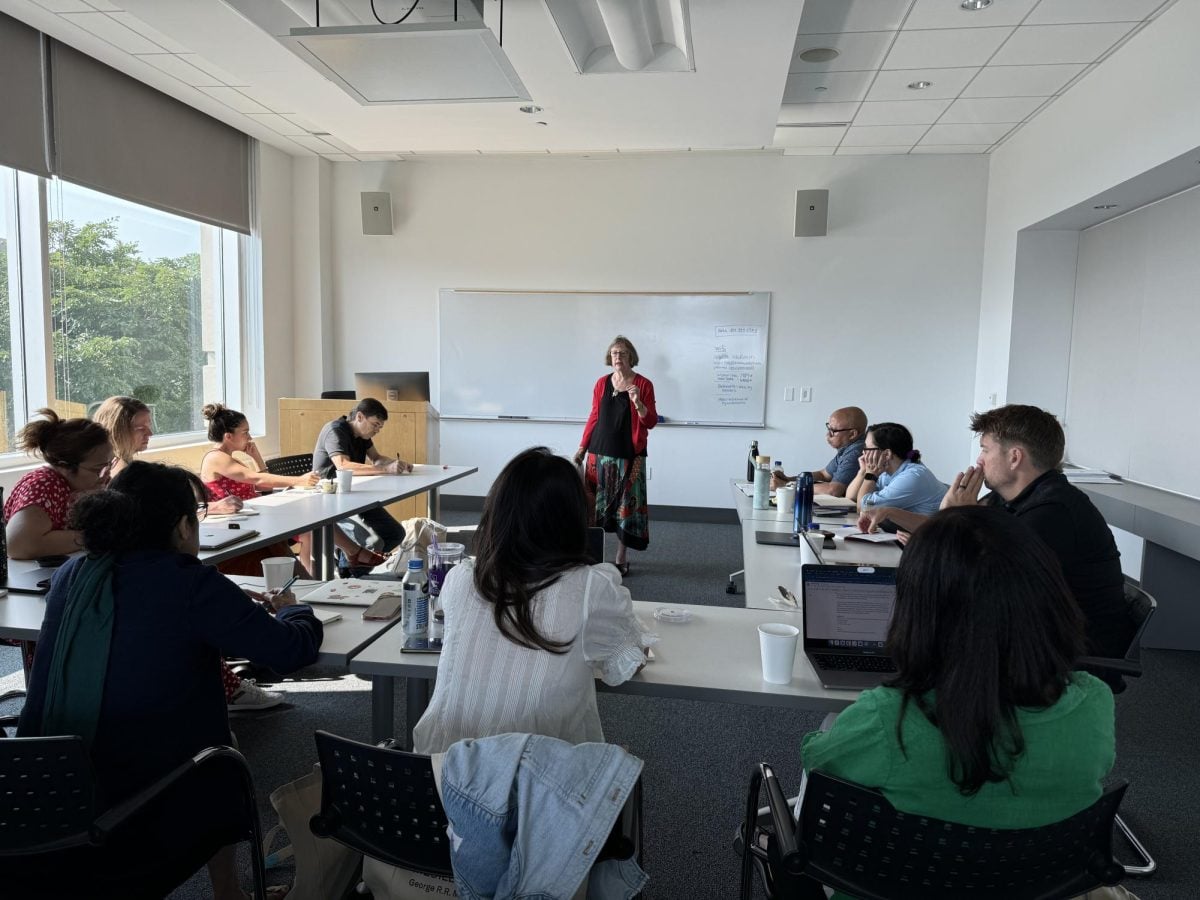
Author and journalist Stephen Witt discussed his new book, “The Thinking Machine: How Nvidia Created the AI Revolution,” and detailed how it reimagines the emergence of artificial intelligence in a Wednesday event.
At the book’s center is Nvidia CEO Jensen Huang, who spearheaded the organization’s powerful shift from a video game hardware company to what Witt called a monopoly in AI hardware. Witt details Huang’s biography, the history of Nvidia and the decades-long hardware innovations that exploded the recent AI boom.
Witt began writing the book after ChatGPT’s emergence, concerned that technology would “eclipse” his writing abilities, he said.
“You can’t bury your head in the sand,” Witt said. “You really have to go right at it and incorporate it, especially if you feel like it’s a threat to you.”
SESP Prof. Ryan Smerek moderated the book talk, hosted by Northwestern’s Master of Science program in Learning and Organizational Change.
He said he hopes Witt’s insights spark curiosity among attendees.
“Most of us were introduced to (Large Language Models) with ChatGPT in 2022, but there was so much going on for a decade before that,” Smerek said. “It’s helpful to know. The way (Witt) writes is in a very engaging way.”
Recognizing the oversaturation of OpenAI reporting, Witt said he shifted focus to Nvidia, with Huang at the helm. Witt considered Huang an anomaly among corporate leaders with the tech executive’s “candid” speaking style, which allowed for the transparency and narrative depth that made the book possible.
Witt described Huang’s complex reputation and image as both a loved and feared leader. Despite Huang’s renown as one of the most effective public speakers, Witt recalled a moment backstage where the CEO displayed visible stage fright.
“It’s that fear that fuels him,” Witt said. “He’s afraid of bombing on stage, so this is where he finds the energy and the drive to give a really good presentation.”
Witt said Huang bet on parallel computing as the future of microchip design — a bet he won when Nvidia outperformed developer Intel’s traditional model.
Witt said Huang faced pushback from investors when he developed CUDA, a software architecture that turned a computer graphics card into what Witt called a “low-budget supercomputer.”
The decision paid off roughly six years later when Nvidia’s hardware combined with neural network AlexNet, laying the foundation for modern AI.
“What makes this story so shocking is you had to completely reinvent both sides of the computer, and both sides were maverick, eccentric research groups that nobody believed in,” Witt said.
Second-year SESP master’s student Adam Christensen said he attended the talk with an interest in AI technology’s impact on human dynamics in organizations.
He added that Nvidia’s industry dominance has made its strategy a critical roadmap for AI’s future.
“Increasingly, it’s important that it’s not only a group of people at the top that are making decisions about what tools are being used and how they’re being used,” Christensen said. “But rather to understand how all members of the organization are exploring using AI technology.”
The discussion around AI safety is still extremely divided, Witt said. Optimists like Huang view safety fears as science fiction, while others raise concerns that the system could “run away from us.”
This uncertain future made writing a book on AI’s evolution challenging, according to Witt.
“I still don’t know what’s going to happen with AI,” Witt said. “So how do you write a book and you don’t know how it ends?”
Email: [email protected]
Related Stories:
— Rutgers Prof. Julia Stephens presents new book at South Asia Research Forum event
— Author Emil De Guzman shares lessons on activism through Northwestern book talk