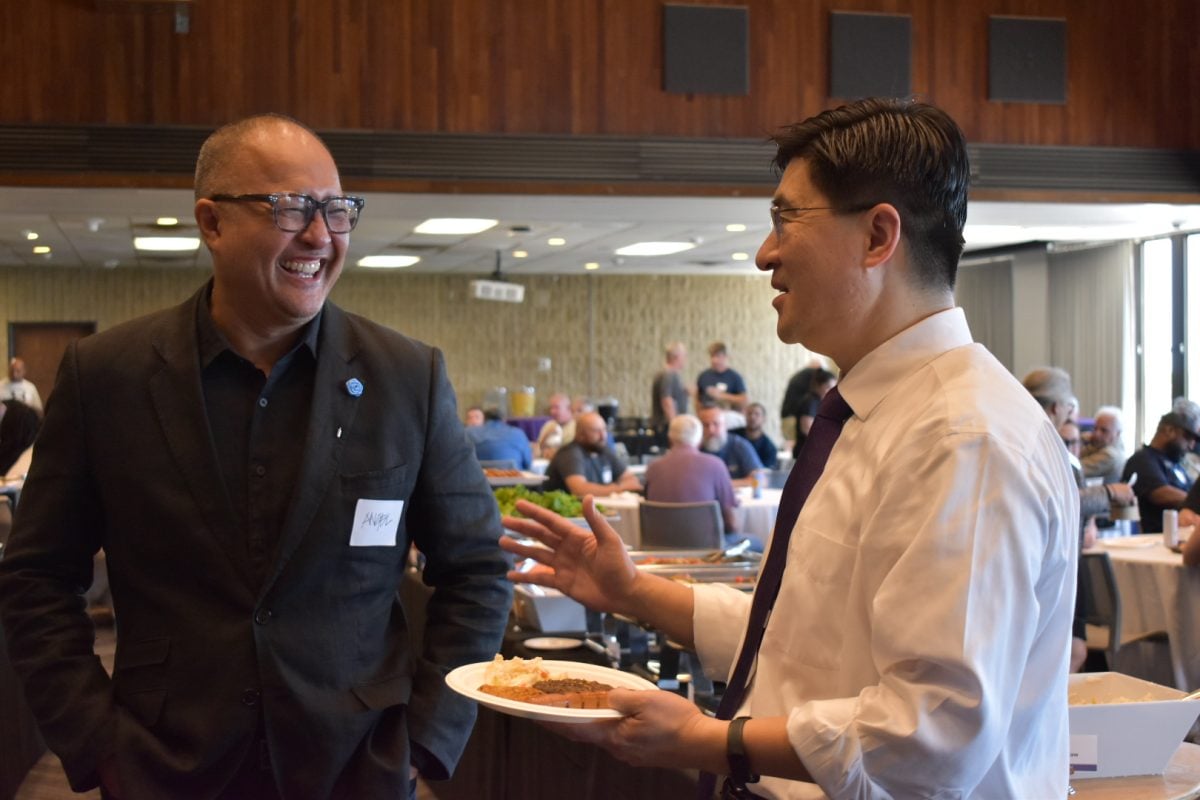
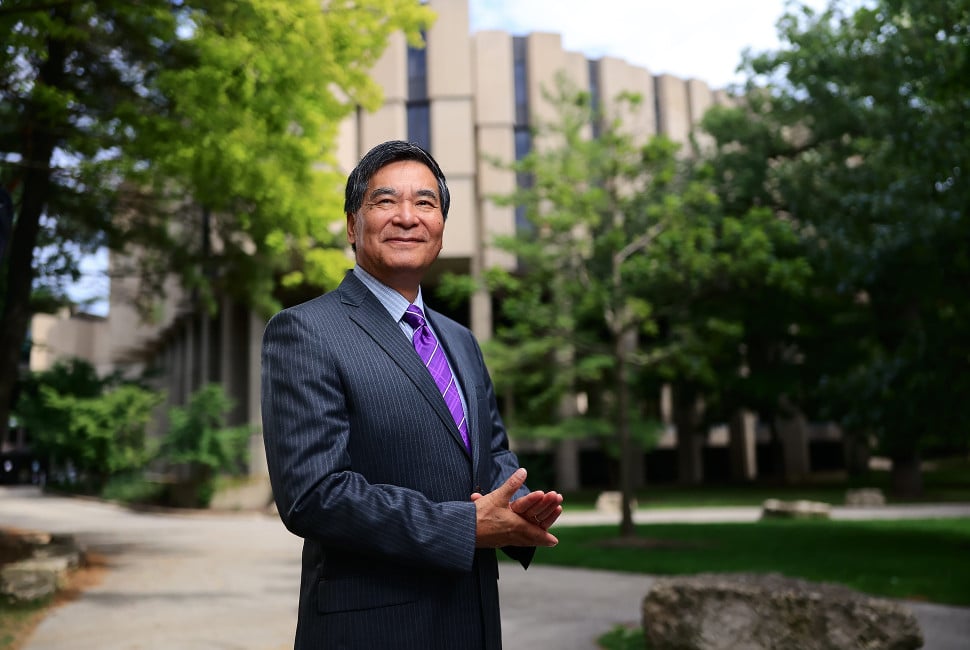
Journalist and author Michael Grunwald spoke to faculty and students about his latest book “We Are Eating the Earth: The Race to Fix Our Food System and Save Our Climate” in a talk at Pancoe Life Sciences Pavilion Wednesday.
The Center for Synthetic Biology hosted the event in conjunction with the Roberta Buffett Institute for Global Affairs, the Institute for Policy Research, the Paula M. Trienens Institute for Sustainability and Energy and the Global Poverty Research Lab.
Grunwald’s nonfiction book discusses how the rise of food consumption has caused harm to the environment and also proposes potential solutions for sustainability and reducing consumerism.
“Pretty much anything that’s bad happening to the planet, agriculture has a pretty big role in it,” Grunwald said. “I realized I didn’t know squat about it and sort of figured, ‘If I don’t know anything, if I’m this spectacularly ignorant, then probably a lot of other people are too.’ So that was sort of the genesis of this book.”
Grunwald worked as a journalist, covering politics and climate change for the Boston Globe, the Washington Post, Time, Politico and is currently working for the New York Times and Canary Media. He said he wanted to use his past experience in environmental journalism to shed light on a larger issue through a full book.
In the novel, Grunwald highlights the issue of increasing agricultural land use to address a larger need for food consumption. He said a reliance on clearing forests to build farms results in higher carbon emissions, through the production of methane in livestock and the reduction of carbon-absorbing trees.
Grunwald said the lack of attention paid to sustainable agriculture has led to a large problem that will continue to plague the environment if not addressed.
“In fact, right now in the United States, we use about half of our agricultural land to make beef that produces about 3% of our calories,” Grunwald said. “We need to make more food with less land and about 80% fewer emissions, if we are going to meet our climate targets by 2050. It’s a really big problem.”
Medill Prof. Natalie Moore said she appreciated how Grunwald used his journalistic background to highlight an issue in various other fields.
“I thought, ‘Okay, here’s someone who’s a journalist who’s taking on writing about an issue that is complicated,’” Moore said. “This is the beauty of being at a university. I think it’s great that it was interdisciplinary and people came from different places.”
McCormick Prof. Danielle Tullman-Ercek, who is the co-director of the Center for Synthetic Biology, said the center often collaborates with other departments, relating to policy and sustainability to implement research.
In her own field of work, Tullman-Ercek said manufacturing and engineering, she also often incorporates environmentalism in her research.
Tullman-Ercek said she praises Grunwald for bringing a crucial issue to light so that scientists can contribute to it through research.
“I think the most important thing that he’s doing is raising the conversation in the broader public,” Tullman-Ercek said. “He’s come up with ideas and proposals, and he’s hit some nails right on the head. So, now we have to get the word out that this is a thing that science can help to develop solutions for.”
Email: [email protected]
X: @connortjang
Related Stories:
— Engineers for a Sustainable World makes strides in student-led projects