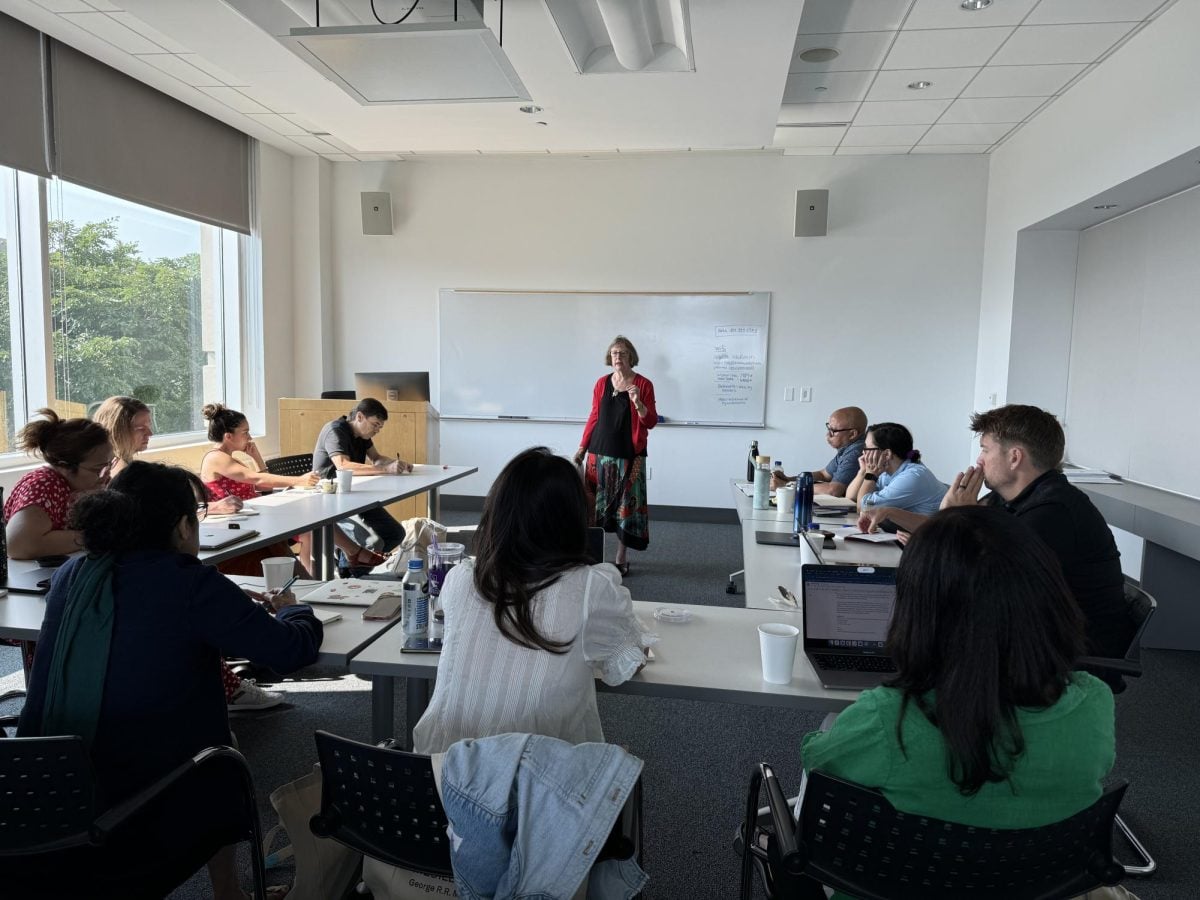
Weinberg senior and Jewish Voice for Peace member Evgeny Stolyarov presented about his time in Palestinian West Bank village Umm al-Khair on Tuesday at University Hall.
In summer 2024, Stolyarov participated in a ten-day solidarity shift through the Center for Jewish Nonviolence. He said these shifts help Palestinians document Israeli settler violence and provide “protective presence,” a form of political activism where volunteers live alongside Palestinian villagers to reduce Israeli settler attacks on Palestinians.
“I want to share my story so that members of the Jewish community and broader student community could learn from a firsthand source the ongoing displacement and occupation that is happening in the West Bank, committed by Israel,” Stolyarov told The Daily in an interview following the event.
CJNV aims “to build a connected movement of Palestinians, Israelis and Jews from around the world committed to coresistance and solidarity against Israeli occupation and apartheid” by “organizing these communities to take part in bold nonviolent action on the ground together,” according to its official mission statement.
During the presentation, Stolyarov described his experiences in Umm al-Khair, where he said Israeli settlements exist adjacent to village boundaries, blocking access to preferred locations for goat herding — a primary source of income for Palestinian villagers. Israeli settlers often report villagers to the police for seeking access to these sites, Stolyarov said he learned from a Palestinian villager in Umm al-Khair.
“The settlement physically blocks access from Palestinians to be able to access their ability to just make money, to make a living,” Stolyarov said. “They’ve made employment basically impossible.”
Stolyarov said a local Israeli settler, whom he referred to as “Shimon the Settler,” often harassed villagers and program participants. With the help of Israeli teenagers, Shimon operates a farming outpost to target local Palestinians, Stolyarov said.
Through the outpost, Shimon harasses Palestinians with the primary goal of expelling them from Umm al-Khair, Stolyarov said.
At one point, Stolyarov said, a teenager who worked under Shimon cut the village’s water pipe, eliminating its access to the resource.
“Palestinians call the police, because that’s really their only thing that they can do,” he said.
He said Palestinians have limited access to permits, visas and legal assistance under Israeli occupation, and that photos and videos discourage the settlers from harassing villagers because of international exposure.
“That’s the motivation behind why these kind of solidarity shifts happen,” Stolyarov said. “Any evidence of settler violence can be used by the lawyers supporting this village.”
Jewish and Israel Studies Prof. Maayan Hilel, who spoke at the event in her personal capacity, contextualized Stolyarov’s presentation with a lecture on Israeli settlement in the West Bank since 1967.
Under the Gush Emunim movement, the Israeli government subsidized housing to Israeli families migrating from cities with high housing costs, she said.
“The Israeli government made it financially attractive — cheap housing, tax breaks, so-called good schools,” Hilel said. “The occupation was, in a sense, marketed to the Israeli middle class.”
Hilel also discussed several historical events that spurred demographic changes, producing a younger generation of politically active young men born in the West Bank. Known as Hilltop Youth, the extremist youth group enacts settler violence against Palestinian communities, Hilel said.
Hilel said she practiced “protective presence” in the West Bank from 2004 to 2011, largely with Combatants for Peace, a nonprofit organization, which is active largely in the South Hebron Hills.
According to their mission statement, Combatants for Peace works to “end the occupation and bring peace, equality, and freedom to our homeland.”
“In recent years, and especially over the past two years, alongside the growing political power of the settler movement, the role of Israeli-Palestinian and international activists has become much more significant and important,” Hilel said.
Near the end of the presentation, Stolyarov discussed the murder of Palestinian activist and school teacher Awdah Hathaleen in 2025 by Israeli settler Yinon Levi — a year after Stolyarov met Hathaleen during the program.
Levi brought a bulldozer to Umm al-Khair to destroy the village’s olive trees, to which Hathaleen and several other villagers responded by trying to convince Levi to leave. During the interaction, Levi fired his gun, killing Hathaleen.
“This is the type of murder that you get, and the type of violence you get when you have a whole structure set up to create antagonisms and to make the life of Palestinians absolute hell,” Stolyarov said.
Communication sophomore and JVP member Elia Silbey said they appreciated learning about the conditions Palestinian civilians experienced amid Israeli settlement.
“It’s really valuable to have that perspective from someone who was there, which we don’t always get,” they said.
Silbey said he walked into the presentation expecting to hear that the “protective presence” of Jewish participants like Stolyarov limited settler violence.
However, after the presentation, Silbey said “it’s always worse than you think,” adding that she wants to share the information discussed with more members of NU’s student body.
“Something that’s hard as a sort of organizer on campus is the feeling that a lot of the population is not aware,” they said.
Silbey hopes the “visceral” information discussed during the event will be “enough” to help students realize the nature of Palestinian experiences in the West Bank, they said.
Communication sophomore Holly Simon said she learned a lot from the presentation and seeks to further engage with the history of Israeli occupation.
As a Jewish student on campus, Simon said she wanted to find opportunities to educate themself on media documenting conflict between Israeli settlers and Palestinian villagers by learning from community members living the conflict in real time.
“What was the most impactful for me on that front was just learning about what life is like under Israeli apartheid in the West Bank,” Simon said.
Stolyarov hopes his story teaches participants about Israeli settlers’ violence against Palestinians, and the Palestinians’ resilience in light of these experiences, he said.
“I wanted everyone to realize how horrific the violence that Palestinians are facing is, but also highlight the absolute bravery and steadfastness that Palestinians in the West Bank are showing in the face of this horror,” Stolyarov told The Daily. “Palestinians aren’t only victims, they have their own independence and are also fighting for their freedom.”
Email: [email protected]
X: @sla3cwy
Email: [email protected]
Bluesky: @lucaskubovchik.bsky.social
Related Stories:
— For Jewish Voice for Peace, Passover means liberation for everyone
— Jewish Voice for Peace hosts panel on Zionism, antisemitism