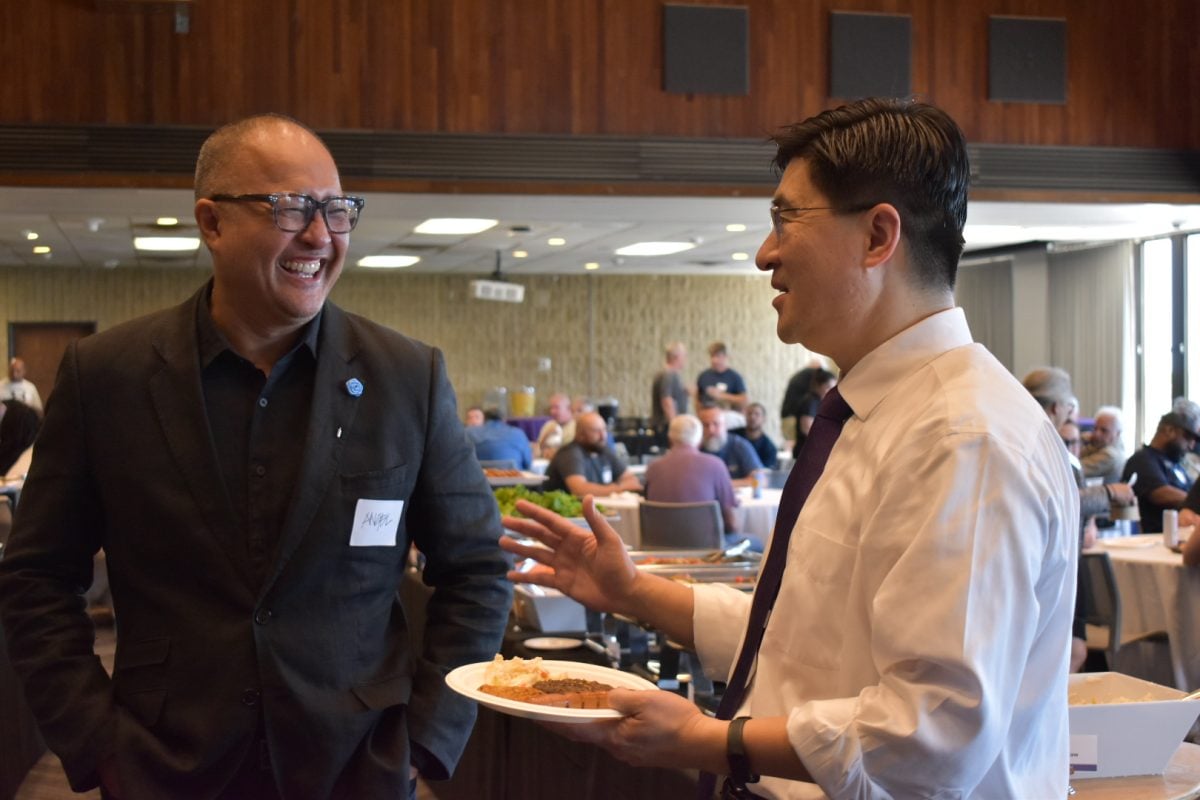
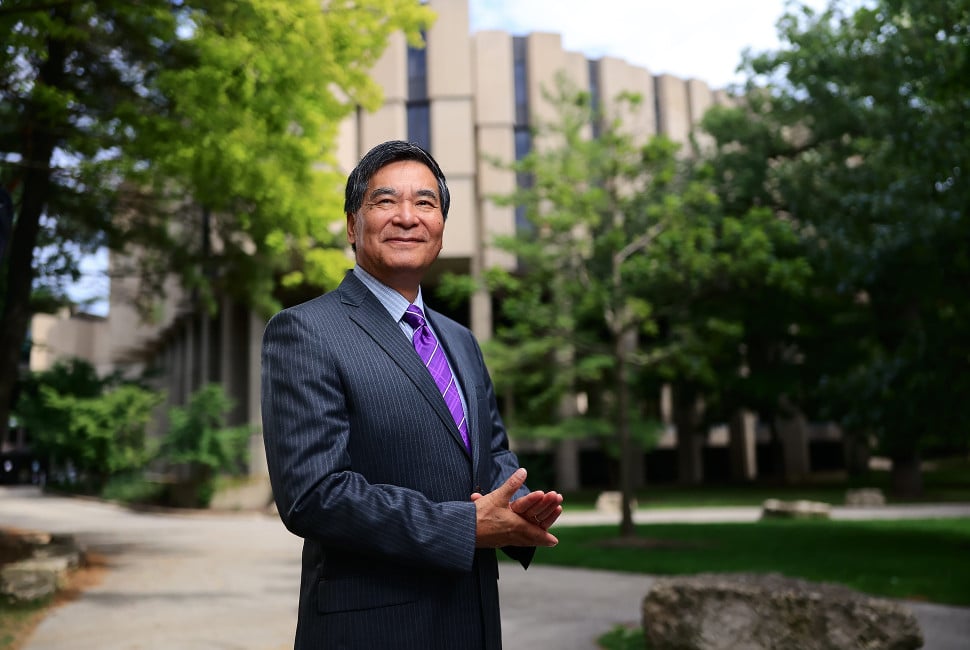
Less than two months before the start of the 2022-2023 school year, the Board of Trustees announced Michael Schill as Northwestern’s 17th president. In an introductory interview with The Daily, Schill highlighted three areas of focus for his tenure: research, diversity and innovation.
Yet at the end of his abruptly cut-short term, the University’s research is facing a $790 million federal funding freeze. NU websites have been scrubbed of terms relating to diversity, and novel cost containment strategies have taken a toll on the University’s budgets, including eliminating more than 400 existing staff positions and reducing the permanent administrative and academic budgets.
“There’s no one way, but I want to be accessible,” Schill said in an August 2022 interview with The Daily. “I want students to know that what I want, and what I aspire to, is that students don’t think I am an isolated leader. What I want to do is make them know that I’m there, and I’m there for them.”
Schill’s presidency began under the Biden administration’s comparatively hands-off approach to higher education. More recently, however, the second Trump administration has aimed to directly influence university policies.
And as federal scrutiny of higher education grew, Schill himself faced increasing attention on a national stage.
A President’s March to the Arch
Before Schill came to NU, he served as president of the University of Oregon from 2015 to 2022. Previously, he also served as the dean of the University of Chicago Law School and of the University of California, Los Angeles’ School of Law.
In July 2022, former President-elect Rebecca Blank stepped down from her role due to a cancer diagnosis. Exactly one month later, Schill was announced as her replacement, giving him mere weeks to complete a rigorous, often months-long transition process and assume the role Sept. 12, 2022.
In the 2022 interview with The Daily, Schill said he remained grounded in his friendship with Blank as he looked to NU’s future.
“I think that the best way I can honor Becky is to be a great president,” Schill said.
Schill was officially inaugurated in June 2023, following Blank’s death months prior.
Revamping Ryan Field
Early in Schill’s presidency, NU announced plans to renovate Ryan Field following a $480 million donation from Patrick Ryan (Kellogg ’59) and Shirley Ryan (Weinberg ’61) to the University in September 2021, which included funds for the renovation.
While Schill did not facilitate the investment, he supported it, describing the old stadium as “worse than” others he had visited during his time as Oregon’s president.
Yet, the stadium renovations sparked heated pushback from both the NU community and Evanston.
University faculty worried that the project would run over its $800 million budget, incurring debt. At the time, Schill assured that there were other options to help complete the renovation in the event of budget concerns.
Beyond NU’s campus, residents of Evanston’s 7th Ward, where Ryan Field is located, raised concerns about potential increases in noise, light pollution and parking congestion in the area. In response, University officials hired a traffic engineering firm to look at potential congestion issues and noted that the project would generate around 2,900 new jobs during the rebuild and more than $10 million in direct fees to Evanston.
“We’re working deeply with the community,” Schill said at the time. “We’ve already started talking about that, trying to make Ryan feel like a win-win.”
After months of debate dominating town-gown relations, City Council finally approved the rebuild of Ryan Field in a controversial vote in November 2023, to the chagrin of many community members.
In June 2024, NU formally broke ground at the construction site. The stadium is set to open for the 2026 football season.
Diversity and Division
In 2022, with the future of affirmative action in college admissions before the Supreme Court, Schill penned an op-ed in the Chicago Tribune on Oct. 27.
The president argued “diversity is a fundamental interest in American higher education” and advocated for the inclusion of race information as “a legitimate consideration” in applications.
The following May, Schill sent an email to the NU community where he wrote that the University planned to work hard “within the law” to protect diversity, adding that the admissions process takes diversity of experiences, circumstances and backgrounds into consideration.
“Northwestern’s commitment to student diversity will remain no matter what the Supreme Court decides,” Schill wrote in the email. “We are dedicated to supporting and improving the experience of all students, and diversity is a critical component of a well-rounded education.”
On June 29, 2023, the U.S. Supreme Court ruled 6-3 that affirmative action admission policies are unconstitutional. In a statement released to the University community, Schill wrote he was “deeply disappointed” by the Court’s decision, but reaffirmed the University’s commitment to diversity in admissions.
Clashes surrounding the role of policies directed toward diversity in higher education resurfaced following Trump’s second inauguration in January 2025. During his first week in office, the president issued an executive order aiming to eliminate diversity, equity and inclusion policies in federally funded programs. That order was followed by a letter to universities from the Education Department, which threatened potential noncompliance with federal funding loss.
Following the demands, the University removed mentions of DEI efforts on NU’s schools websites and other support sites. Additionally, a dozen NU staff members’ titles have been changed to exclude DEI-related terms.
However, some affinity institutions on campus, like the Gender and Sexuality Resource Center and Women’s Center, have continued to operate, even with their scrubbed websites.
“We are committed to ensuring that students, faculty and staff enjoy a community that is welcoming to all,” a University spokesperson wrote to The Daily in April.
Football Hazing Scandal
Less than a year into Schill’s tenure, the University was confronted with allegations of hazing and racism within its football program. Following an initial suspension, the University fired former football coach Pat Fitzgerald in July 2023, two days after a Daily report detailed the allegations.
Yet, after letting Fitzgerald go, Schill and the University faced both criticism and evolving legal threats.
Some former NU football players filed lawsuits against Fitzgerald and NU, alleging that the University and coach were negligent in preventing and intervening in hazing within the football program. The players settled with the University in April 2025.
On Oct. 6, 2023, Fitzgerald filed a wrongful termination lawsuit against NU and Schill, seeking more than $130 million in compensatory damages. In August 2025, Fitzgerald and the University settled the lawsuit.
The terms of both settlements have not been disclosed.
Encampment and Appeasement
On April 25, 2024, students and faculty erected tents on Deering Meadow, forming an encampment as an act of pro-Palestinian protest. The encampment lasted for five days before an agreement was reached between encampment organizers and University administrators.
The agreement included terms about the removal of the encampment, disclosure of NU’s holdings and additional support for Jewish, Muslim and Middle Eastern and North African students.
“I am proud of our community for achieving what has been a challenge across the country: A sustainable, de-escalated path forward that prioritizes safety, including our Jewish community,” Schill’s notes for a post-encampment meeting with the NU’s Board of Trustees read, which were released in a report by the House Committee on Education and Workforce on Oct. 31, 2024.
Yet, Schill came under fire for his decision to negotiate with encampment protestors by some Jewish organizations and Republican politicians, and ultimately was called to testify before the Education Committee on May 23, 2024.
At the hearing, committee members grilled Schill on his decision to negotiate with the encampment organizers, the alleged rise in antisemitism on NU’s campus and the University’s relationship with Qatar and the Qatar Foundation through NU-Qatar.
While Schill attempted to perform a balancing act between the dueling groups, it ultimately ended only with dissatisfaction among both Washington Republicans and pro-Palestinian student activists.
In multiple reports released during the following year, Republicans voiced concern over Schill’s decisions and leadership through the encampment.
“At best, President Schill’s testimony lacked candor and is unbecoming of a university president,” read a U.S. House of Representatives Staff Report on Antisemitism released in January 2025. “At worst, Schill’s testimony was false and met the criteria of a federal crime.”
Reforms and Regulations
Ahead of the 2024-2025 school year, the University announced updates to NU’s demonstration policy and Student Code of Conduct, alongside a new display and solicitation policy.
The updated demonstration policy bars overnight protests and prohibits demonstrations at The Rock before 3 p.m. along with protests with amplified sound before 5 p.m. The policy was criticized by student activists and faculty, who raised concerns over free speech protections.
On Sept. 27, Schill and Provost Kathleen Hagerty announced that the University will limit official statements on “public or geopolitical matters except those related to the operation of the University” in a message to the NU community.
The decision came almost two months after the President’s Advisory Committee on Free Expression and Institutional Speech, convened by Schill in February 2024, submitted a report summarizing its examination of the University’s free speech policies.
The move toward institutional neutrality breaks from Schill’s past history of issuing statements on political matters, including a message that condemned violence related to the Israel-Hamas war on Oct. 12, 2023.
“That is the view of Mike Schill, citizen, Jew and human being,” Schill wrote in the message. “I didn’t give up those parts of me when I assumed the presidency of Northwestern.”
Freeze in Funding
On April 8, the Trump administration froze $790 million in federal funding for NU. The Department of Health and Human Services confirmed the freeze was due to federal antisemitism investigations into the University, specifically from the Education and Justice Departments.
In the wake of the freeze, more than 100 research projects received stop-work orders from the Defense Department, a dozen grants from the National Institutes of Health were cut and hundreds of National Science Foundation grants were cancelled.
In the aftermath, NU closed multiple research centers, froze new hiring, canceled some summer research programs and restricted summer financial aid. The University continued to fund research impacted by stop-work orders and NIH cuts, at a cost of roughly $40 million a month.
Cost-cutting measures continued into the summer as the University eliminated more than 400 staff positions, initiated a hiring freeze and permanently reduced administrative and academic budgets.
According to a piece by the Wall Street Journal, as of July, the University is reportedly in talks with the Trump administration over a potential settlement, but as of September, The New York Times reports that the talks have slowed.
“The Board remains actively focused on regaining access to the federal research funding that has been committed to the University but unavailable for nearly six months,” a University spokesperson wrote in a statement to The Daily on Sept. 16.
Departures and Parting Pleas
On Sept. 4, Schill announced his sudden resignation in an email to the NU community. He has not identified a reason for his departure.
“From the very beginning of my tenure, Northwestern faced serious and often painful challenges,” Schill wrote in the email. “In the face of those challenges and the hard, but necessary choices that were before us, I was always guided by enduring values of our University.”
A month before he announced his resignation, Schill sat for a closed-door transcribed interview with the Education committee.
On the same day Schill announced his departure, the committee released the interview’s transcript, which mirrored much of Schill’s testimony from May 2024.
NU announced former President Henry Bienen as interim president on Sept. 9. Bienen was the University’s president from 1995 to 2009 and began his second tenure on Sept. 16.
In one of his last appearances as president of NU, Schill spoke to parents of new students during Wildcat Welcome on Sept. 9.
“I want to urge each and every one of you to fight for Northwestern,” Schill said to new parents. “Fight for science over quackery, fight for truth over lies, and fight for the right of our faculty to write and teach — free from government oversight and restriction.”
Email: [email protected]
X: @ninethkk
Related Stories:
— University President Michael Schill resigns amid ‘painful’ challenges