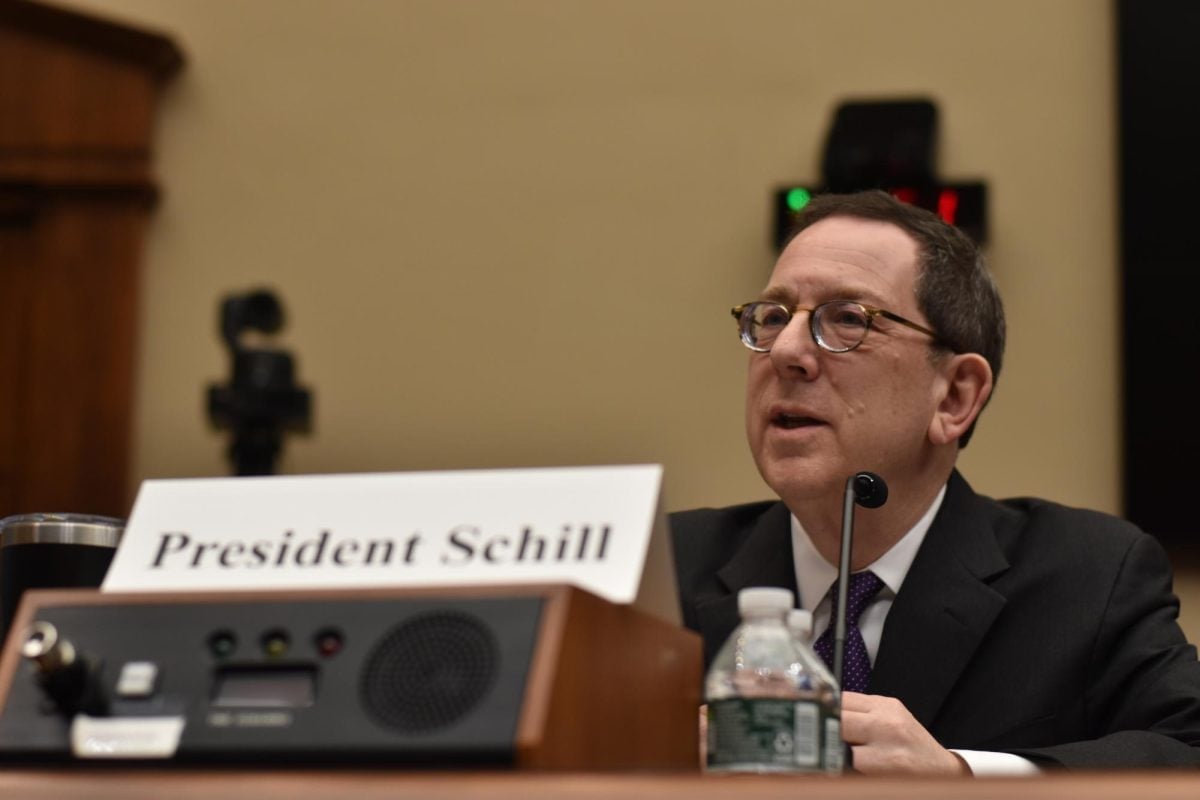
Over a year after Northwestern President Michael Schill testified before the House Committee on Education and Workforce, Schill returned to Capitol Hill for a transcribed interview in a closed session with the committee Aug. 5.
The committee publicized the interview transcript in a Thursday news release the same day Schill announced his resignation. Parts of the transcript were redacted, including some names of those in attendance.
Much of the interview followed similar topics to Schill’s appearance before the committee in May 2024, when he was grilled on negotiations surrounding NU’s pro-Palestinian encampment, contract with the Qatar Foundation and efforts to combat antisemitism on campus.
“When I testified before the committee last May, I acknowledged that Northwestern was not sufficiently prepared to meet the alarming rise of antisemitism that occurred nationwide on college campuses,” Schill said in a prepared statement to conclude the interview.
He later affirmed the University’s commitment to “eradicating antisemitism,” acknowledging it “cannot be done overnight.”
When asked for comment regarding the interview, a University spokesperson wrote in a statement to The Daily, “President Schill’s words speak for themselves.”
Here are four takeaways from Schill’s interview:
1. Schill sheds light on decision to negotiate with encampment organizers
Several interview questions surrounded the agreement made with pro-Palestinian demonstrators to end the encampment on Deering Meadow in April 2024.
Defending his decision to negotiate, Schill said he assessed three options: allowing the encampment to continue, bringing in police to remove the tents or coming to an agreement with demonstrators.
However, he went on to explain that allowing the encampment to continue was not an option because there were several weeks of the academic year remaining.
Removing the tents by force was also not viable, Schill added, because NU’s police force was too small. He said he was told by the police chief and Mayor Daniel Biss that the Evanston Police Department would not assist with removal.
“This was clearly a situation where one had to choose between three bad options, of which two of the options disappeared,” Schill said.
Biss confirmed to The Daily on Friday that he was asked by Schill to deploy EPD to make arrests and clear encampments on campus.
“After careful consultation with city officials and public safety leadership, it was clear there was no immediate threat to demonstrators or the broader community, and Evanston Police intervention would have been inappropriate, unwarranted, and undemocratic,” Biss said in an emailed statement to The Daily. “I declined his request then, and I stand by that decision now.”
During the interview, Schill was also pressed on why he did not consult the President’s Advisory Committee on Preventing Antisemitism and Hate before coming to an agreement with encampment organizers. The committee, introduced by Schill in November 2023, crumbled shortly after the agreement.
Negotiating with demonstrators “wasn’t in the remit of that committee,” Schill said, adding that the group was made up nearly entirely of professors and lacked anyone with security training.
Earlier in the interview, Schill also called the movement to divest and boycott Israel, a key demand of encampment organizers, “profoundly wrong.”
Echoing his testimony in May 2024, he said he would never propose boycotts to the Board of Trustees. As such, Schill said he did not feel the need to discuss the demands with the Committee on Preventing Antisemitism and Hate.
“Why would I waste the time of this committee discussing something that I’m never going to recommend?” Schill said.
2. Schill defends new University policies, required training
NU policies targeting student demonstrations and antisemitism in the wake of the encampment also consumed the discussion, as Schill defended steps the University has taken in the year since his testimony.
In September 2024, NU updated the University’s demonstration policy and Student Code of Conduct, adding parameters for displays on campus and an intimidation standard that “prohibits subjecting another person or group to abusive, demeaning, harassing, humiliating, intimidating, threatening or violent behavior that substantially affects the ability of the person or group to learn, work or live in the University environment.”
The updated policy includes a ban on demonstrations between midnight and 6 a.m. as well as at The Rock before 3 p.m. on weekdays. Amplified sound is also barred in the area before 5 p.m.
In response to questions about the demonstration policy, Schill defended the guidelines as content-neutral and said they are enforced regardless of subject matter. He pointed to demonstrations on campus when graduate students organized and when dining workers employed by Compass Group went on strike as examples of enforcement.
Since Schill’s appearance on Capitol Hill last year, the University also launched a mandatory training titled “Building a Community of Respect and Breaking Down Bias.”
Schill acknowledged criticisms of the required training, which was met with boycotts from Students for Justice in Palestine and Jewish Voice for Peace shortly after it was announced.
He added that the training was mostly created by the Jewish United Fund, although the University provided editorial suggestions. Schill said the University will continue to do yearly antisemitism training, and while they may change the training to address concerns, that will likely not be seen in the coming academic year.
The University did not respond to The Daily’s emailed question about whether NU would address criticisms brought up by community members regarding the required training.
3. University response to antisemitism questioned by committee; Schill cites areas of progress
The interview largely focused on the NU’s response to antisemitism on campus, especially the University’s disciplinary response to antisemitic instances. Yet, Schill maintained the school’s commitment to ensuring students of all backgrounds feel safe at NU.
During discussions surrounding discipline on campus, Schill referenced a chart from a progress report released by the University documenting all reports of antisemitism received by NU since Oct. 7, 2023. As of the time of the interview, the chart has 121 complaints.
Schill was asked why NU has not expelled or suspended any students and has only terminated two employees, despite the number of incidents reported.
“I believe that the punishment or discipline that a student or faculty or staff member receives should be proportionate to the offense,” Schill responded.
He also said that he is not involved in the process of instilling penalties and, therefore, does not know if any of the acts warranted expulsion.
The committee also asked Schill to address a campus-wide poll conducted by The Daily in May. The survey found that over 60% of Jewish students and 30% of all students view antisemitism as a problem at NU.
Additionally, the poll reported that 58% of Jewish students say they or someone they know has experienced antisemitic behavior on campus.
Schill said he is concerned by the 58% statistic, but he is “more worried” about the 42% who do not say they know anyone on campus who has experienced antisemitism.
“People should recognize that somebody has experienced it, so it should be 100 percent,” Schill said.
Schill also affirmed that “the incidence of antisemitic acts has gone down on campus,” noting that reports of antisemitism went down 83% from April 2024 to April 2025, according to the progress report.
He cited the University’s revamp of the website that houses information on antisemitism complaints, increased visibility surrounding data and improved training as areas of improvement by NU.
“By and large, our feeling is that we have made tremendous progress,” Schill said.
4. Committee drills Schill on NU’s connections to Qatar
Near the end of the interview, Schill was grilled on NU in Qatar, which was established in 2008, and the University’s contract with the Qatar Foundation, a state-led organization that funds NU-Q, which is set to expire at the end of the 2027-2028 academic year.
Schill was asked about how NU first became involved with Qatar, which happened nearly two decades before he took office as president. He characterized the time as one where “universities were trying to establish a global footprint.”
“The U.S. government wanted (NU) to be there,” Schill said.
Schill added that at the time, the University believed it was important to bring “Western education and liberal thought to the Middle East.”
When asked why the University is still affiliated with Qatar, Schill reiterated multiple times that NU is contractually obligated to the QF through 2028. Before determining whether to continue or discontinue NU-Q in the meantime, he said NU is doing a multiyear review.
As part of the review, Schill said he intended to send his associate vice president for civil rights to NU-Q to determine if they are following University policy and whether there is a hostile learning environment. Stopping shy of mentioning specific examples, he noted that he has heard some things that have concerned him.
“I have read things, have heard things from people at Qatar who are affiliated with the University in Qatar that have raised questions in my mind about whether the objectives set forth in (2008) are being fulfilled,” Schill said.
When directly asked about what he had heard, Schill said only that he had “heard some statements” which he called “beyond repulsive” and “troubl(ing).”
Additionally, Schill noted that NU does not benefit financially from its presence in Qatar as most of the money the University receives from NU-Q goes to running the campus.
The committee also expressed concern over Qatar’s influence on NU, including how Qatari censorship laws affect the NU-Q campus.
“I have never been asked by anyone at the University – to my memory – never asked to do anything – change a decision, do any new course of action – because of a request from the Qatar Foundation or the University, NU-Q,” Schill responded.
When asked if Schill knew of any instance of censorship by Qatar at NU-Q, Schill said he could not remember any.
Futhermore, the committee brought up communications from the QF and people affiliated that exhibited pro-Palestinian sentiments, including an email that stated, “the Qatar Foundation always has and always will stand with Palestine.”
Schill declined to voice an opinion on the matter, citing institutional neutrality, and saying he “can’t stop the Qatar Foundation from taking their own positions on these things.”
Earlier in the interview, however, Schill highlighted some University programs with ties to Israel including the Israel Innovation Project, the Crown Center for Jewish and Israel Studies and the Kellogg Crown Family Israel Center on Innovation.
“I don’t think there’s any country in the world that we are more enmeshed in and engaged in than the state of Israel,” Schill said.
Email: [email protected]
X: @ninethkk
Email: [email protected]
Email: [email protected]
Related Stories:
— University President Michael Schill resigns amid ‘painful’ challenges
— University President Michael Schill testifies before House Committee on Education