
Affirmative action panel discusses potential impact of Fisher v. University of Texas on Northwestern

Affirmative action panel discusses potential impact of Fisher v. University of Texas on Northwestern

Christine Nguyen/Daily Senior Staffer

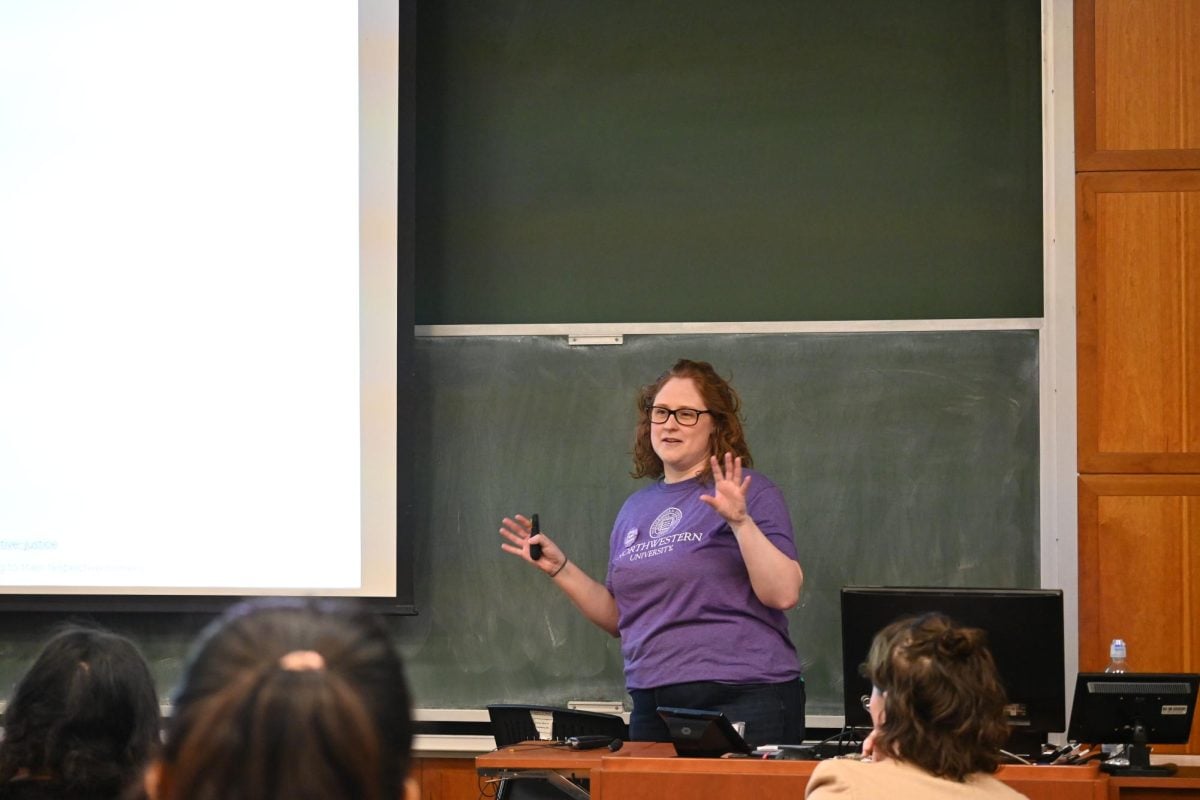
Northwestern sociology Prof. Anthony Chen speaks to students, faculty and Evanston residents about the origins of race-based affirmative action and what research says of its benefits. Chen spoke Thursday as part of a panel discussion on the implications of the Supreme Court's Fisher v. University of Texas decision on the NU community.

December 5, 2012

An expert panel on Wednesday discussed the Supreme Court’s most recent review of affirmative action and its potential impact on the Northwestern community.

About 100 people attended the event at Harris Hall, where authorities on sociology, law, enrollment and industry weighed in on Fisher v. University of Texas.  The panel was moderated by Daniel Rodriguez, dean of NU's School of Law, and sponsored by the Office of the Provost, Associated Student Government and the Political Union.

The Supreme Court heard arguments in October in Fisher v. University of Texas, a case filed by a white woman, Abigail Fisher, who claims she was denied admittance to the University of Texas at Austin due to policies that factor race in admissions decisions. Fisher says she was denied admission to the university because minority students were given preference in the admissions process. The university argues Fisher would not have been admitted if race played no role, and that it is free to assemble a diverse student body as part of its mission.

The panel expressed concern that the Supreme Court would use this case as an opportunity to reverse the  2003 decision in Grutter v. Bollinger that upheld affirmative action using race as part of a “holistic review” of an application. Speakers said today's Supreme Court justices are more conservative than they were a decade ago, which may mean either a complete reversal or more strict regulations on how race may be used in admissions decisions.

Panelist Mike Mills, NU's associate provost for enrollment, debunked many misconceptions about affirmative action, explaining how race can be considered after weighing several qualities and how admissions decisions cannot be based on “attaining (a) predetermined rigid number” of minority students. Mills said the impact the Supreme Court’s decision will have on NU admissions would depend on the specifics of the ruling.

NU Provost Daniel Linzer said when the Supreme Court rules on the case, his office will meet with the University's general counsel to discuss whether NU has to alter its admissions policy.

He explained that the decision could have particular impact on the makeup of Northwestern's Class of 2017, whose early decision applicants will be admitted this month prior to the Supreme Court’s decision; regular decision applicants, however, will be admitted following the decision.

“We may have a mixed policy in place on the entering class of 2013,” Linzer said.

Mills said a complete reversal of Grutter v. Bollinger would affect the number of minority students at NU, even if his office continued to increase diversity by factoring in applicants’ socioeconomic status.

“We would take a drop in our African American and Latino numbers,” he said.

In August, NU filed an amicus brief in the Fisher case with nine other institutions in support of the University of Texas, advocating for diversity in higher education.

“Admission policies are critical instruments for achieving our educational mission,” University President Morton Schapiro said a news release in August. “In this Supreme Court deliberation, it is important that Northwestern be ‘on the record’ about the connection between these policies and our mission to pursue diversity and institutional excellence.”

Wednesday's panel also looked to how a potential ruling against affirmative action could impact business. Panelist Ava Youngblood (McCormick ’79,), chief executive officer of Youngblood Executive Search, spoke about the under-representation of minorities and women as at the helm of Fortune 500 companies. She said affirmative action is necessary for equal representation in the workplace.

“If we begin to limit diversity coming into college, we will never achieve the goals,” Youngblood said.

Print Friendly

Comments

Comments on The Daily Northwestern's articles and opinion pieces are intended to encourage productive discussion. They are moderated and may be removed for offensive or profane content.

4 Responses to “Affirmative action panel discusses potential impact of Fisher v. University of Texas on Northwestern”

  1. Bob on December 7th, 2012 9:01 am

    It seems these "diversity" goals are counterproductive to the educational institution and the progress of our society. Engineering diversity through "holistic" evaluation is a politically correct way of achieving quotas.

    When students are admitted to an institution best suited to their educational development, they succeed at a higher rate than students whose past progress and achievement are markedly behind the main of the student body. Lowing or lessing the weight of objective admission criteria leads to higher drop-out rates, selection of easier majors just to get through, and lower success down the line.

    The lessening of the importance of objective standards for admission percolates throughout the academic environment with educators applying different grading standards to different groups of students. Likely this is why we see fewer minority students pursuing majors where evaluation of progress is objective (science, technology, engineering, and math), they migrate to majors where grading is subjective and different standards are difficult to detect. This phenomenon also leads to the development or expansion of such degree programs.

    One of the downsides of the diversity movement has been a focus on differences that has led to self-segregation on the modern college campus. Different groups tend to cluster together more and interact less.with other groups. This doesn't seem healthy in the long run.

    Universities such as Northwestern also force students into more ideological segration through the expansion of the the residential college system. I wonder if the growth of these "themed dorms" expose the weaknesses of the various academic departments within the university. If the departmental programs were stronger, likely they wouldn not need to be injected into dorm life as students would be inspired by the programs and professors/instructors alone.

    [Reply]

    VA:F [1.9.22_1171]
    Rating: 0 (from 0 votes)
  2. Bob on December 13th, 2012 3:55 am

    I take all the crappy comments I've ever said back.

    [Reply]

    VA:F [1.9.22_1171]
    Rating: 0 (from 0 votes)
  3. Stephen on December 16th, 2012 11:48 pm

    Frankly, I have to agree with Ms. Fischer in her argument. If she was more qualified in all other respects than her minority counterparts, there is no reason for her to be denied admittance to the University of Texas. I don't disagree with the fact that our top universities need to be consciences of the fact that the diversity of a student body is an important objective to achieve on a variety of levels. However, I am of the opinion that blatantly accepting students (or offering jobs to employees) who are less qualified on all other non-racially based criteria should not be accepted for the sole goal of improving institutional diversity. Sadly, this is what "affirmative action" has come to mean around America. Frankly we are killing ourselves by promoting those who frankly shouldn't be promoted in place of those who should be.

    [Reply]

    Owen Reply:

    Things like "more qualified in all other respects" and "blatantly accepting students who are less qualified" do not actually make sense when you understand college admissions. Everything is taken in holistically. People are dynamic. Different students offer different things to the institution. Quite simply, it's funny when people get into this argument of affirmative action because a university doesn't even need to cite race in choosing one student over another, because there are always going to be many other differences the university could cite instead.

    Moreover, your point of view seems to be driven (like many) fundamentally by the misunderstanding that college admissions are some sort of awards process. They aren't. No one "deserves" to be admitted somewhere because admissions are not about rewarding the past - they are about building communities and students for the future. So, with that in mind, the university is 100% in the right to admit whoever it thinks is better in creating a community, in growing in his or her time at that university, and more.

    [Reply]

    VA:F [1.9.22_1171]
    Rating: 0 (from 0 votes)