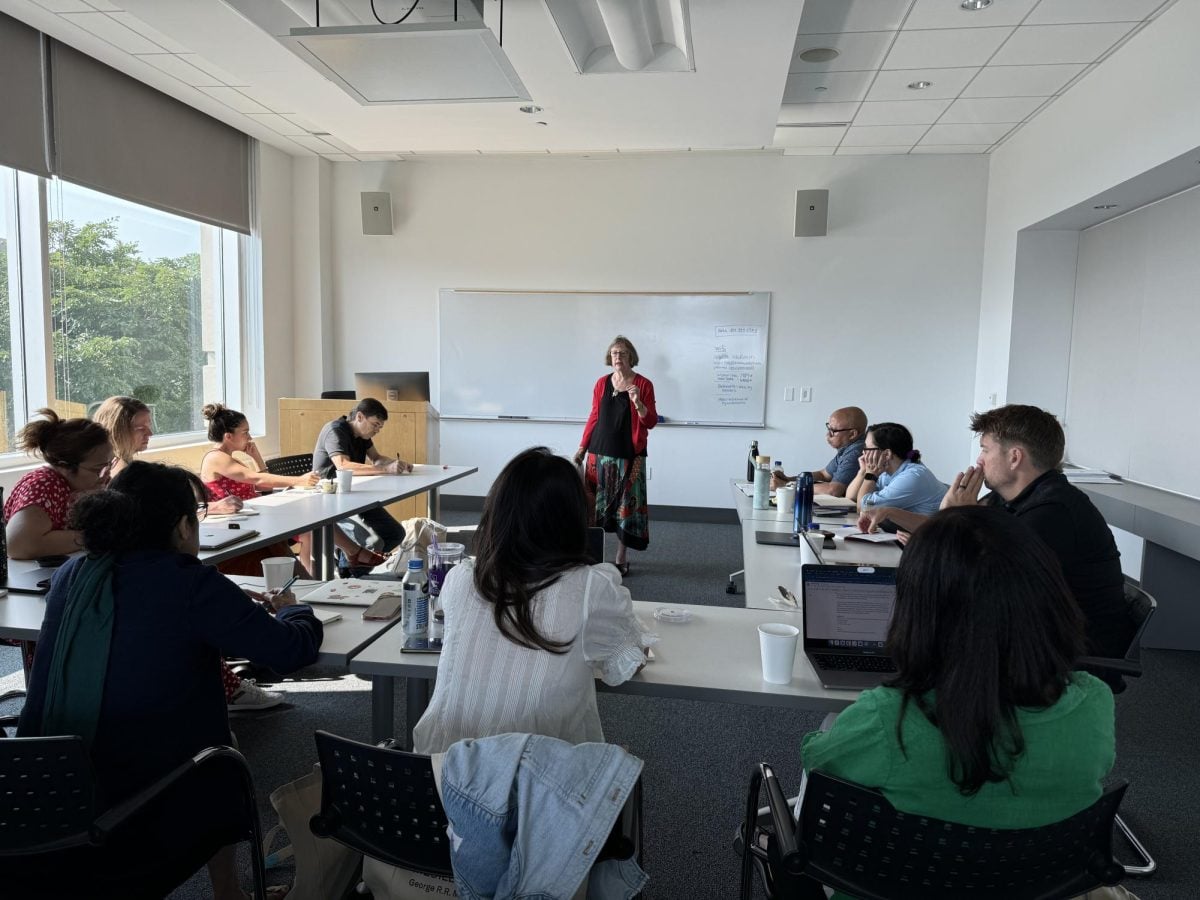
As history Prof. Michael Allen lectured about the Vietnam War in his American Wars class this quarter, he drew a connection between South Vietnamese police tactics and present-day immigration enforcement in the U.S.: that police force can alienate civilians rather than winning them over.
He said this comparison was not meant to tell students what to think about current politics, but instead to demonstrate a historical pattern.
“I’m using things from the current environment to illustrate something I’m trying to teach about,” Allen said.
As President Donald Trump’s administration continues to dominate headlines, current events have regularly arisen in classrooms like Allen’s. While some Northwestern faculty said they are not rewriting their syllabi to directly address the administration, others said they have adjusted examples and discussions to help students contextualize rapidly changing political developments.
Global health studies Prof. Noelle Sullivan said avoiding current political events altogether has become increasingly difficult due to the scale of recent changes to global health systems.
“Everything that we were teaching in an ‘Intro to Global Health’ class now feels like a history class because the whole thing has just been completely disordered,” Sullivan said. “You’re trying to figure out how to help students make sense of the rubble.”
For example, Sullivan said she has addressed the Trump administration’s America First Global Health Strategy in her classes.
Legal studies Prof. Joanna Grisinger, who teaches classes on constitutional law, said the Trump administration has made certain legal questions feel more urgent.
“There’s a lot happening and a lot of ongoing litigation,” Grisinger said. “I definitely adapted the topics I was covering to make sure students had an understanding of what was pending in the courts, what had just come down, what’s likely to happen in the next few years.”
Grisinger said she has recently incorporated more material on the Second Red Scare and anti-communist legal cases while discussing attacks on academic freedom at universities under the Trump administration.
She added that she left the final day of her Law and Society class open on the syllabus to potentially discuss any recent political developments.
Other faculty said they now are more conscientious of the political polarization within classroom discussions.
Anthropology Prof. Thomas McDade said he now approaches certain topics carefully in order to maintain an environment where students across the political spectrum feel comfortable participating.
“As the professor and leader of the course, it’s my responsibility to make sure that all the students feel valued and respected and safe and welcome in that space,” McDade said.
McDade, who teaches science-focused anthropology classes like Human Growth & Development and Social and Health Inequalities, said current events occasionally emerge organically in discussions about public health because “anything related to science can be politicized.”
He said that he has discussed the Trump administration’s handling of vaccine information while teaching about scientific transparency and public trust in health data. Still, he said, he avoids sharing his own political beliefs during class discussions because he wants students to feel comfortable expressing their own views.
Anthropology Prof. Melissa Rosenzweig said current political events also sometimes naturally enter discussions in her classes like political ecology, which examines how environmental issues intersect with systems of power.
However, she said she tries to keep conversations focused on how broader political and environmental systems intertwine.
In one class, Rosenzweig said she discussed the Trump administration’s decision to allow deep-sea mining in the Pacific Ocean.
“The conversation was about, ‘How do we feel about this idea of capitalism seeking out new frontiers? How do we address that?’” Rosenzweig said. “It was less about the specifics of the Trump administration’s actions.”
For Grisinger, drawing connections between current and historical events is part of helping students understand the systems surrounding them.
“If you’re teaching legal doctrine, you’re still teaching it in light of the context in which it’s happening and what’s going on,” Grisinger said. “Coming to it as a historian, I try to make sure I’m explaining things in the context in which they happen.”
Rather than avoiding controversial topics, Sullivan said she focuses on helping students evaluate evidence and understand how expert analysis differs from personal opinion.
Allen said he similarly tries to keep his focus on historical analysis. Still, he said teaching in the current political climate has become more complicated as distrust toward higher education grows.
“The thing that is tricky in this moment is knowing that students and the broader public are not very trusting in institutions right now,” Allen said. “They’re not very trusting in elite higher education and professors, so there’s a kind of skepticism toward a lot of what we say and do.”
Sociology Prof. Miri Eliyahu (Weinberg ’18, TGS ’23) said she feels professors should ultimately focus on teaching students theory and analytical skills rather than introducing personal politics into coursework. She said she considers that indoctrination.
However, she said current events inevitably enter discussions and coursework — and that the distinction is to focus on helping students analyze the impact of events.
“We always talk about current events,” Eliyahu said. “Our role is to teach the students to be analytical and critical about what they see, regardless of who’s in the administration.”
Email: [email protected]
Related Stories:
— Bienen talks NU-Q, federal funding deal, University future in interview with The Daily