When bestselling author Min Jin Lee left her career as a lawyer after just under two years, it took her 12 years to publish her first book, “Free Food for Millionaires.” Lee said her friends thought she was “a lunatic.”
Since then, Lee has risen to international fame with her critically-acclaimed family saga “Pachinko,” which has sold millions of copies across the world and named one of The New York Times’ 100 Best Books of the Century.
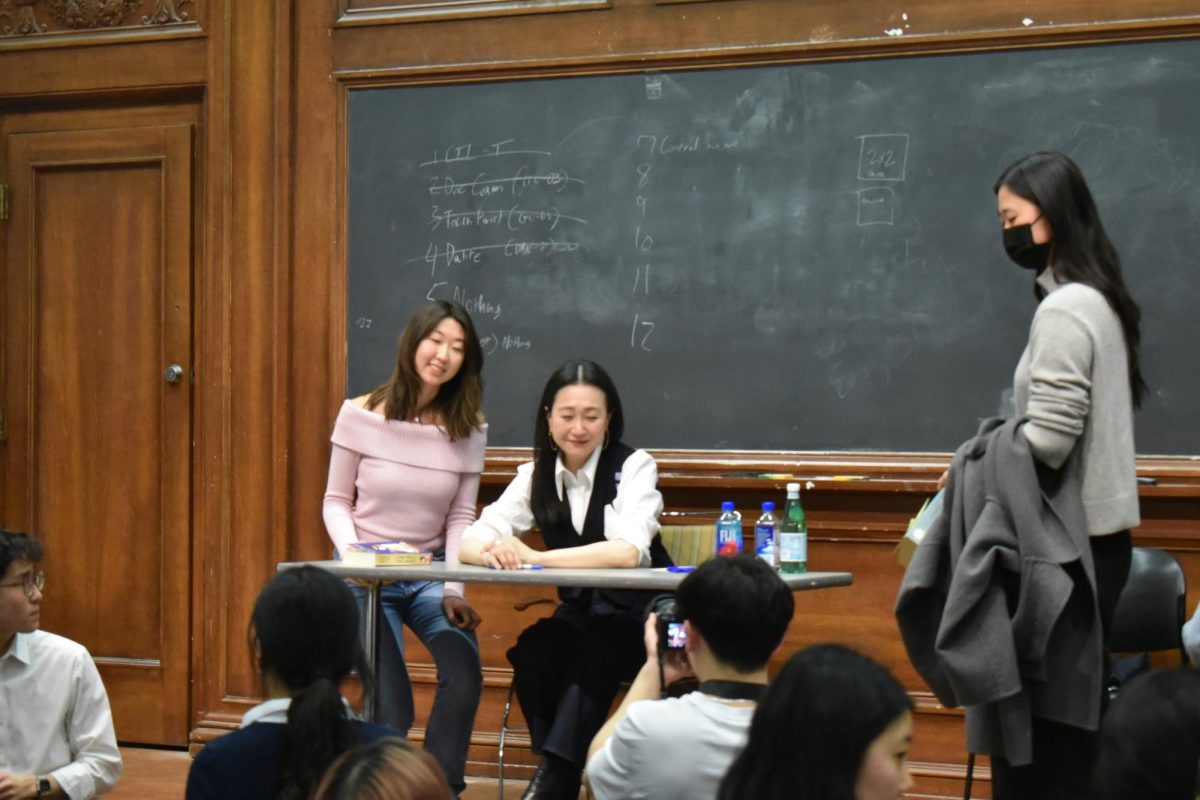
Almost two decades after her debut novel’s release, over 200 people gathered in Harris Hall on Thursday night to hear Lee speak at the Korean American Student Association’s winter speaker event.
KASA executive members Weinberg senior Jun Park and Weinberg junior Henry Im moderated a discussion with Lee. The conversation explored topics including her path from law to writing, the Korean diaspora and anti-Asian sentiment. Afterward, it opened to an audience Q&A.
Lee said a liver disease pushed her to leave law and pursue writing.
“Because I’m an immigrant, I thought that I would stay (in law),” Lee said. “But because I had a very serious liver disease, I thought, ‘Well, if I’m going to die, I don’t want to die doing this.’”
“Pachinko” was her second book, adapted from an earlier manuscript titled “Motherland,” which she said she abandoned because it was “a very angry book.”
Little remains of that work in “Pachinko,” except for a chapter that had been published in the Missouri Review as a short story, she said.
“If you told me at age 20, it will take you 12 years to write ‘Free Food for Millionaires,’ I would have said real estate broker, anything,” Lee said. “But I would not have picked this path.”
Her next book, “American Hagwon,” is slated for publication in September, concluding what Lee originally intended to be a trilogy about the Korean diaspora. However, she said that she has a fourth book, “Marshall Plan,” in the works.
“American Hagwon” will focus on a white-collar family’s displacement by two different financial crises, tracing a journey from Korea to Australia to California.
“I wrote ‘American Hagwon’ with the idea that, if this was my last book, I had to figure out what is the value that Koreans care about more than any other value,” Lee said. “It wasn’t money, it wasn’t status, it wasn’t power, it wasn’t religion. The thing that they talked about over and over again was education.”
Lee spoke about her time researching and interviewing for her novels, as well as her perspectives on issues such as anti-Asian sentiment and artificial intelligence.
During the COVID-19 pandemic, Lee said some people thought that “Asian bodies carried a virus” during the era of heightened anti-Asian and Asian American sentiment.
“All bodies can carry viruses if you’re a human,” Lee said “The fact that they thought only Asian bodies carried viruses was a racist and a deeply dangerous idea.”
Lee warned that Sinophobia puts all East Asian people at risk, claiming many are unable to distinguish people of different ethnicities. When hatred toward one group becomes acceptable, she said, it bleeds into discrimination against all people who appear East Asian.
Weinberg junior Alex Cho said he resonated with various aspects of “Pachinko,” including his background as an Asian American and its focus on Korean history.
“I didn’t know this beforehand, but all my relatives went through a lot of the Korean war conflicts with Japanese colonialism,” Cho said.
Recently, Lee was invited by New York City Mayor Zohran Mamdani to be on his inauguration transition committee. She said she was surprised by the invitation, as she had not campaigned for him, but ultimately accepted her position, saying felt like she needed to represent the NYC Asian community.
Lee said she wanted younger people to participate in politics — and that someone’s age shouldn’t “discount” them.
“We’ve had people who don’t have driver’s licenses in the White House,” Lee said. “I’m really okay with (Mamdani) trying this out.”
During the audience Q&A, Weinberg first-year Elizabeth Castillo said as a high schooler in Guatemala, “Pachinko” was the first novel she read in English.
Language learning has been a large part of Castillo’s life, she said, emphasizing that she taught herself English and some Korean.
“Learning about different cultures, learning about different languages, different people, is something very special,” Castillo said. “Every person’s story is so unique that limiting yourself to only what you know is not the best thing you could do.”
Lee’s comments on the uncertainty young people face particularly struck Castillo, given the impact of AI and rising job instability. Lee urged students to not turn to AI for writing, among other things, warning against “de-skilling” people and “up-skilling the machine.” Castillo said hearing Lee speak was important to her, believing that people should push themselves to read “out of their comfort zone.”
In response to Castillo’s question about writing inspiration, Lee said the most important thing for aspiring writers is to write and to read the “great works.”
“It’s very easy to find these things,” Lee said. “I will say that is probably the only good thing about the internet. It will at least tell you where to look.”
Clarification: This story has been updated to include a more accurate estimate of the number of attendees.
Email: [email protected]
Bluesky: @yongyuhuang.bsky.social
Related Stories:
— Pulitzer-winning poet Natalie Diaz explores basketball, language, Indigenous identity
— 2026 Chicago Poet Laureate celebrates, critiques Chicago history