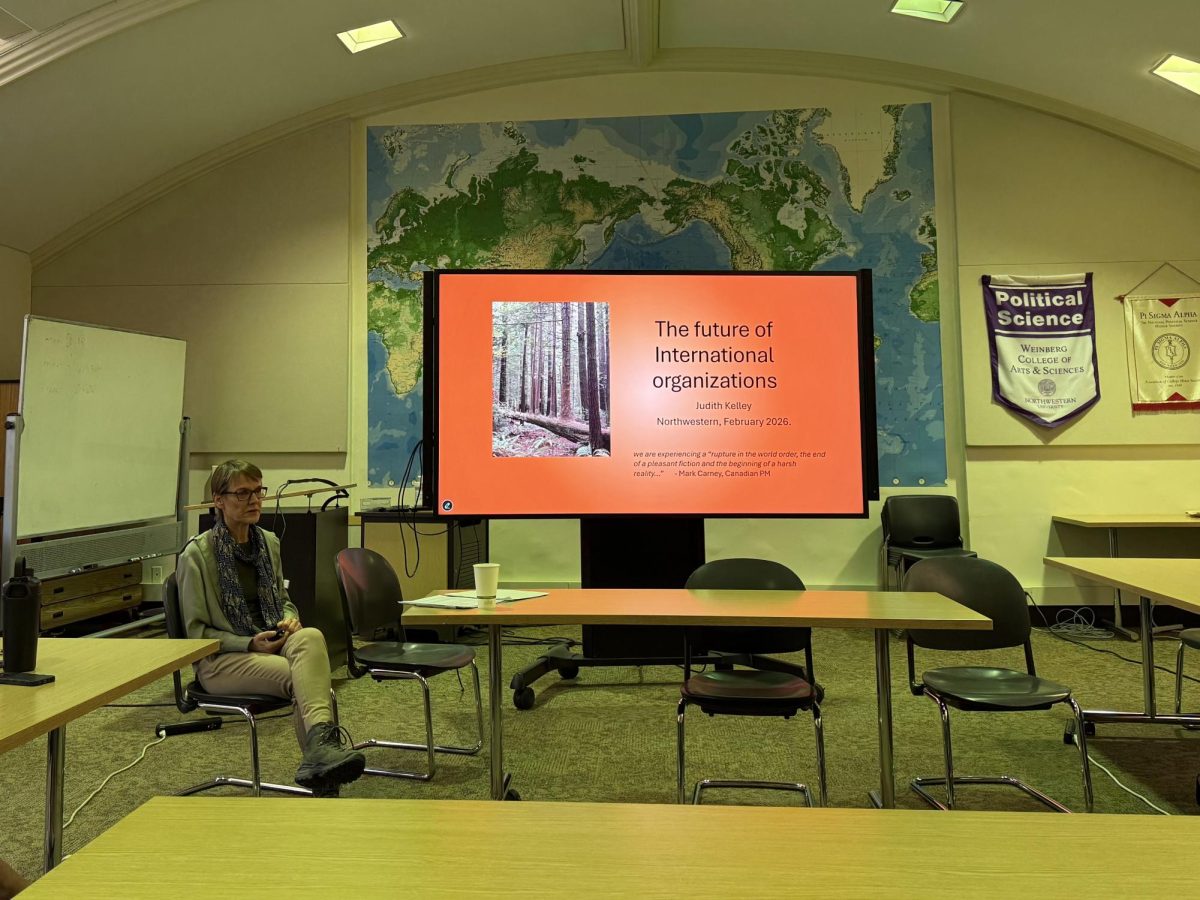
Duke University Prof. Judith Kelley said international organizations are facing a period of instability in an International Relations Speaker Series talk hosted by Northwestern’s political science department Friday.
She said while this instability is serious, it is not unprecedented.
“Our current predicament we’re in is not nearly as new as it might feel to us and not nearly as ‘Trumpian’ as it might feel to us,” Kelley said. “This has been a long time coming.”
Kelley, a former dean of Duke’s Sanford School of Public Policy, previously held advisory roles at institutions like the World Bank.
She said declining trust in U.S. global leadership predates the current Trump administration by decades, citing drops in U.S. alignment with majority votes in the United Nations General Assembly and long-term decreases in overseas development assistance.
Kelley highlighted that the U.S. has periodically reviewed its participation in international organizations for years, assessing whether the organizations align with the country’s priorities and interests.
The Trump administration conducted one such review in January, which resulted in the announcement of a withdrawal from 66 organizations. Kelley said such reviews of U.S. involvement in these organizations have been commonplace under administrations from both major political parties.
“We tend to blame one side, but I think that’s a little unfair,” Kelley said. “Even before Trump, the U.S. had withdrawn support from international organizations many, many, many times before.”
Regarding the recent review, Kelley said its “bark is worse than the bite,” as the U.S. would have fully withdrawn from organizations if they were intent on undermining them.
She added that even if the U.S. says they will stop funding certain organizations within the UN — as they did in this recent review — the impact will be limited as UN agencies’ funding comes from base allocations, which the U.S. will still pay.
Rather than a widespread exit from the global system, however, Kelley said the current moment is defined by a “rupture of trust” in which the U.S. often retains seats in international organizations while reducing funding or cooperation.
“It’s a very messy picture,” Kelley said. “We’re not really withdrawing. We’re taking some money away from some. It’s still not clear who’s going to get funded.”
She said an example of the U.S. undermining these organizations was when it signed non-surrender agreements in 2002, which limited the International Criminal Court’s jurisdiction.
First-year political science Ph.D. student and attendee Christophe Bidandi said the talk enabled him to apply Kelley’s analysis to his own areas of interest.
“I’m really interested in the ICC and its involvement in African conflicts,” Bidandi said. “This gives me a new angle to look at the issue.”
First-year political science Ph.D. student Gideon Gordon, who also attended the talk, said it reframed how he understands the instability facing international organizations.
Specifically, as someone who studies the Civil War, Gordon said the talk broadened his perspective as it helped him to consider a more overarching view.
“It’s disturbing that this isn’t new,” Gordon said. “That was my biggest takeaway, that this is part of a shockingly consistent pattern from the U.S. government to treat international organizations pretty badly.”
Kelley said how international organizations perform is a crucial aspect to consider but often overlooked.
Rather than focusing on power dynamics between countries and international organizations, Kelley said it’s important for politicians to determine whether such organizations are effective.
“We have been discussing for so long as IR scholars whether international organizations matter, and we have not at all been paying attention to whether or not they work,” Kelley said. “That is such a missed opportunity.”
Email: [email protected]
Related Stories:
— Professors talk U.S. military strike in Venezuela at Buffett event
— Stacey Abrams reflects on democracy, authoritarianism at Pritzker talk