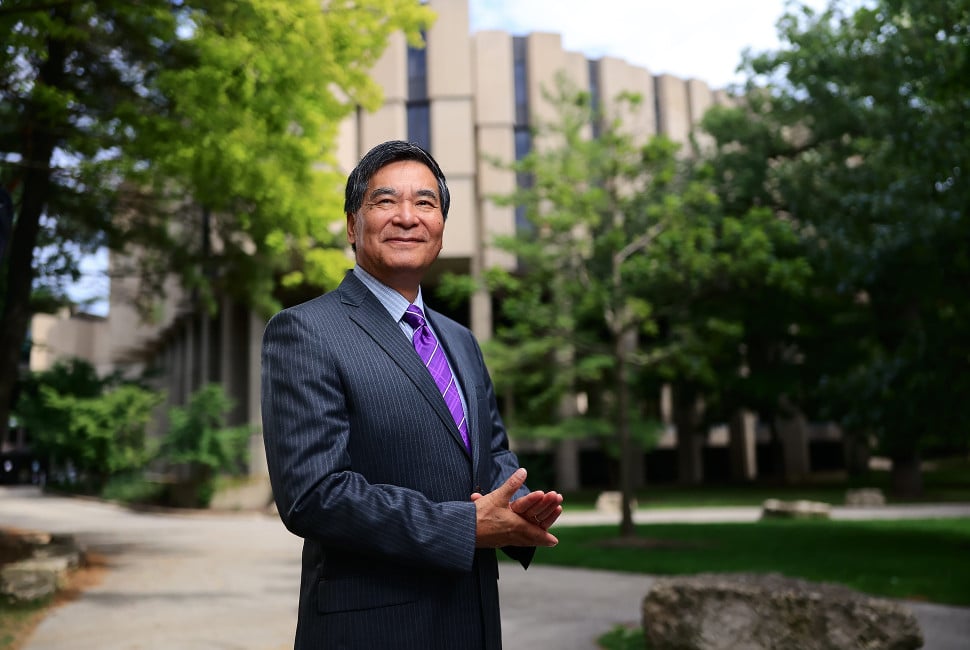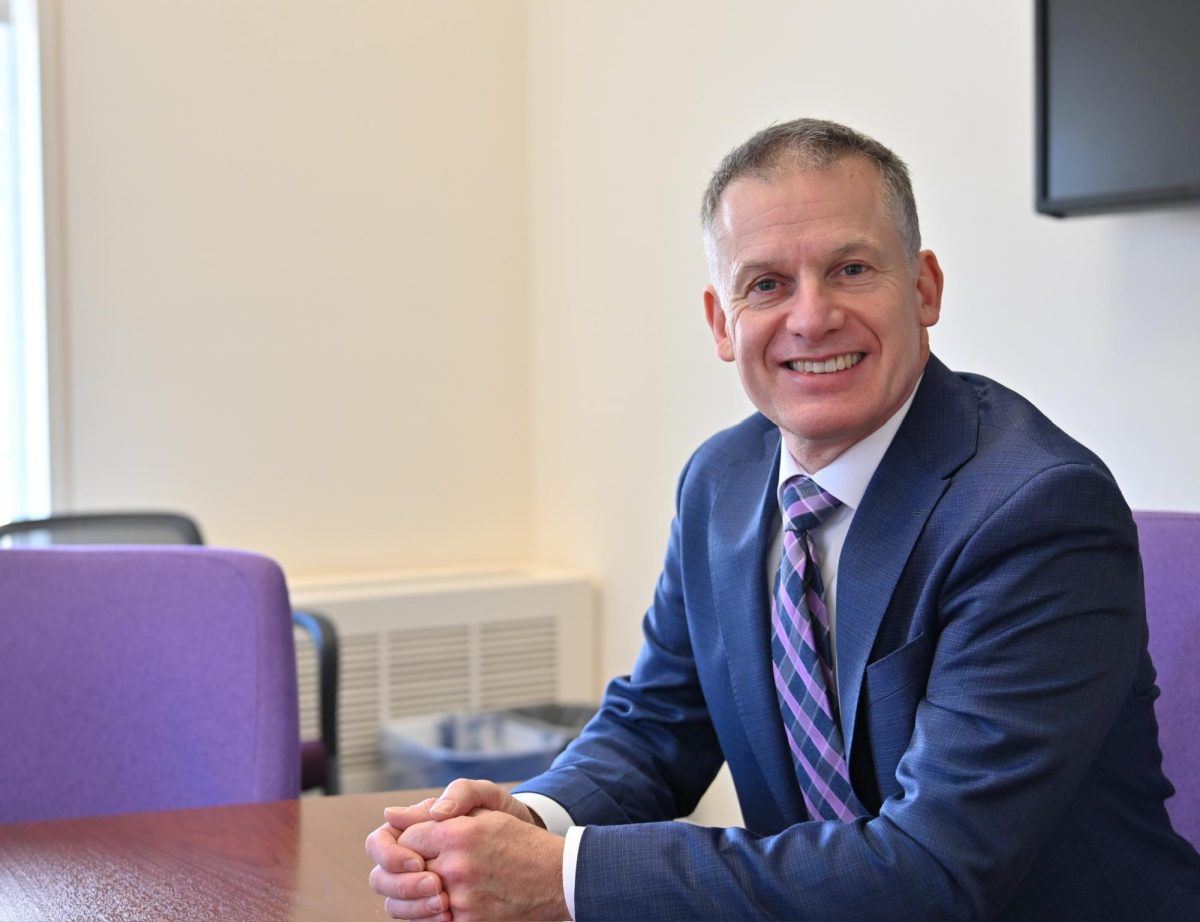
Incoming Provost and McCormick Associate Dean for Research and Doctoral Education and Prof. Erik Luijten sat down with The Daily on Wednesday to talk about his goals for the new role and recent challenges facing the University.
Luijten was announced as the University’s next provost on Jan. 7, over two months after outgoing Provost Kathleen Hagerty said she would step down at the end of the year. She has served in the position for almost six years.
Speaking about his future as provost, Luijten said “excitement” was the word that came to mind.
“I felt, ‘Wow, my life is going to change,’ and this is such an opportunity to (bring) Northwestern to the next phase,” he said. “I really love the University … Now I felt, wow, this is a big responsibility, but also an opportunity for me to learn a lot, to make a big difference.”
He will work alongside Hagerty in the coming months to learn more about the Office of the Provost, according to the Jan. 7 announcement.
This interview has been edited for brevity and clarity.
The Daily: What are some of your goals as provost?
Luijten: I would say on the one hand the University has had a very difficult year, and it’s clear to everyone that there have been true challenges for the University, and so I very much want to lead with positivity coming out of that — turning a corner — and propel the University forward to the next level.
That brings me, then, to the second aspect. I’m so proud of the University and feel so happy to be here since I arrived. I’ve been seeing this upward trajectory for a long time now, and that really predates even the time that I arrived here, with (interim University) President (Henry) Bienen setting the University up for a lot of success. But then also, subsequent teams of presidents and provosts really laid the foundation for success, and we have seen that over and over.
So, my goal is really to keep going on this upward trajectory, and even in this difficult year that we just have left behind us, there were still a lot of positives. I mean, of course, Joel Mokyr got a Nobel Prize in Economic (Sciences). It’s a huge deal, and something that seems really fabulous for a university to have a Nobel Laureate amongst us.
There are still, despite, for example, the suspension we had of research funding, a lot of initiatives. We have this data science initiative that was initially launched by (former University President Michael) Schill, and that has resulted now in this NNCI, the Northwestern Network for Collaborative Intelligence, and I’m very excited about that. I think that it’s obvious to all of us that data science and (artificial intelligence), that are not going away. So to play an important role in that, to see how we can use it for good, that’s something fabulous and if NNCI is the way in which you do, that will be great.
You walk across campus, you see there’s still quite a bit of construction. Kellogg (School of Management) is constructing basically the replacement for the Allen Center. I learned last week that, in terms of undergraduate applications, (the University received its) highest number ever of applicants. Of course, we still ranked number seven. You can have your ideas about rankings, but it’s still the point of pride, and it speaks to how we are perceived in the country. I’m sure there are other points that I’m not mentioning now, but still many, many positives and so that’s really what I want to build on.
I think it’s not a secret that because of the difficulties that we had, and not just with the research funding, but of course, the whole agreement that was struck with the government — people have different feelings about it, and even President Bienen, who ultimately got us this agreement, says, ‘Look, there are certain aspects of it that I don’t like, but this, I believe, is the best we could get, and the alternative would have been worse.’ So, I understand that we have these feelings, and there have been other situations somewhat related, like, for example, frozen salaries for faculty and staff. Quite a few positions have been eliminated, so staff had to be let go. (There was) no faculty hiring this year. A lot of things that burden people, and so I also want to be mindful of that, that we truly have to work on getting the morale back up, understanding that this was very difficult for different people in different ways, but that, despite that, now it’s time to turn the corner and go back on a positive trajectory.
The Daily: Faculty have also expressed, particularly following the deal, concerns about a lack of transparency between faculty and the administration. What can faculty expect from your leadership in this office?
Luijten: I understand why faculty say that, and I’m a faculty member myself, so I get it. The deal is a very special example. I understand, but I’ve only just heard this, that it was so difficult to navigate the situation with the federal government and sort of like changing goalposts that a very small team at (the) University was engaged in that. So maybe that is a very specific and highly unusual example where transparency may have been very difficult until, let’s say, the last moment.
What I heard, and simply as someone in the audience when President Bienen spoke to all the staff, was that it was uncertain until the last moment whether he would sign it, and that it kept changing until hours before it was finalized. So, that’s a very special example. I feel that the University can do even better when it comes to communicating.
It’s inevitable that there will be decisions that are difficult, that there will be decisions that not everybody likes. It’s naive to think that it’s not going to happen again. So the art is, then, to convey, let’s say, the constraints that you’re facing when making a decision, because that will foster understanding of why you came to a certain outcome. If you clarify what you’re grappling with, what you need to balance, I think that most people at the University are very open to thinking about the fact that there are different aspects to any problem, to most problems. So communicating that more is something I will absolutely try…
The Daily: As we are under a federal government that just seems to be taking a lot of money away from higher education research, how are you going to advise faculty as they look to apply for grants, especially for those who are trying to do research in the LGBTQ+ field or related to (diversity, equity and inclusion)?
Luijten: So I think that last point that you brought up is particularly important, because for just the first part of your question, I would say, look, there were all these threats. Let’s say to the (National Institutes of Health) budget, to the (National Science Foundation) budget, etc. But then, in practice, many of these, let’s say cuts that were effectively announced, the (U.S.) Senate interfered, and these budgets are largely intact.
But you are correct. There are specific areas that are under attack by the government. In the long run, we hope that this is not the situation that will last. In the short term, my hope is that, specifically for those topics, foundations will step up philanthropy. There are many people (who) have strong feelings about this type of research, where the government makes essentially a moral judgment about whether they think this is worthwhile or not and I think that there is a good chance that private investments, donors or other philanthropy may be a resource to at least temporarily fill that gap.
The Daily: It was recently reported at the Faculty Senate that the University was in a $150 million deficit. … Does the University expect next year to not be in a deficit?
Luijten: I cannot claim insight into the budget. The University, of course, is facing all sorts of financial constraints. For example, President Bienen announced that after no raises, like frozen salaries, last year, that’s not going to be the case this year, which is very good news for staff and faculty.
Ph.D. students have a collective bargaining agreement, so they have built in 3% raises (in fiscal years 2026 and 2026). Faculty hiring is going to resume. I think that President Bienen said, we’re not going to go crazy, but it’s not completely frozen like it was this year. Faculty hiring means, often lab renovations or office renovations. It means startup funds for faculty to set up a lab or whatever they need to do their research. So all these are new expenditures that we have to anticipate, and they are obviously part of the budget.
But I’m not privy to projections at the moment for the coming year, but I do agree with anyone who would say, “We cannot work with a structural deficit?” Because if you have (a) deficit year after year, you’re obviously building your debt that then ultimately also needs to be paid off, and in the meantime, you pay interest. So I hope that we go back to a balanced budget, ideally even a modest surplus, because that allows the University to make investments, and that’s very important.
We will have a new president, hopefully by the end of the spring. This person will have a vision and will have plans. As a provost, I look forward to working closely with this person, not just executing ideas, but hopefully become a team and together develop plans for how to get these ideas realized that I mentioned earlier on in this interview, so that all will require funding, and so we need to go back to a financial situation where we are able to afford it.
Email: [email protected]
X: @ak_newsom
Bluesky: @aknewsom.bsky.social
Email: [email protected]
X: @ninethkk
Related Stories:
— McCormick Associate Dean, Prof. Erik Luijten announced as Northwestern’s next provost
— Provost Kathleen Hagerty to step down by end of 2025-26 academic year after 5 years
— Bienen talks federal funding deal, immigration enforcement in interview with The Daily