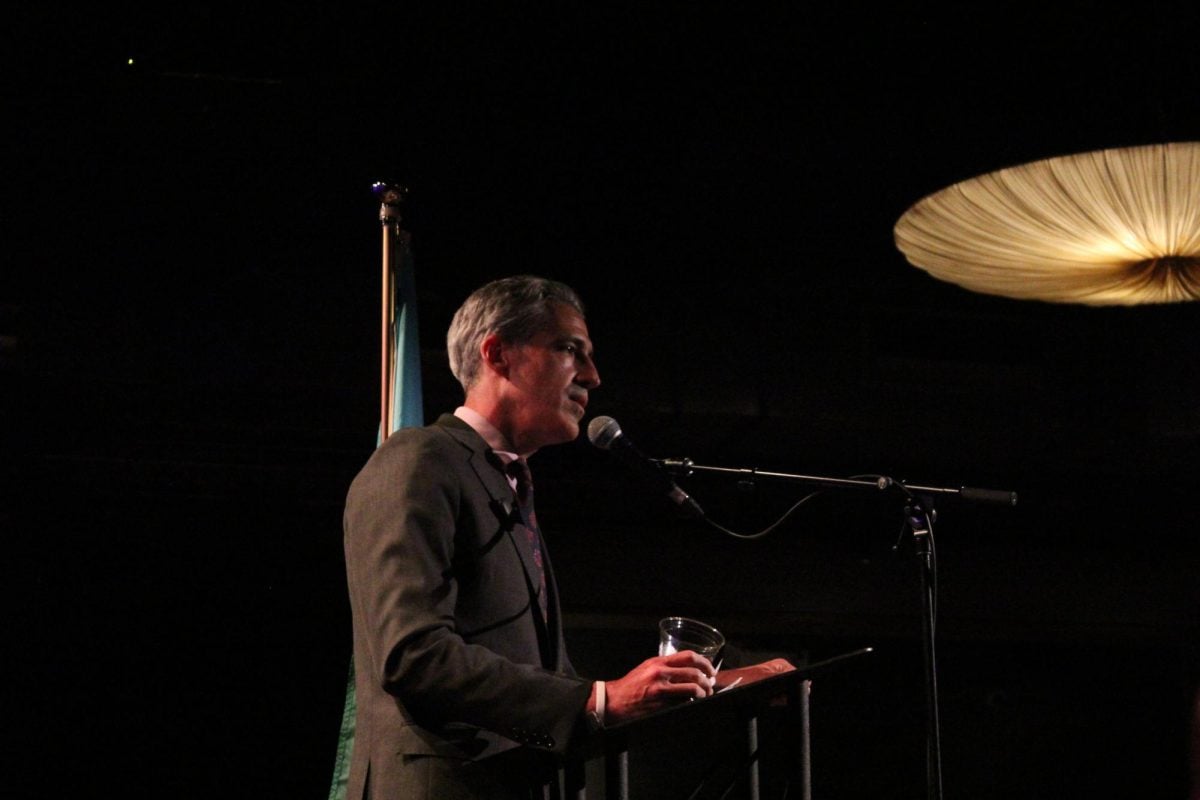
Evanston Mayor Daniel Biss announced he will resign from office October 18 after serving as mayor for five years in his State of the City Address at Evanston SPACE Tuesday afternoon.
He said the purpose of resigning in October is to trigger a special election in the spring in order to minimize the amount of time Evanston has a mayor that its residents didn’t choose in an election. In March, Biss secured the Democratic nomination to represent Illinois’ 9th Congressional District, and on Nov. 3, he will face Republican nominee John Elleson in the general election.
Whatever the outcome of the election, Biss said the city can still count on him to “be in the fight” and do what he can to build a better Evanston, region and world.
“I am confident to my core, based on what I have seen these last five years, that though things in this town are sometimes challenging, that our best days are ahead, and that we have here the extraordinary mix of talent and dedication and creativity and willingness to take risk that is needed to confront this community’s — and this complex world’s — biggest problems,” he said.
Following Biss’ October resignation, City Council will be tasked with appointing his acting replacement.
Biss said petitions to become a candidate for the spring special election can be filed between October 19 and 26.
“My preference would be to find somebody else who I could support and get behind,” Ald. Jonathan Nieuwsma (4th) said following Biss’ address. “My efforts have been focused on trying to find somebody, recruiting a candidate to run to replace Mayor Biss and be the permanent mayor.”
During his address, Biss said the last year and a half have been among the most challenging in the city’s history, beginning with “politically-motivated attacks” on Evanston’s largest employer, Northwestern. In April, the Trump administration froze $790 million in federal funding for the University.
He also cited attacks on the city’s reparations program, as Evanston is the first city to distribute municipal reparations. The initiative distributes up to $25,000 to Black residents who lived in the city between 1919 and 1969 or their direct descendants. The U.S. Department of Justice announced its intention to join a lawsuit challenging the program this month.
Despite what he called a “frustrating” and “politically-motivated” case, Biss said the city will stay committed to telling the truth about its past.
“It doesn’t cow us or push us away from that mission, because that mission is more important than who happens to sit in the White House or the Department of Justice,” he said. “That mission is core to who we are, not only as a city, but who we are as a human people.”
Biss also discussed Immigration and Customs Enforcement activity in and around Evanston, saying it “wreaked havoc” on Evanston communities. He added he believes Operation Midway Blitz was “nothing short of a federal occupation of our streets.”
He also said dark times brought out the best in Evanston, with community members organizing and old divisions melting away because of a shared purpose: keeping community members safe.
Although he admitted the city’s relationship with Evanston/Skokie School District 65 and Evanston Township High School District 202 can be complicated, he said when it came to protecting Evanston children from federal agents, they worked together well. Biss said it’s important not to pretend that disagreements aren’t real or important, but to build collaboration and unity on the basis of disagreements.
Evanston Latinos Executive Director Ricardo Villalobos, who introduced Biss at the event, emphasized the importance of collaboration. He said Evanston is a place where countless Latino residents have shaped the community’s character.
As the community continues to evolve, Villalobos underscored the importance of how Evanston chooses to shape its future.
“The most important question any community can ask is not, ‘Who’s already in the room?’ It is, ‘Who is missing from the room?’” he said. “And as Mayor Biss continues his journey of public office, my hope is that he and all of us continue asking that question, because every community is a work in progress.”
Biss highlighted Envision Evanston 2045 as one of the most significant projects he has worked on as mayor. He called it a complex plan that is, at its heart, about having affordable housing in Evanston for existing and future residents. Although the work will likely not be done by the time he leaves office in October, Biss said it’s crucial that the project respects the city’s stated commitment to diversity.
He said the plan should focus on diversity not just in the city as a whole, but in every neighborhood,ward and block.
“The vibrancy and life force of diversity does not come from census data,” Biss said. “It comes from what life is like on your block.”
Biss also cited Evanston’s Healthy Buildings Ordinance — which he called “the strongest climate ordinance of its kind in the Midwest by far” — and Crisis Alternative Response Evanston as further examples of the city’s success during his tenure. He said the HBO represents Evanston’s commitment to action and the CARE program spotlights the importance of collaboration — two themes throughout his address.
“We can just do the easy thing and back down and say a nice slogan and hope that no one notices we didn’t really live up to it,” Biss said. “Or we can do the hard thing that might make someone mad, might make someone else uncomfortable, might make somebody’s reelection trickier, but is what our values and our people and our society demand. At our best, that’s what we do.”
Email: [email protected]
Related Stories:
— Federal government moves to join lawsuit against Evanston’s reparations program
— Biss wins Democratic congressional primary
— City Council retains simple majority for acting mayor selection