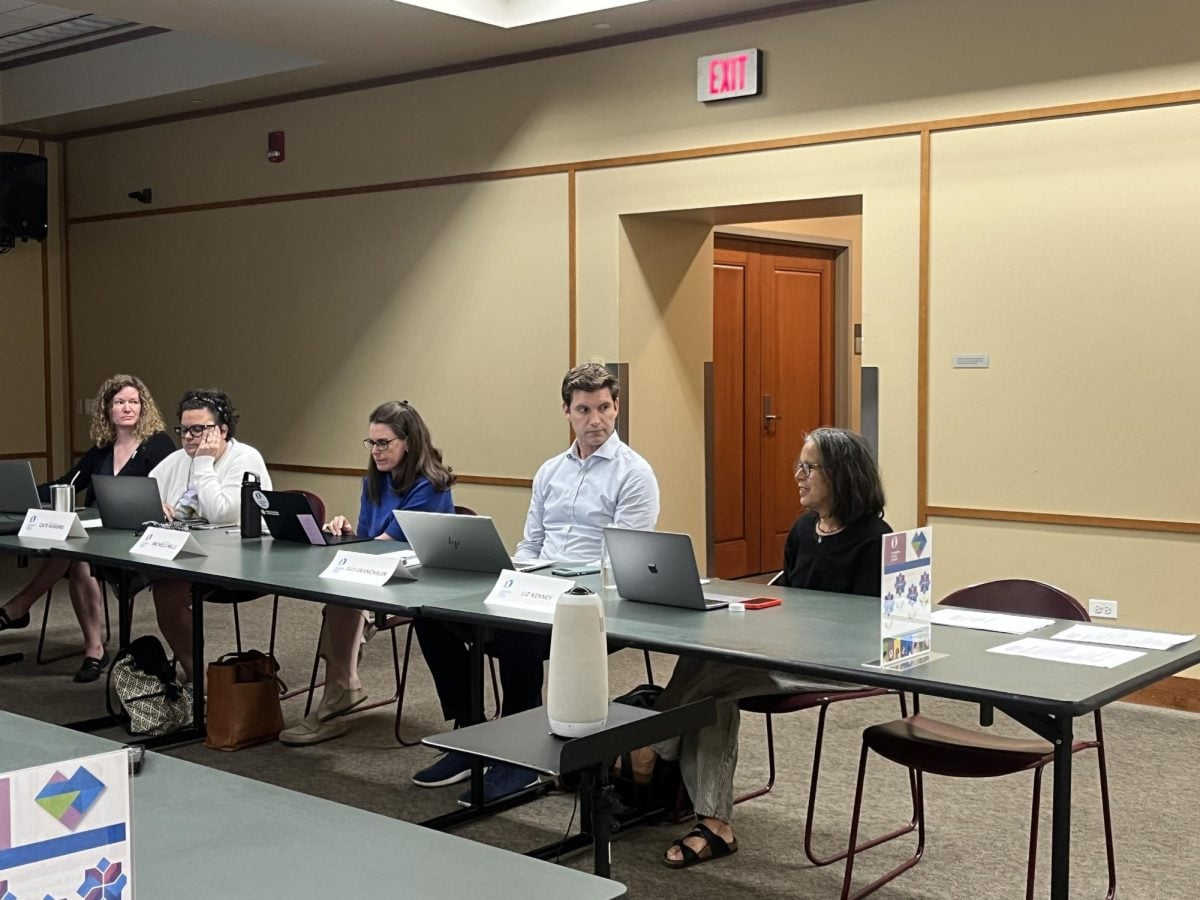
The Evanston/Skokie School District 65 Board of Education assessed alternative spending cuts at its Monday meeting.
Board members are currently looking to complete Phase 3 of the district’s Structural Deficit Reduction Plan, which aims to cut $16 million to $18 million from the district’s budget by fiscal year 2030.
The district is targeting a $6.3 million budget reduction for the 2027 fiscal year. Superintendent Angel Turner said the board must decide where to cut an additional $635,077 of spending before the next fiscal year to meet that goal.
In the past few weeks, the district has moved to eliminate several student-facing positions, including some counselors and middle school librarians. This has drawn significant pushback from parents, teachers and students, who have attended meetings in droves to express their concern.
In a Friday announcement, Turner said the district would reinstate the middle school library program and “prioritize and retain student-facing positions.”
Board members discuss before- and after-school programming
During Monday’s meeting, the board considered alternative options including modifying the School Age Child Care program, which provides before- and after-school programming for kindergarten through fifth grade students who are enrolled in District 65 elementary and magnet schools.
Deborah Osher, the district’s director of instructional leadership and programs and partnerships, gave a presentation on the history of the SACC program.
Osher said the current SACC model is “financially unsustainable.” She added that District 65 is unique compared to other nearby school districts in Skokie, Wilmette and Glenview in that it has a before- and after-school program funded by the district.
Osher also highlighted “long-standing existing partnerships” like Books & Breakfast that provide alternatives to the SACC program.
Still, board member Mya Wilkins said she was reluctant to make “major changes” to the program. Wilkins said she wanted to first ensure the board understood the implications of these decisions, given the program’s importance.
“One of the great things about SACC is that the people who work there really do become part of the school community and build a real relationship with students,” Wilkins said.
During public comment, community members also expressed concern about potential changes to the SACC program.
Miriam Kendall, a member of Screen Sense Evanston, said board members should prioritize “human connection” and discussed her dislike of the board’s recent iPad purchase.
“The future of education is not iPads, but is instead passionate educators, compassionate counselors, expert librarians, quality aftercare and early childhood education,” Kendall said.
The board ultimately concluded that it would call on the administration to draft a more comprehensive plan that would delineate ways to make the program sustainable.
Community members call for administrative cuts
Some community members questioned the number of administrators the district employs, which they said are not proportional to student enrollment.
Many said the district identified more than $8 million in potential administrative cuts in a slide deck at its April 20 meeting, 19 days after the contractual deadline that would have made it actionable for fiscal year 2027. At Monday’s meeting, some board members said they were not aware of this deadline.
Legion of Data Nerds member Jean Clipperton said their group had conducted an analysis that demonstrated the outsize growth of these administrators’ paychecks.
“The district hired its way into the crisis and now wants students to pay their way out of it,” Clipperton said.
Board member Chris Van Nostrand agreed and said the district’s administrator-to-student ratio is “out of whack compared to peer districts” and needs to be “right-sized.”
Van Nostrand added that it was “hard” not to compare the potential cost savings of modifying the SACC program with the large potential cost savings that would result from administrative cuts.
Still, board member Andrew Wymer cautioned against making expansive administrative cuts, as he said doing so would mean the district would no longer be “functional.”
Board member Maria Opdycke expressed frustration with the perceived lack of transparency around the April 1 deadline and called for a reduction in the administrative budget.
“Recognizing that we can’t just get rid of the administration and replace them with robots, there should be an opportunity for us to say, ‘Ok, in the face of all these student-facing cuts that we are proposing, we’d like to see the central office reduce its administrative budget by $250,000,’” Opdycke said.
Board discusses other potential reductions
The board also discussed potential reductions in technology and parking, crossing guards and the district’s Family and Community Engagement liaisons program. It also decided to maintain the FACE liaison positions that are currently occupied.
Board member Sergio Hernandez spoke to the importance of the program, which supports district families during times of transition both academically and socially.
“We still seem to have a lack of diversity in our staffing that reflects our student body,” Hernandez said.
In a memo to the board before Monday’s meeting, Tamara Mitchell, the district’s chief financial officer, wrote that the district will also be almost $5 million short of the necessary funds to finish construction of the new Foster School. The school is set to open for the 2026-27 school year, following decades of community advocacy for the return of a neighborhood school in the predominantly Black 5th Ward.
Mitchell wrote that while lease certificates have served as the “primary funding source for construction expenditures,” those proceeds “will not cover the full cost of the project.”
While the district had anticipated using proceeds from the sale of the soon-to-be-closed Dr. Bessie Rhodes School of Global Studies, Mitchell wrote that the “timing and final amount of those proceeds remain uncertain.”
Throughout the meeting, board members and community members emphasized the importance of teachers and District 65 staff. At the meeting’s onset, Turner thanked staff for the “care and dedication” they bring to their schools.
“During what has been a difficult period in our district’s history, they continue to center students (and) support one another,” she said
Email: [email protected]
Email: [email protected]
Related Stories:
— District 65 moves to reinstate middle school library program
— D65 parents protest librarian reassignment as board looks for alternative spending cuts
— Following pushback, D65 board votes 5-2 to eliminate two school counselor positions