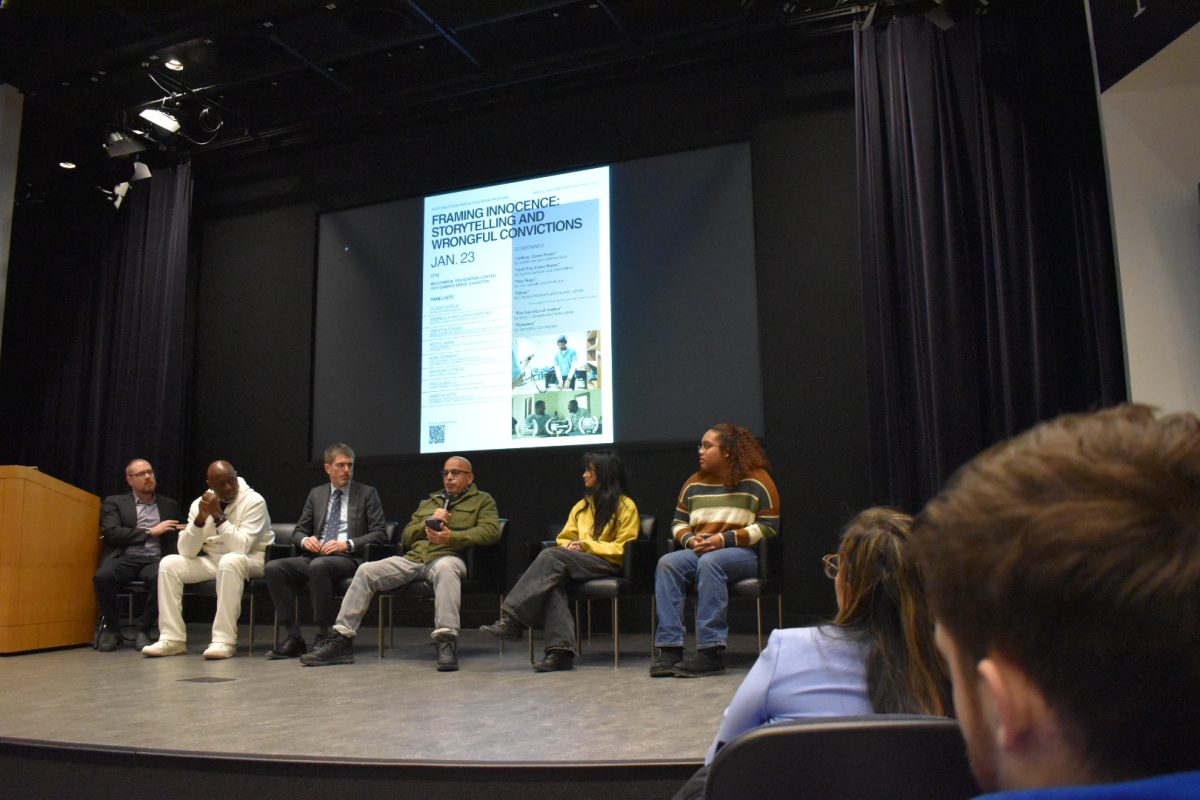
A panel of current and former incarcerated individuals, family members, a legal expert, a student filmmaker and a Northwestern faculty member spoke about incarceration, wrongful convictions and the power of storytelling Friday, following the screenings of four documentaries that explored the experiences of incarcerated individuals in local jails.
The event, “Framing Innocence: Storytelling and Wrongful Convictions,” showcased four documentaries that Medill School of Journalism students produced as part of the Documenting Carceral Injustice course. One of them, “Hey Hugo,” won the Best Documentary Award at the 2025 CineYouth Film Festival.
The discussion focused on the experience of being incarcerated while maintaining innocence, the systems most responsible for wrongful convictions and ways the audience could mobilize in response.
Keith LaMar, who called in from Ohio State Penitentiary with limited time, said he believes connectivity is important to having empathy for incarcerated individuals maintaining their innocence.
“The thing that’s most difficult when you are wrongfully convicted is the people who are punishing you don’t see it that way,” LaMar said. “You can go through everything that a guilty person will go through.”
Panelist James Soto is a Northwestern Prison Education Program graduate who spent 42 years in prison alongside his co-defendant and cousin David Ayala. The two were the longest-serving wrongfully convicted individuals in Illinois state history. Now, Soto works as a paralegal at Northwestern Pritzker School of Law.
He said while “it is wonderful to be on this side,” he and those close to him still tremendously suffered, and many continue to deal with the lasting effects of wrongful incarceration.
Karl Leonard, staff attorney at The Exoneration Project and a lecturer in law at The University of Chicago, said one of the biggest causes of wrongful convictions is “the obsession of the legal system with getting it over with instead of getting it right.”
“There’s this huge premium on finality, and you had your trial, and that’s it, and you’re guilty forever,” Leonard said. “And the burden is now on you to prove that you don’t deserve to be in prison, and all the cards are stacked against you, and it’s you against the state.”
Medill Prof. Brent Huffman, who teaches the documentary course as part of NPEP, said undergraduates collaborated with NPEP students at Stateville Correctional Center — which closed last year — and Sheridan Correctional Center to create films about the lives of incarcerated students.
“Their stories, as maybe many of you are aware, are often taken from them and retold in terrible ways by the carceral system,” Huffman said. “So, this is a chance to empower them to tell their story.”
The films traced how arrest, trial, lengthy prison sentences and failed attempts to petition for release affected the lives of incarcerated people and their communities. The documentaries explored both the individuals’ experiences inside prison and interviews with family members at home.
The films screened included: “Jeffery, Come Home,” by Esther Lim (Medill ’25) and Jankhna Sura (Communication ’24); “Until You Come Home,” by Sophia Jackson (Medill ’25) and Zella Milfred (Medill ’25); “Hey Hugo,” by Ysa Quiballo (Medill ’25) and Annie Xia (Medill ’25); and “Oliver” by Caroline Bomback (Medill ’25) and Daniela Lubezki (Medill ’24).
In addition to the student films, the organizers played “The Injustice of Justice,” a physical animation video available on YouTube by illustrator Molly Crabapple and narrated by LaMar. The video tells the story of how LaMar was accused of murder following the 1993 prison riot at the Southern Ohio Correctional Facility, though he maintains his innocence.
Family members of the incarcerated individuals spoke about the realities of missing their loved ones — from meals to funerals — and the empty holes their absences leave behind.
Quiballo, who co-directed “Hey Hugo,” said storytelling is important because it brings out underrepresented voices.
“It’s really easy to have conversations with just individuals, but when you really see all of the stories put together, you begin to see that this is not a unique story,” Quiballo said. “This is happening to so many people, and unfortunately, it is not a unique case for people to be wrongfully convicted.”
Email: [email protected]
Related Stories:
— Medill students, incarcerated classmates collaborate on award-winning ‘Hey Hugo’ documentary
— Formerly incarcerated individuals and educators discuss prison education and reentry at NPEP panel