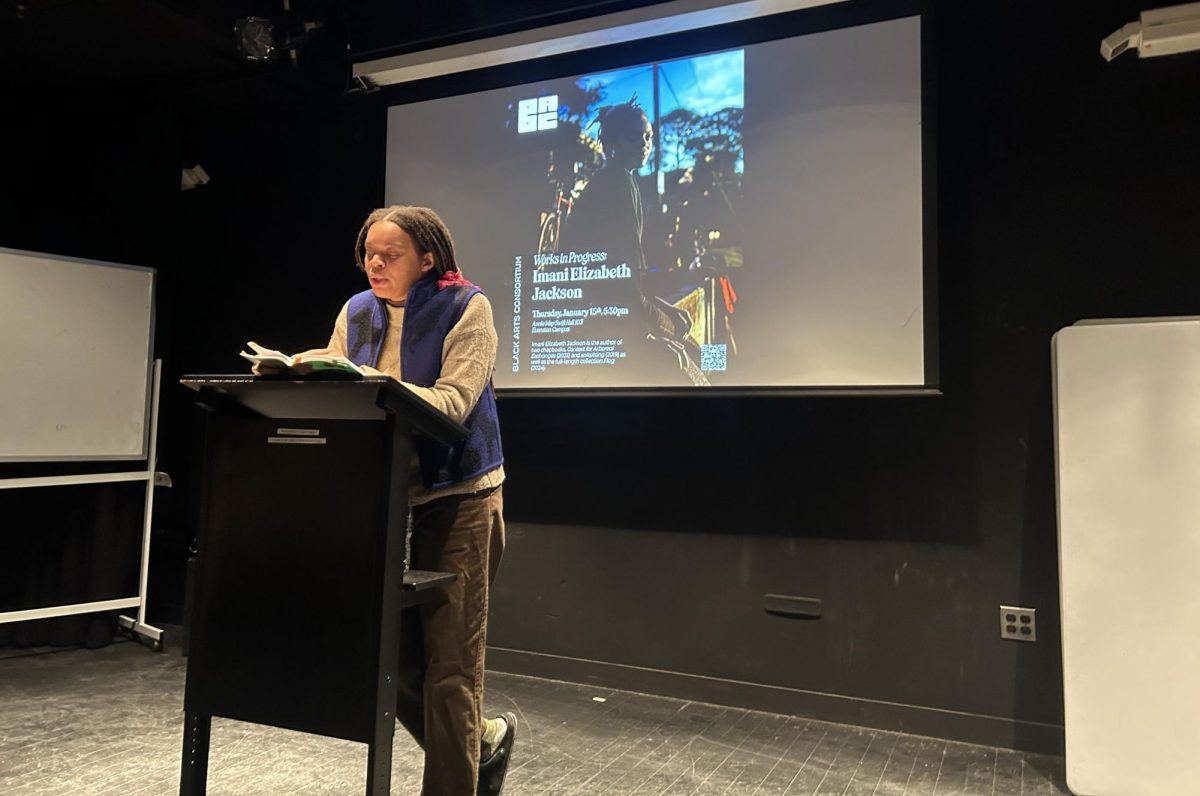
Chicago poet Imani Jackson shared works in progress and excerpts from her 2024 collection “Flag” during a speaker event organized by the Black Arts Consortium on Thursday evening in Annie May Swift Hall.
Jackson explored themes of family, nature and memory of place for about 15 attendees, then engaged in a Q&A afterward.
“I’m going to start with a dream, my grandmother,” Jackson said.
Jackson started with a poem about her grandmother’s home in Englewood, the neighborhood on the South Side of Chicago where her father grew up, and the impact it felt by a highway’s construction on it.
She also explored themes of memory and family relationships.
“The Garfield exit would come up, just beside the house,” Jackson said, as she read about the house’s former location. “And then I, decades later, would find myself at every possible occasion pointing as I came off that ramp saying, ‘Look, this is where my father grew up. Yes, right there.’”
Acknowledging the past year has been “a quiet, fallow time” for her, she said she has been working on poetry related to her new area of interest: prairies alongside Lake Michigan.
While earning her Master of Fine Arts at Brown University, from which she graduated in 2021, Jackson said she shifted from an original interest in oceans — especially in relation to the transatlantic slave trade — to rivers. Eventually, her passions shifted to what she called “the ghosts of the prairies that still exist around this city and landscape.”
At one point, Jackson shed tears while reciting a section about how her father grew up playing inside the construction zone. Jackson took a pause to wipe her eyes and joked to the audience, “I’m having an emotion.”
Jackson then read a poem about her connection to the Catalpa trees that once stood beside her father’s childhood home, touching on relationships between humans and nature, loss and the passage of time. She followed with a poem about the ecology of the prairies she has grown interested in. At several points, Jackson broke out into song, singing the words on her page. The last part of the reading included excerpts from “Flag.”
Director of the Black Arts Consortium and English Prof. Ivy Wilson said presenting a platform for Black poetry is “one of the pillars” of the group.
He also praised attendees for their questions.
“I’m really appreciative of the questions around craft,” Wilson said. “This was very different from what, oftentimes, we get in academic settings. I was going to ask a question about morphology, and not ecology, but I’m especially grateful for the ways in which the questions here were about the tactility and the physicality of writing.”
Third-year Black Studies Ph.D. candidate Allani Dye said Jackson’s exploration of ecology as a theme related to her work on intersections of environment, culture, storytelling and sustainability.
“I’m not a poet, but I’m looking to incorporate different kinds of literature into my work,” Dye said. “Knowing that Imani is a Chicago local was a great way to hear from a Chicago artist but also to speak and think with someone who understands the prairie.”
After the readings, attendees asked Jackson about her inspirations and writing processes in a Q&A. Jackson said she had a tendency to write, “either extremely slowly or in a huge burst all at once.”
She touched on constructing her work in fragments over time and stitching them together, and talked about learning how to utilize blank spaces in poetry.
“It was understanding that the total space of the page, not just the words on it, constitute the poem,” Jackson said. “Which is why when I read, I tend to include a lot of silence. That is what, for me, always threads the poem together.”
Email: [email protected]
Related Stories:
— Northwestern poetry night highlights trans writers
— 2026 Chicago Poet Laureate celebrates, critiques Chicago history