Volunteers stood with clipboards and tally sheets at more than 29 Evanston intersections throughout October, counting bicycles and scooters to assist the Public Works Agency in its update to the city’s Bike Plan.
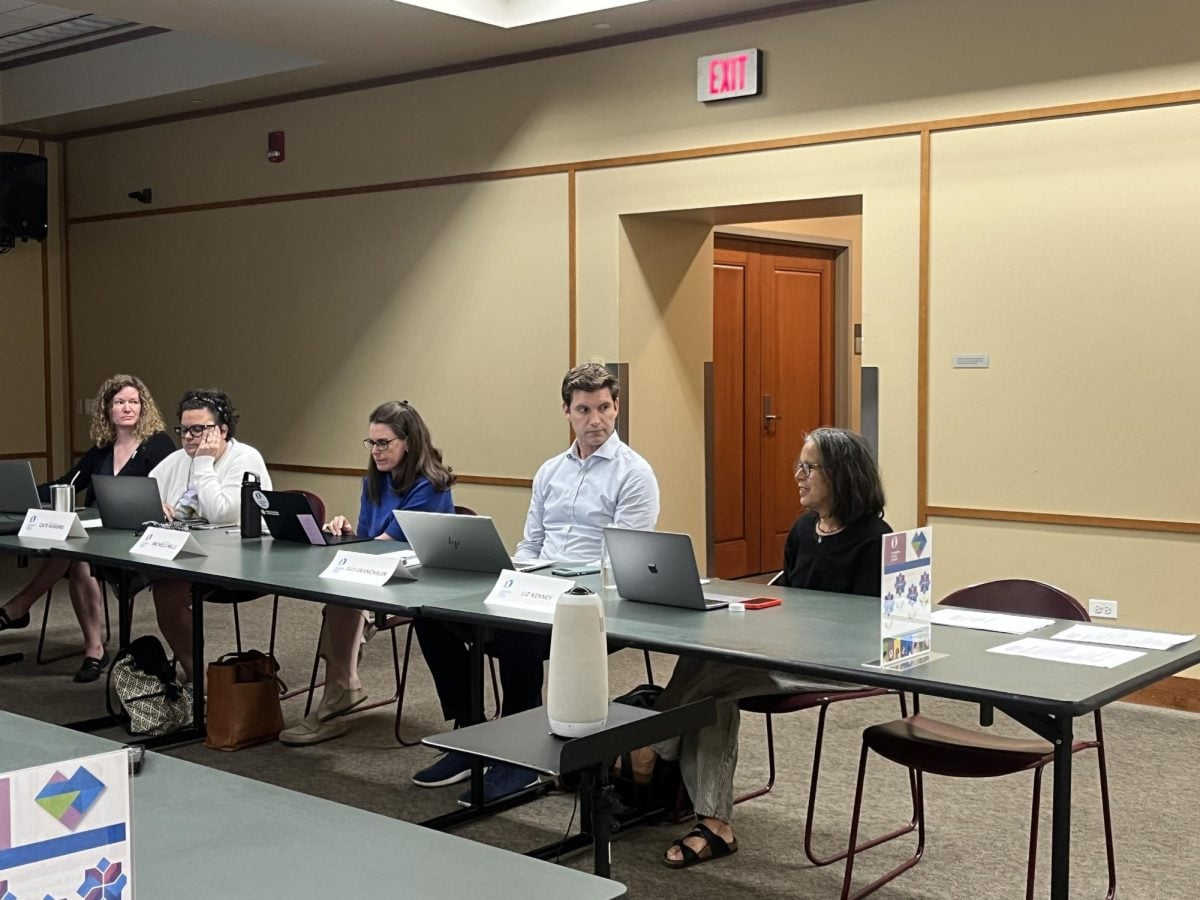
Project manager Chris Sous told City Council at its Sept. 8 meeting that the count will help Public Works identify corridors in need of infrastructure improvements. Traffic, crash and road safety data, along with city standards and community feedback, will also support the update.
The new Bike Plan will be the third since the bicycle system’s creation in 1974. Previous versions released in 2003 and 2014 were assisted by community counts at 13 intersections in 2001 and 20 in 2013. The latest iteration of the plan is set to be completed mid-2026.
“At least for the intersection I was working with, the number of bikes has multiplied considerably,” said 9th Ward resident Jeff Balch, who counted at Dodge Avenue and Oakton Street.
The intersection lies northeast of Dawes Elementary School, a location that saw a 177% increase in tallied ridership between 2001 and 2013, according to the city’s 2014 Bike Plan Update.
Since 2013, ridership has nearly doubled again, Balch added. He said he looked at the data from the last count to compare his numbers.
“There’s also a rise from almost no scooters to a lot of scooters,” Balch said.
During Balch’s two-hour counting period on a weekday morning, 10 of the 68 vehicles tallied — about 15% — were scooters.
The increase aligns with the rapid spread of e-scooters over the last decade. Five-year Census Bureau estimates show a steady rise in alternative transportation, including scooters, in residents’ commutes. About 0.9% of residents used some form of alternative transportation in 2023 compared to 0.6% a decade prior.

A point of focus for the updated Bike Plan is the improvement of east–west corridors, a topic Ald. Shawn Iles (3rd) stressed during the September council meeting.
Balch connected these improvements to observing the vast majority of ridership at Dodge and Oakton traveling north–south rather than east–west.
“It has partly to do with the high school and the downtown being a destination,” Balch said. “But it also has to do with how it feels.”
During two days of observation at the intersection, Balch recorded that every rider coming from the west used the sidewalk instead of the street. He said this was likely due to the roadway feeling unsafe.
Third Ward resident Nathaniel Al-Najjar, counted at the intersection of Church Street and Chicago Avenue. He described similar problems with the downtown portion of Church Street — the east–west thoroughfare is little more than a “bit of paint,” he said.
Al-Najjar advocated for a protected bicycle lane on the street, where a barrier — often a curb or bollard — sits between drivers and cyclists.
In much of Evanston, however, such a lane does not exist. Three-quarters of the roadway bicycle system is served only by signs, especially on east–west corridors, leaving cyclists to ride on the street or sidewalk. East–west signed routes alone make up 44% of all street bicycle infrastructure. North–south routes, by contrast, account for two-thirds of protected lanes.
Lincoln Street, one such signed east–west route, will be updated soon, according to Sous.
“So many people use it,” 7th Ward resident Chris Kramer said. “It just blew me away that all we had was those green signs.”
Lincoln Street is a high-speed road for cars due to its width, and signs are inadequate to protect bikers, he said.
Kramer counted at Asbury Avenue and Lincoln Street, a location not included on the city’s official list. The unofficial count was led by community members also part of the Evanston Transit Alliance, an organization Kramer, Balch and Al-Najjar are all part of.
The city had two official counts at intersections on Lincoln Street. They form the northern edge of a large gap in the intersection map, mostly consisting of signed routes. Community members did the supplementary counts because they felt the city was “missing a lot of people” with its official intersection list, according to Kramer.
The area is also important for interconnectivity with Skokie, Wilmette and regional trail systems, a topic Ald. Juan Geracaris (9th) emphasized at the September council meeting.
With Evanston bicycle ridership falling well above regional and national averages, Kramer and Al-Najjar agreed that the primary goal of their work should be making life with a bicycle easier.
“If I wasn’t going to be … scared for my life by the lowest common denominator drivers every day, then maybe I would get on a bike,” said Al-Najjar, who jokingly called himself a part of the ETA’s “pedestrian subcommittee.”
Balch, an avid biker who raised his children without a car, advocated for protected lanes like those on Dodge Avenue, dismissing complaints about traffic slowdowns it may cause.
Cars going slower is good for everyone, he added.
“I’d love to see the city move in a direction of encouraging bicycle use in any way it can,” he said. “These bike counts are all about continuing to improve.”
Correction: A previous version of this story misstated the Evanston Transit Alliance’s involvement in conducting supplementary bicycle counts. The Daily regrets the error.
Email: [email protected]
Bluesky: @ryaninevanston.bsky.social
Related Stories:
— Chicago Avenue bike lane project sparks tension among businesses, residents
— Chicago-area biking groups push for bike trail upgrades, sustainable infrastructure