An Israel Defense Forces reservist born in the U.S. debated with students about the Israel-Hamas war at a table by The Arch on Friday afternoon, jointly organized by the Coalition Against Antisemitism at Northwestern and the Chicago Jewish Alliance.
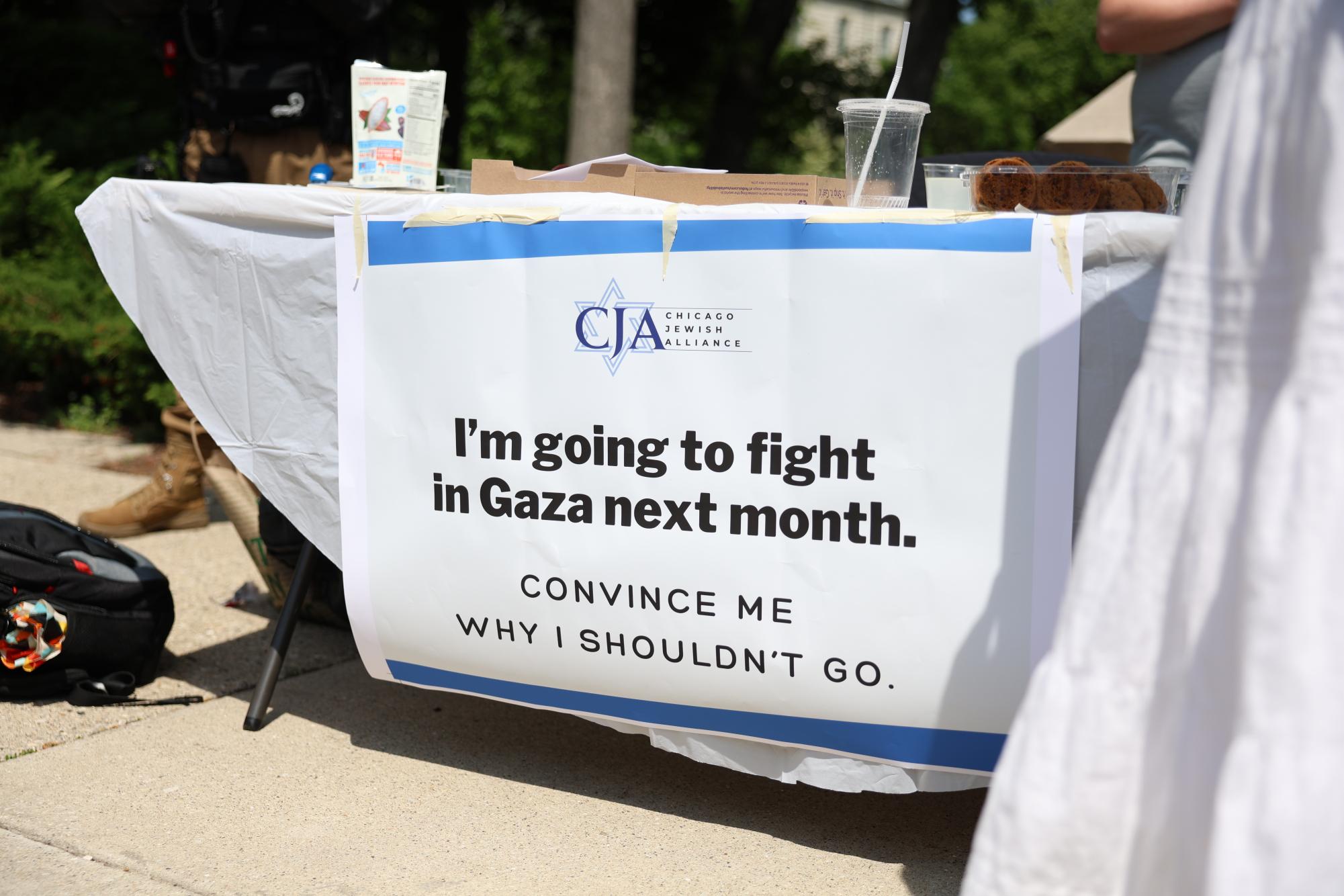
Eli Wininger, who was previously deployed to the Palestinian territories during the Israel-Hamas war, sat at a table guarded by private armed security with a sign reading, “I’m going to fight in Gaza next month. Convince me why I shouldn’t go,” as he invited students to exchange ideas with him on the conflict.
“It’s one thing to hear propaganda on TikTok, but it’s another thing to talk to someone who has been there,” Wininger told The Daily. “I’m a firsthand source at the end of the day.”
The Israel-Hamas war began on Oct. 7, 2023, after the militant group Hamas attacked Israel from the Gaza Strip, killing about 1,200 civilians and soldiers, according to Israeli officials. The IDF launched retaliatory military operations in Gaza following the attack. More than 72,000 Palestinians have died thus far in the conflict, according to Palestinian officials.
In October, Israel and Hamas reached a ceasefire, which secured the release of all remaining Israeli hostages and led to the limited withdrawal of Israeli forces from Gaza. Despite the ceasefire, the IDF has killed hundreds of Palestinians in the months since, according to Palestinian officials.
Following his return from deployment in March 2024, Wininger has visited multiple universities with the same goal: to host civil dialogue with students in order to combat what he described as rising antisemitism, especially through online rhetoric.
He said he believes it is important for students to hear eyewitness accounts from both sides of the war, regardless of which one they agree with.
“If a Palestinian who came out of Gaza and wanted to talk to students and share their firsthand perspective, that would be really fascinating, insightful and something that they should listen to,” Wininger said.
Wininger, who encountered many NU students with whom he disagreed, said he is trying to humanize IDF soldiers.
In an interview with The Daily, he complimented NU students who debated him from noon to 5 p.m., despite multiple strong reactions to his presence from students and passersby on Sheridan Road. Wininger said he wanted to keep the conversations civil and remain calm even during heated exchanges.
“I’ve been called enough names that eventually it just bounces off,” Wininger said.
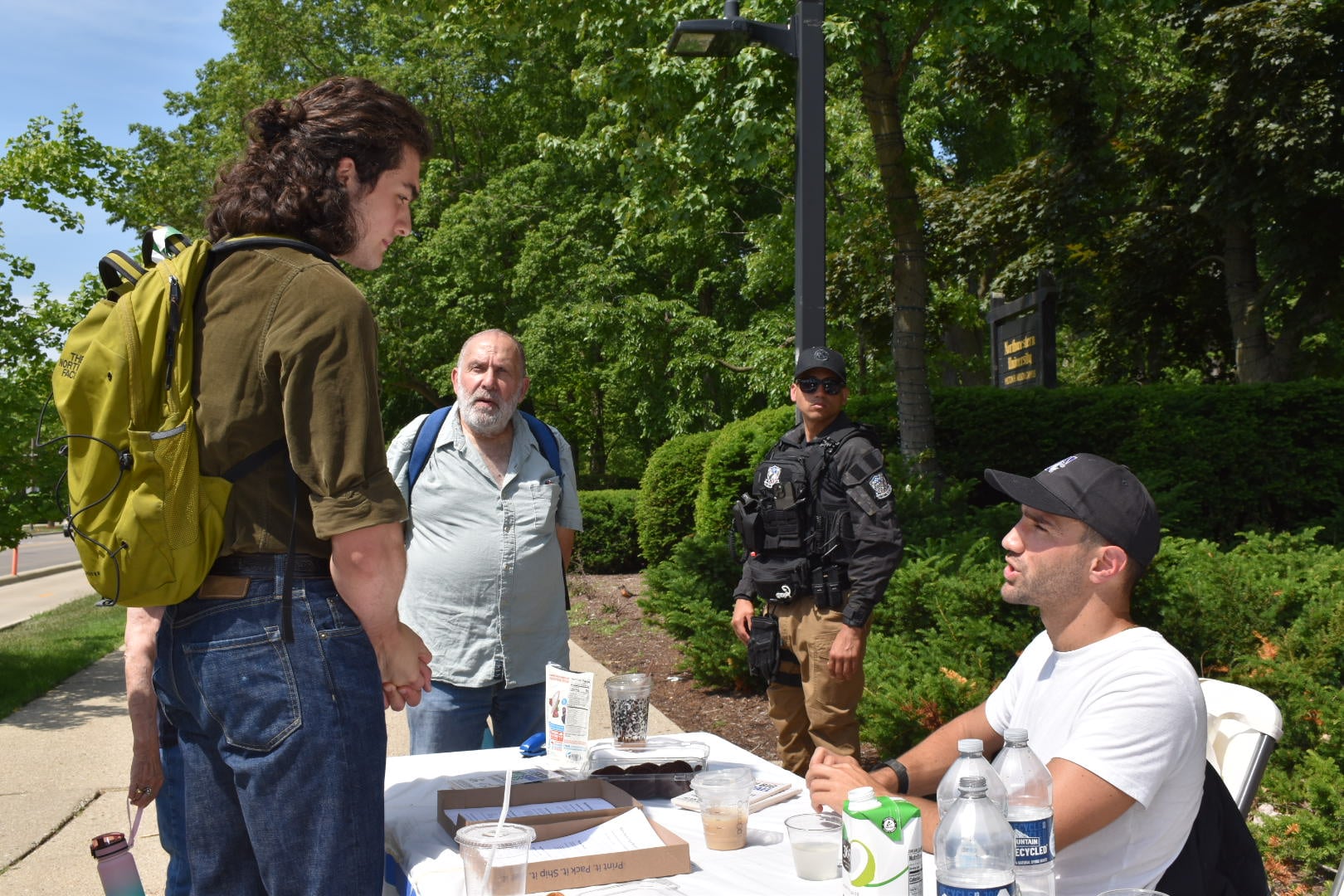
Students engaged in a wide range of conversations with Wininger and each other about the war, expressing both support and skepticism toward his arguments. Reactions ranged from expressing solidarity with Wininger and organizers to periodic heckling from spectators who shouted commentary without approaching the table.
First-year Ph.D. student in civil engineering Nate Blum said he discussed whether the deaths of Palestinian civilians can be defined as a genocide. Wininger said they cannot, while Blum disagreed.
“It’s a very narrow definition of genocide that he uses that doesn’t take into account the cultural aspects, the squalor that these people are forced to live in, the encroaching influence of the IDF into their homes and their daily lives,” Blum said. “All of these things that are designed to stop them from living their lives as Palestinians.”
McCormick junior Samuel Feldman, who also spoke to Wininger, said it provided an opportunity for students to civilly discuss the conflict without animosity.
He contrasted the event with the 2024 pro-Palestinian encampment on Deering Meadow, which he said led to hostility toward Jewish students. He said he was disappointed by the University’s handling of the encampment.
“Seeing how Jews were treated during the encampment and the lack of responsibility of the administration at Northwestern has led me to believe that the only real place that you can feel comfortable and safe in (your) own skin is in Israel,” he said.
Feldman said while he avoided the encampment, many of his friends told him they were spat on and pushed around by people at the encampment.
CAAN National Chair Lisa Fields said her group set up the table to combat what she called “problematic” anti-Israel sentiment on campus, and that Wininger’s visit was “an effort to not inflame, but to inform.”
Fields, who helped establish CAAN in 2023, said the organizers contracted an individual to create social media content for the event. The individual could be seen holding a camera and interviewing attendees. Segments of debates have already been posted on Wininger’s Instagram.
Fields said she has seen a lack of “diversity of thought” in NU students, and hopes learning about Wininger’s experiences will inform students about conflict in the region.
“As a parent at Northwestern, I have witnessed tremendous misinformation, disinformation and in many cases, indoctrination of a group of students who are otherwise really fabulous,” she said.
Weinberg first-year Marc Jinich said he approached the table out of curiosity, as he was familiar with the host organizations.
Despite the potential for the event to be controversial, Jinich said it was “empowering” to watch students “reasonably” debate the issue. Jinich said he would like to see more of these types of conversations on college campuses.
“He’s listening to what other people have to say,” Jinich said. “No one is screaming, no one is heated at all.”
Blum said he felt the event was designed for clicks, with a debate format that he felt was unfair and “underhanded,” given the time Wininger had to prepare his arguments with statistics and historical facts.
Blum said he felt the organizers intended to curate misrepresentative video compilations of students who would be made to appear uneducated on the subject matter.
“It’s not an academic debate. It’s a debate for TikTok,” Blum said.
Max Turetzky contributed reporting.
Email: [email protected]
Email: [email protected]
Email: [email protected]
X: @Summer_Huu
Related Stories:
— Pro-Palestinian student activists look to future after federal funding deal