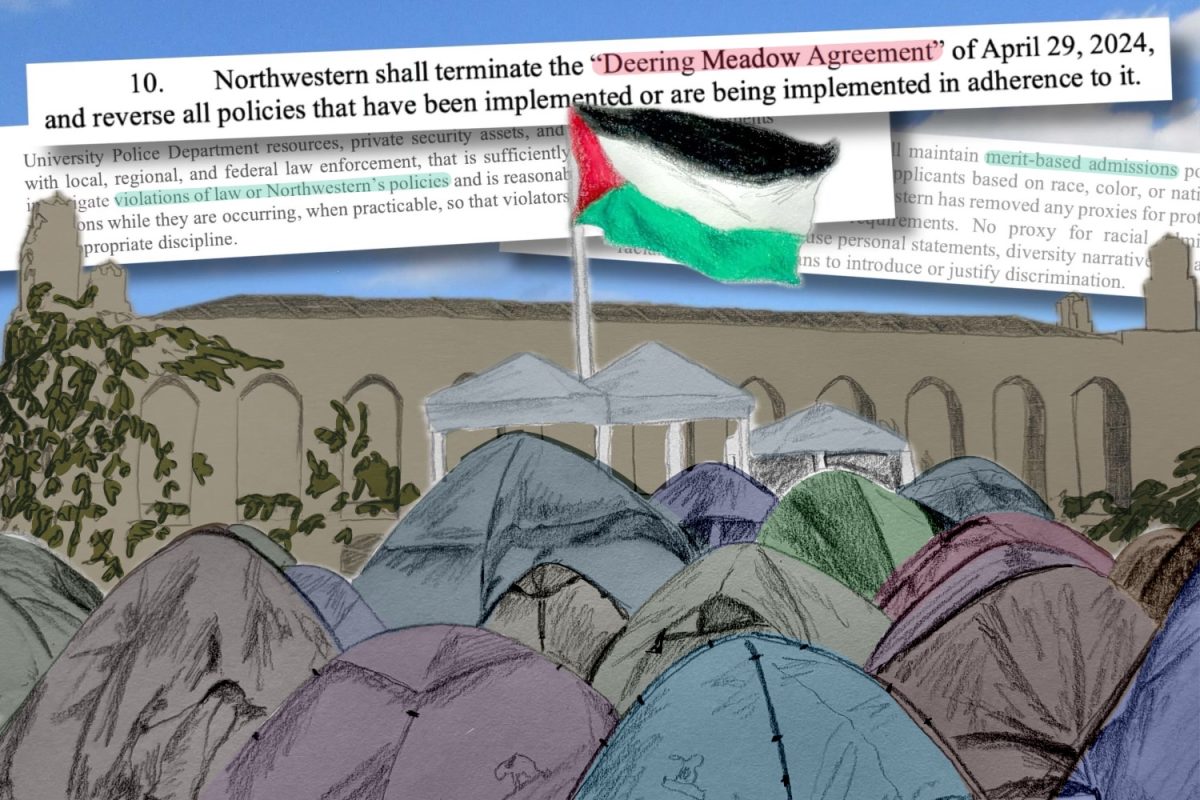
On April 29, 2024, Northwestern reached the Deering Meadow Agreement in response to encampments on campus by pro-Palestinian student groups.
Today, pro-Palestinian student activists are preparing for the future of their advocacy following the University’s termination of the Deering Meadow Agreement as part of the Nov. 28 deal with the Trump administration to restore federal funding.
The November agreement states the University will “not use personal statements, diversity narratives, or any applicant reference to racial identity as a means to introduce or justify discrimination.”
“If I personally had known Northwestern would make a deal with the Trump administration, I never would have applied here in the first place,” said a student participant in the Deering Meadow encampment.
The student participant, who requested anonymity for fear of retaliation from University and federal authorities, said they felt the deal opposed NU’s values of equality and justice.
They added that the deal reversed the progress achieved by equality initiatives and programs.
“I think that the deal has taken away a lot of the ability of students to speak out and speak freely,” the student participant said. “There is a constant fear of being doxxed, being attacked or being criminalized for speaking out on an issue they feel passionate about.”
However, they said they believe there is still a future for pro-Palestinian student activism.
The student participant said their experiences from the encampment, along with those of other activists, will help them face future obstacles the deal may introduce.
“Part of the future of activism is building strong communities, remaining connected and practicing empathy,” the student participant said.
Another student activist, who requested anonymity for fear of retaliation from University and federal authorities, said that due to increased surveillance from NU and federal authorities, they felt that students could not voice certain views in the current political climate.
But the student activist said they also believed openness about those views was a way to encourage more people to join their cause.
“When you say words like ‘apartheid,’ ‘settler colonialism,’ ‘genocide,’ those are alarming to people, and they’re not dramatic by any means,” the student activist said. “I think if more people are willing to say those things when they’re aware of the risks, that is inspiring to people.”
Debate over such terms has circulated not only on campus, but worldwide. Some intergovernmental organizations, like the United Nations’ Independent International Commission of Inquiry on the Occupied Palestinian Territory, including East Jerusalem, and Israel, label Israel’s military action in Gaza since October 2023 a genocide.
Some organizations, such as B’Tselem – The Israeli Information Center for Human Rights in the Occupied Territories, have described Israel’s actions as apartheid and restricting Palestinians’ rights.
According to the Anti-Defamation League, an international advocacy group that aims to combat antisemitism, allegations of apartheid and genocide are inaccurate and mischaracterize Israel rather than providing legitimate criticisms.
Still, campus activism remains inclusive and rewarding, the student activist said, and that peer mentors played a critical role in their education on community organizing.
Although they said they thought repression of student activists would become worse following the federal agreement, they said the importance of the causes they organized for could energize activists in the future.
“What we’re fighting for is so much greater than any agreement or demonstration rules that the University can put in place,” the student activist said.
Weinberg senior and Jewish Voice for Peace member Evgeny Stolyarov criticized the NU’s deal with the federal government and said its language fosters fear among the community.
The federal funding deal reversed all policies previously agreed to in the Deering Meadow Agreement, as well as included language on maintaining security to address and discipline violations of University policy and requirements to provide disciplinary records of student visa holders that result in suspension, expulsion or arrest, to the extent permitted by Family Educational Rights and Privacy Act.
“The University does not want change to happen,” Stolyarov said. “We have to pressure them, and we can only do that if we are not afraid of them. Part of our work has been making it clear that we cannot be intimidated, and we cannot be silenced by this university.”
Despite frustration regarding NU’s deal with the federal government, Stolyarov said he believed that JVP’s work is important to disrupt narratives about anti-Zionist Jewish activism and helps create solidarity with Palestinians.
In October, NU Graduate Workers for Palestine filed a class-action lawsuit against the University over the required bias training, alleging the training included an “unscholarly and discriminatory definition of antisemitism.”
A GW4P member and fifth-year Ph.D. candidate at The Graduate School, who requested anonymity for fear of retaliation from University authorities, said they believed the federal agreement confirmed their concerns about how NU’s censorship of Palestinian activism would lead to the repression of other groups on campus.
“The way in which the pro-Palestinian movement has been repressed is scandalous, outrageous and unacceptable,” the GW4P member said. “We’ve been crying and screaming that this would open the door for other forms of repression.”
A University spokesperson wrote in a statement to The Daily that NU is “committed to free expression and is guided by our policies on demonstration, display and solicitation, and discrimination and harassment.”
A SESP junior and inactive member of Students for Justice in Palestine, who requested anonymity for fear of retaliation from University and federal authorities, said they have met people who had changed their mind on Palestine because of pro-Palestinian organizing, which they said was “always encouraging to see.”
Still, the anonymous GW4P member said that “with regard to the genocide in Palestine, (they) could not be more heartbroken and disappointed and just devastated by the overall loss,” despite believing that speaking out does have an effect.
“I don’t think it was useless,” the GW4P member said. “But it’s very difficult to call these little victories ‘victories’ in the context of the immense lack of responsibility … (and) the ruthlessness with which the West deploys its imperial power to the detriment of such huge numbers of people who suffered.”
The SESP junior said the deal was a testament to the power of student activism.
They added that their activism as an SJP member and the federal funding deal showed them how important it was to continue applying pressure to University administration to hold them accountable.
“The agreement, more than anything else, shows that the federal government is scared of that power,” they said.
They also said that while the activism they have been involved in was “inherently polarizing,” it also meant more community members considered why issues were important to certain people.
They said that while post-encampment activism needs new methods, arguments and increased public solidarity to continue activism in light of the federal agreement, they, along with other student activists, feel “a mandate to keep going.”
The SESP junior said they believed the Deering Meadow encampment was the most important moment in student activism in decades.
“And it still wasn’t enough,” the SESP junior said.
Email: [email protected]
Related Stories:
— One Year Later: NU reflects on pro-Palestinian encampment that changed student activism