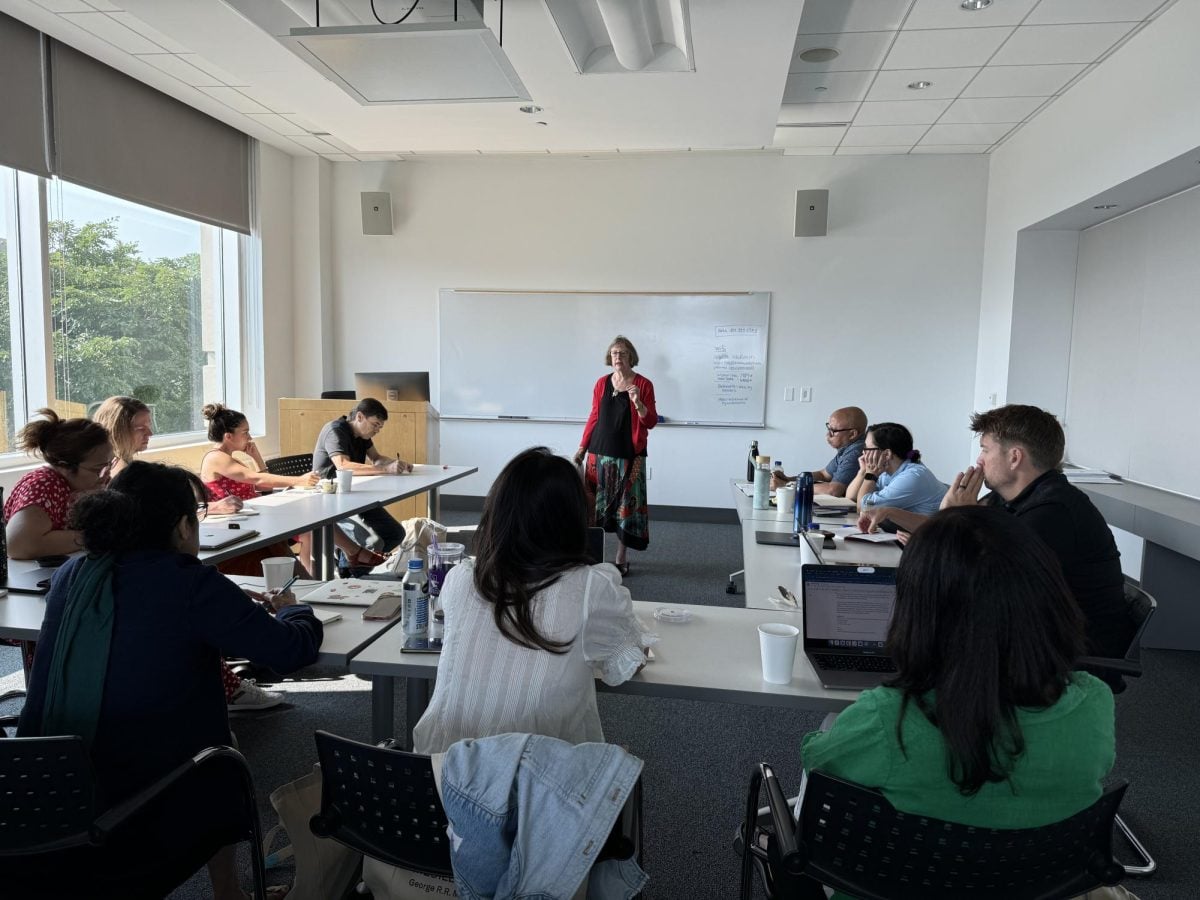
The final session of the Litowitz Center for Enlightened Disagreement’s new undergraduate certificate took place last week.
Piloted this year, students had the opportunity to earn the “Residential Program in Enlightened Disagreement” certificate by attending a series of six modules throughout the year, with two every quarter.
From learning how improvisation techniques apply to dialogue to hearing from “How Minds Change” author David McRaney, students learned skills around hosting constructive and respectful dialogue on sensitive issues.
“From the first module, I was sold,” McCormick first-year Yihuan Zou said.
Zou said as an international student, she hoped coming to Northwestern would mean encountering and engaging with people from different backgrounds with varying perspectives.
Litowitz Center co-Director and Kellogg Prof. Nour Kteily said the program aims to help students build courage to express their perspectives in conversations without feeling uncomfortable.
“The view here isn’t just that everybody becomes more politically centrist, or certainly not that people feel shyer about expressing their political perspectives,” Kteily said. “It’s actually the opposite. The goal is to make people feel empowered to speak their mind.”
Litowitz Center co-Director and psychology Prof. Eli Finkel said the leadership team purposefully had students begin in the fall with simple lessons about listening and communication before throwing them in the “deep end” with discussions during Winter Quarter.
He said he was impressed with how students managed difficult conversations.
“We had a couple of tricky conversations. We had some tears. And I just have to say, I’m just really impressed with the students in the program,” Finkel said. “We’re not trying to build a world where conversation is never difficult. On the contrary, we’re trying to build a world in which people are able to get the most out of the conversations.”
Weinberg first-year Michelle Kishinevsky said although she was unfamiliar with the idea of “enlightened disagreement” before the program, she came out of it a better listener.
Kishinevsky said the skills taught in the program are especially important in what she described as a polarized society.
“This program really allowed students from different backgrounds to, through every module, just sit down and have conversations with one another,” Kishinevsky said.
Communication first-year Sonia Saega said she was impressed by the program’s organization considering it was the pilot year.
Saega said while the program is important in terms of engaging with current events, the skills taught are relevant to bridging differences at any point in time.
“When you actually get to talk to people who have a different position, you realize that basically, we’re not that different,” Saega said. “It’s just that some values are prioritized in a different order.”
Kishinevsky said although they discussed some contentious issues throughout the program, students’ shared motivations resulted in constructive conversations.
“Knowing that everyone in there was there for the same reason, and that is to learn how to have these open conversations and communicate, definitely also made it easier,” Kishinevsky said.
Kteily said in another module, students were asked to rant for one minute about an issue they cared about to another person. Then, their partner had to summarize what they had complained about without saying anything negative.
For example, Kteily said if one partner complained about people talking on speaker phone on the subway, then the other partner could discuss how the first person values respect and courtesy in common spaces. The practice would allow participants to see the “underlying positive value” of someone’s rant, he said.
“I thought that was a very good way to truly understand how to actively listen to someone rather than just thinking about what you’re going to respond with while talking to another person,” Kishinevsky said about the module.
Saega said she plans to apply to be an undergraduate fellow for next year.
She added that while she heard some people claiming the program was “teaching us how to think,” she said she believed it was equipping students with strategies that they had the choice of applying to their daily lives.
“You have to have your own filters of how you will apply this,” Saega said. “But I definitely think it’s useful.”
Email: [email protected]
Related Stories:
— Point Taken merges psychology, emotion to foster calmer disagreements
— Northwestern gifted $20 million for Litowitz Center for Enlightened Disagreement
— ‘Safety in numbers’: Liberal NU students discuss consensus politics, cordial disagreement