Northwestern experts reiterated the importance of flexibility when navigating the rapidly changing landscape of a world powered by artificial intelligence on Tuesday.
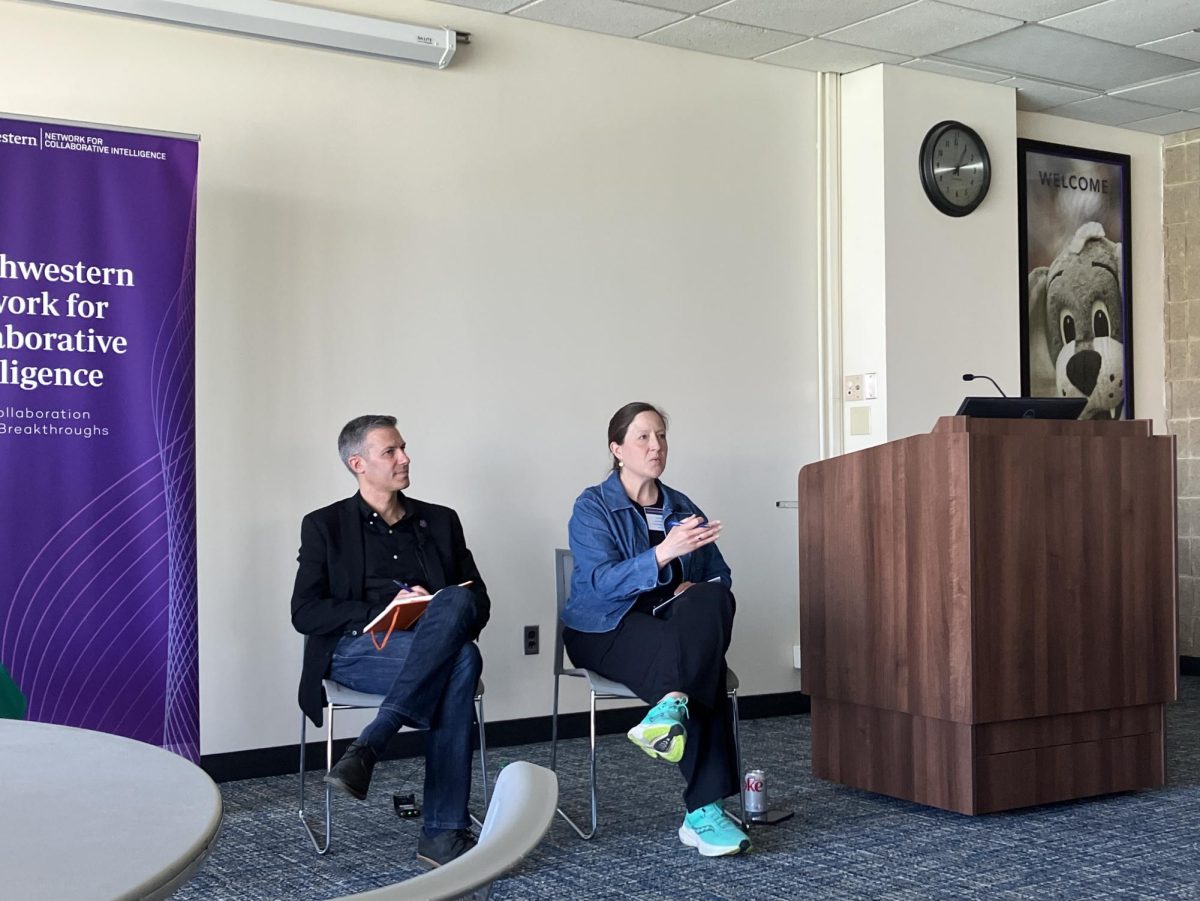
The “AI & The Future of Education” panel featured Medill Prof. Jeremy Gilbert and McCormick Prof. Sara Owsley Sood. Associate Provost for Undergraduate Education and McCormick Prof. Karen Smilowitz moderated.
“AI is not something anyone can ignore, even if you don’t want to use it,” Smilowitz said.
Gilbert and Sood both serve as education pillar leads of the Northwestern Network for Collaborative Intelligence, a University initiative promoting interdisciplinary AI and data science research. The panel is part of a series of events hosted by NNCI.
Sood, who is the associate chair for undergraduate education in McCormick, said the challenge AI poses to educators is unique in how quickly models develop.
“A new model comes out,” she said. “We put a Band-Aid on it and figure out how to adapt our classes, and then six weeks later, that Band-Aid is ripped because another model comes out.”
Sood said that AI’s evolution provides an opportunity for educators to reflect not only on the skills they hope to impart on students but also the ways in which they can assess and motivate them.
The introduction of AI into classrooms has also raised the question of how AI intersects with learning outcomes, Gilbert said, according to the results of an internal survey that a student shared with him in 2023.
“One of the things that came up over and over again was not just whether students were willing to use the tools, but a fundamental question of what it was that they were supposed to be learning in any individual class,” Gilbert said.
The panelists also emphasized the importance of providing opportunities for everyone at the University to engage with AI.
NU has woven AI education into programs at both the graduate and undergraduate levels, including a MBAi degree for Business & Artificial Intelligence, a joint MBA degree from McCormick and the Kellogg School of Management.
McCormick also announced a new AI major in March. Students can declare it starting Fall 2026.
“Everyone needs to be educated at some level in AI,” said Sood, the AI major program director.
In the future, Sood said she imagines there being a three-course sequence for all undergraduates to take regarding AI use. The sequence may include a general overview of the technology, the ethics of AI use and a third course determined by the students’ area of study, Sood added.
The way NU adapts AI for its curricula also holds relevance to prospective students, Gilbert said.
During Monday’s Wildcat Day, where admitted students visited and experienced a day on campus, Gilbert said prospective students and their parents asked many questions about NU’s plan to prepare students for entering a workforce influenced by AI.
“It’s a really scary time to start college when you have all of these existential questions about what the job market’s going to be like,” Gilbert said.
Similar to what Sean Mooney, the director of the Center for Information Technology at the National Institutes of Health, said at an NNCI panel on April 7, Sood said it’s important to think about how AI can be an “amplifier” rather than a replacement for human actions.
Despite the moment being “transitory,” Gilbert said, both he and Sood said they believe certain facets of education remain consistent despite AI’s rising prominence.
“The one thing that’s not going to change is our students’ and graduates’ need to communicate their ideas to the world,” Sood said.
Email: [email protected]
Related Stories:
— Experts express optimism for future of AI in research and innovation