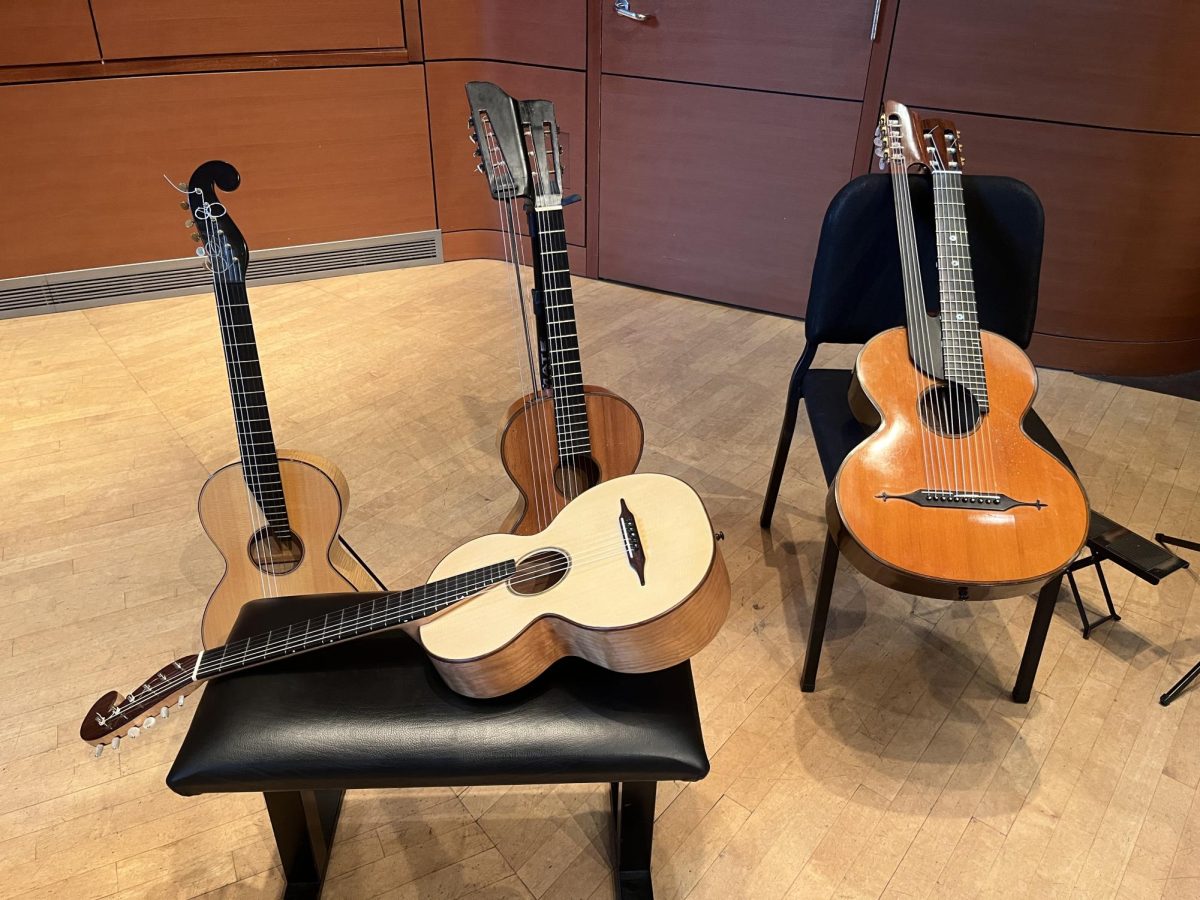
With guitar music and performances of literary texts intertwined, the McClintock Choral and Recital Room became a 19th-century parlor for almost two hours Sunday.
The event, “Performing in the Parlor: The Golden Age of Guitar and Elocution,” mixed a repertoire of 19th-century music pieces with literary texts — a common combination in the U.S. at the time. Throughout the performance, Anne Waller, Mark Maxwell and Brian Torosian (Bienen ’89, ’95,’03) played on 19th-century Viennese guitar reproductions. Interspersed between the musical pieces, Fiona Maxwell (Communication ’18) performed selections of text.
“What we’re hoping to do with the concert is to kind of give audiences a sense of what it would have been like to attend a cultural event in the 19th century, specifically at Northwestern or in Evanston at that time,” Fiona Maxwell said.
Waller said she grew up listening to guitar recordings, and when she was 14 years old, she began classical guitar lessons. Today, she is a senior lecturer at the Bienen School of Music and has spent 45 years performing as a part of the Waller & Maxwell Guitar Duo with her husband, Mark Maxwell.
As the daughter of two guitarists, Fiona Maxwell said she also played music growing up. However, it quickly became obvious that her path would differ from her parents’ — even as a toddler, she wouldn’t stop talking.
“It was clear that I was going in the verbal direction,” Fiona Maxwell said.
She took an interest in not only theater, but also history, majoring in both during her time at NU.
She became especially interested in the NU archives about the School of Oratory, where elocution and oratory were taught.
“Through that archival research, I saw how my art form and my parents’ art form actually were like sister art forms,” Fiona Maxwell said.
During the pandemic, Fiona Maxwell, Mark Maxwell and Waller started performing together. They each have their own expertise, with Mark Maxwell and Waller focused on the musical aspects and Fiona Maxwell on the literary ones.
Although many of their performances have combined historical and contemporary pieces, Waller said “Performing in the Parlor” was strictly rooted in the 19th century.
“I would really like people to take away the fact that, yes, the guitar was in America almost from the beginning,” Waller said.
Waller, Fiona Maxwell and Mark Maxwell worked together to find connections between music and text and pair them together. For instance, a text about 19th-century American life was matched with American music, and a story of sailors getting shipwrecked in France was paired with French music. Making these combinations was a “fun puzzle” for the family, Fiona Maxwell said.
The family knew they wanted the event to be at NU, since the idea grew out of the University’s archives, Fiona Maxwell said. NU also has a history of early guitar performance and elocution, she added.
In fact, all of the texts adapted and performed by Fiona Maxwell for the event were also performed by NU students and faculty during the 19th century — with one exception.
“I recently uncovered this kind of oral history autobiography of this Italian woman immigrant who came to Chicago and, through settlement houses, became a really renowned storyteller,” Fiona Maxwell said.
This woman was Rosa Cassettari, and Fiona Maxwell adapted a moment from Cassettari’s spoken memoir for “Performing in the Parlor.”
For attendee Rania Adamczyk, this part of the performance was one of her favorites.
Adamczyk did theater with Fiona Maxwell when the two were kids, and she has enjoyed following Fiona Maxwell’s journey into historical performance, she said. Adamcyzk added she has also attended similar performances by the family.
“They were really intentional about pairing the music and the spoken performance pieces,” Adamczyk said. “It gives you an interesting window into life.”
Fiona Maxwell said these performances are important both to local history and the broader history of women and performance in the U.S.
“This art form of elocution, and also music, was a really important way that women, minorities, immigrants were able to kind of enter into public conversation,” Fiona Maxwell said. “Through the music they shared, they were able to show that they belonged in public in America, and that they also had valuable perspectives.”
Email: [email protected]
Related Stories:
— Alex Sampson stuns with charismatic crowd work and rich vocals at Reggies Chicago
— Curtain Call: Freshman Fifteen and The Bix synthesize for the vibrant ‘Shirts vs. Skins’