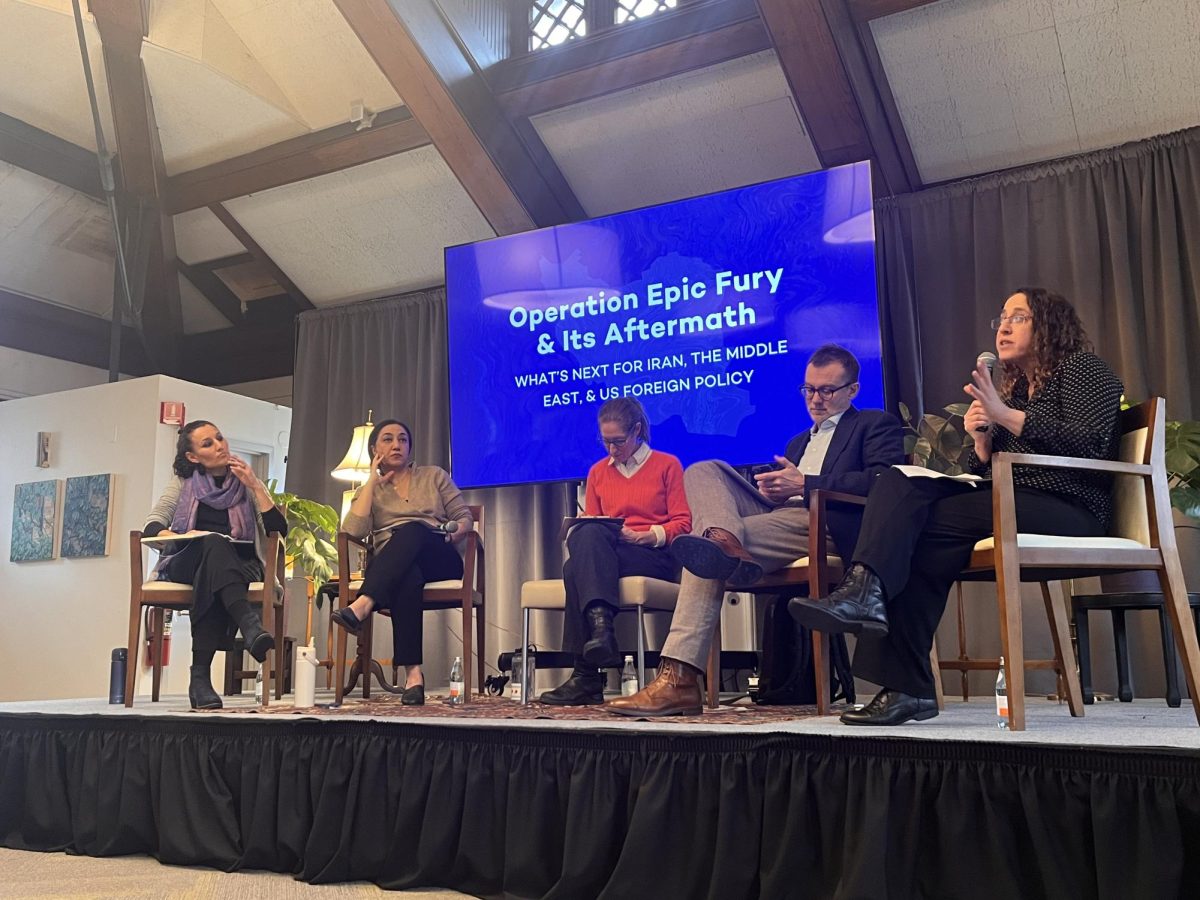
Northwestern faculty explored the context around Operation Epic Fury and its ramifications for the future of Iran and the Middle East region at the Roberta Buffett Institute for Global Affairs on Wednesday afternoon.
On Feb. 28, the Trump administration unleashed military operation “Operation Epic Fury” on Iranian security infrastructure to dismantle the “regime’s security apparatus,” according to a U.S. Central Command news release.
Political science Prof. Wendy Pearlman, who hosted the event, summarized the U.S. and Israel’s “new round of war” on Iran. She opened the stage for each panelist to give a five-minute speech and answer one question from Pearlman before engaging with audience members in a Q&A at the end.
SESP Prof. Shirin Vossoughi started the conversation by contextualizing the U.S.’s current military action in Iran with a modern history of conflict in Iran. She began with the 1953 coup backed by the U.S. and the United Kingdom against Iran’s democratically elected leader, Mohammad Mosaddegh, which led to the Iranian Revolution occurring between 1978 and 1979.
Since the revolution, Vossoughi said many Iranians have been challenging the Islamic Republic’s structures and policies.
However, she added that the United States’ current military action in Iran has become an obstacle for opposition groups to continue their efforts against “internal repression and external intervention.”
“Part of what I’m hoping you take from this is that Iran is not a passive society waiting for foreign intervention,” Vossoughi said. “At the same time, the success of the repression has made it very difficult for internal opposition to succeed in bringing about structural transformation.”
Global health studies Prof. Elham Hoominfar highlighted the environmental implications of the current military actions in Iran, citing recent damage by the United States to Qeshm Island’s desalination infrastructure in the Persian Gulf.
She recognized the growth of movements in Iran advocating for the environment, women’s rights, labor rights and minority rights.
However, she said these grass-roots organizations are currently limited in their capacity to protest change because of the conflict.
“These casualties of war are not only people and cities,” Hoominfar said. “This war is against our future, socially and environmentally.”
Crown Family Center for Jewish and Israel Studies postdoctoral fellow Shira Pinhas framed Israel’s involvement in current military actions in Iran within the context of its “long-standing efforts to prevent the establishment of an independent Palestinian state.”
She discussed how opposition by Palestinian parties to the Israeli-Palestinian conflict within the Israeli parliament has been “brutally repressed” by Israeli police.
“As my colleagues have shown, this war does not promote democracy in Iran and neither in Israel,” Pinhas said.
She finished her presentation by showing audience members an installation by Peter Sloterdijk and Gesa Mueller von der Hagen, “The Pneumatic Parliament,” which left audiences with a satirical impression of U.S. involvement in the Middle East.
History Prof. Michael Allen analyzed the rhetoric of U.S. foreign policy and its role in the current military actions in Iran.
“An explanation of this event must include a consideration of the United States,” he said. “It’s important that we reflect on ourselves and our role in this.”
Allen highlighted what he described as President Donald Trump’s tendency to favor military conflict and the history of American presidents to impose wars against “weaker peoples.”
He also acknowledged the growth of presidential power in foreign affairs since World War II, citing former U.S. Presidents Lyndon B. Johnson and Richard Nixon’s decision to prolong direct U.S. involvement in the Vietnam War until 1973 despite continued public protest.
“The longer (Trump’s military action in Iran) continues, the more unpopular he, and it, will become,” Allen said. “This may be the only barrier to his continuation of the policy.”
Email: [email protected]
Bluesky: @lucaskubovchik.bsky.social
Related Stories:
— ‘Another forever war’: Local Democrats condemn U.S. military attacks in Iran
— Ukrainian Club hosts student panel exploring impacts of Russian invasion at Buffett Institute event