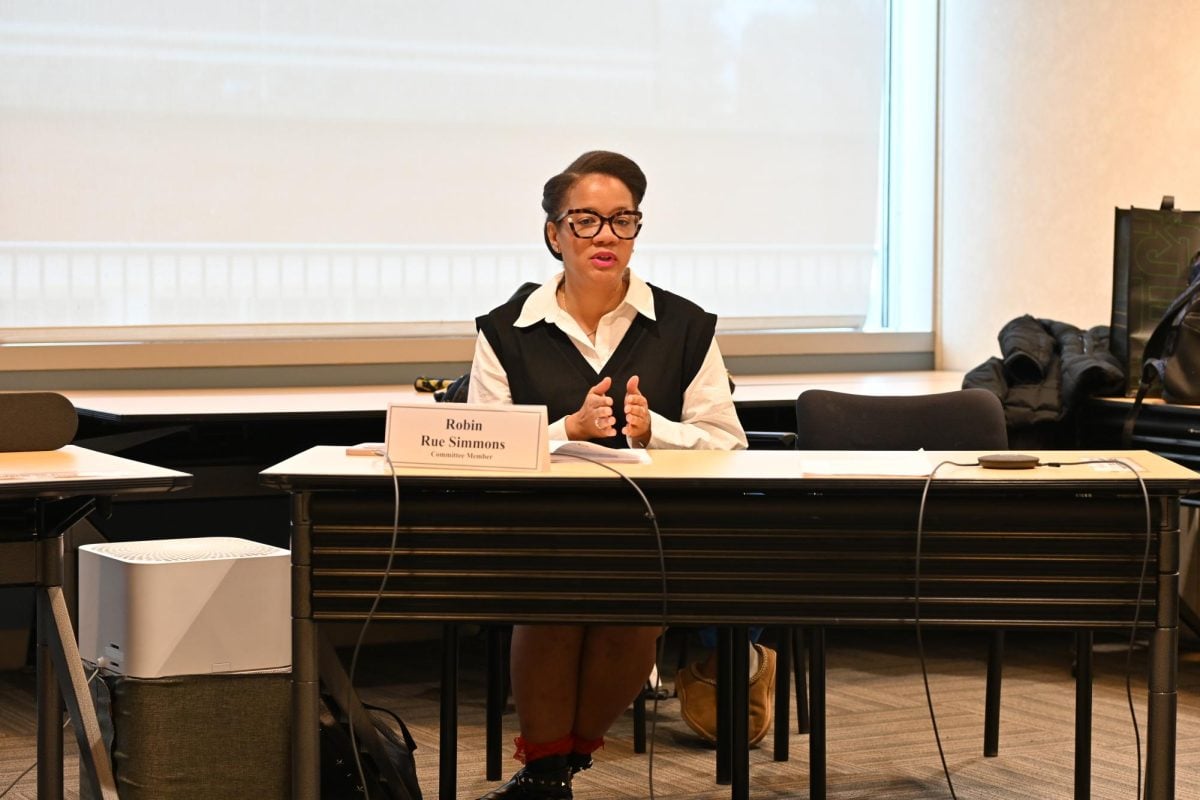
The Evanston/Skokie School District 65 Board of Education further scrutinized its multiphase deficit reduction plan Monday night, deliberating on student technology plans, school closures and special education programming.
Board deliberates on renewing iPads in schools
Members were asked to approve the purchase of 1,300 iPads and keyboard cases for student use next school year. Elena Cáceres, the district’s executive director of technology, presented a cost-cutting plan executed last academic year that allows iPads to be used by students for one additional year before getting repurposed or sold. This new plan cut a third of existing costs, Cáceres said.
District 65 currently purchases and provides an iPad for every K-8 student. Illinois mandates that all school districts ensure that students receive opportunities to gain computer literacy skills at each grade level K-12.
However, some parents who spoke during public comment Monday disagreed with the need to provide students with technology to be used both in the classroom and at home.
“My kindergartner doesn’t need a tablet,” said Kingsley Elementary School parent Colleen Egan. “He can’t even read.”
After the presentation, board members questioned the plan to purchase an iPad for each K-2 student instead of using tablet carts. Cáceres said additional purchases would need to be made in order to facilitate that change, in addition to class scheduling changes.
Board member Andrew Wymer asked for one school to pilot K-2 carts instead of individual tablets before the board moves forward on approving the plan.
Board considers future of Structural Deficit Reduction Plan
In February 2024, District 65 began implementing its three-phase Structural Deficit Reduction Plan, which reduced the district’s spending by $6.5 million during Phase 1 and $13.3 million during Phase 2.
The board has yet to complete Phase 3 of the SDRP, which aims to cut the district’s spending by another $10 to $15 million, but voted to close Kingley Elementary School and terminate Willard Elementary School’s Two-Way Immersion Program.
Board member Maria Opdycke suggested the name of the plan be changed to focus on the future of students rather than the deficit itself.
“I would like us to pivot our discussion to enhancing our learning environments via asset transformation and excellence, so this is essentially looking at our spaces as opportunities,” Opdycke said.
Board President Patricia S. Anderson agreed that members should focus on elevating educational spaces but stressed financial sustainability, urging the board to “keep that as a mantra.”
Kingsley’s closure resolution, adopted in January, also requires the board to reconsider closing Lincolnwood Elementary School following the 2026-27 school year, depending on the district’s financial and building capacity status in October.
Board Vice President Nichole Pinkard said regardless of whether board members supported or opposed closing Lincolnwood earlier in the process, each member should examine cost-cutting options.
“For those of you who believe that if we had just done the Lincolnwood plan, that is coming back on the table,” Pinkard said. “For those of us who didn’t vote for it, I think we have a responsibility to lean in and try to put some other ideas up.”
Community voices concern over special education funding
Recently, District 65 released an audit of the district’s special education programs and spending. The district’s special education spending has increased exponentially since the 2021-2022 school year, growing from $3.4 million to $6.1 million during the 2022-2023 school year and then about $7 million the following school year, according to the audit.
During a meeting last month, board members addressed rising costs, but during public comment Monday, several parents expressed concern that special education costs are being blamed for the deficit.
“Something has been weighing really heavily on many families, and that’s because in talks about the district’s deficit, blame too often is falling on one legally protected group of students, and that is children with disabilities,” Lincolnwood Elementary parent Alex Elliott said. “They are not the cause of this district’s financial problems. Special education is not optional programming.”
Board member Chris Van Nostrand asked during the board’s Feb. 23 meeting how District 65’s approach to special education would change if the district did not receive federal special education grants and therefore was not required to keep state and local expenditures the same or growing yearly.
He apologized for “any distress (he) may have caused parents” and clarified those comments Monday night.
“I stand fully behind our D65 students receiving special education services, whom we have a moral and legal obligation to support,” Van Nostrand said.
Email: [email protected]
Related Stories:
— D65 board standardizes transportation policy, approves hazard road designations
— District 65 board hears $13.2 million deficit reduction plan options
— D65 board unanimously votes to close Kingsley Elementary School