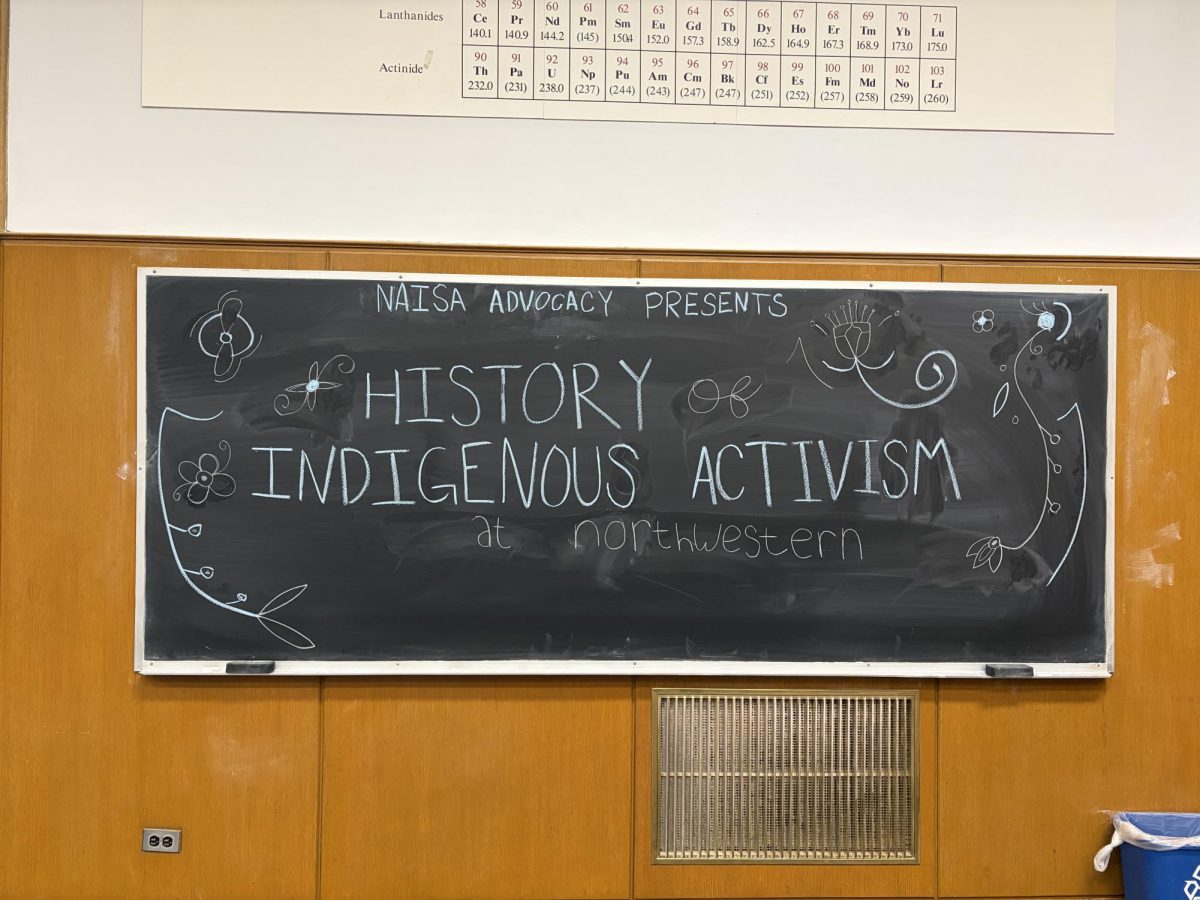
The Native American and Indigenous Student Alliance hosted a presentation on the history of Indigenous activism at Northwestern Tuesday evening.
“Preserving our history on our terms is something that’s really important and something that has been a collective priority for us in our existence at Northwestern,” Weinberg junior and NAISA Sustainability and Advocacy Coordinator Meadow Neubauer-Keyes said. “We’re still here, though we still face a lot of difficulties, whether from the community or admin. We’re still here.”
The presentation, titled “A History of Indigenous Activism on Campus,” covered Evanston’s Indigenous history. It specifically focused on John Evans, one of Northwestern’s co-founders, and his role in the 1864 Sand Creek massacre in Denver, Colorado.
Evans, the governor of Colorado at the time, told members of the Cheyenne and Arapaho tribes in the area to report to a military fort for safety and then issued a proclamation inviting white settlers to “kill and destroy all … hostile Indians.” Col. John Chivington then led an attack on the village, killing hundreds of Native Americans, mostly women, children and the elderly.
Weinberg junior and NAISA Marketing and Communications Chair Olivia England said she didn’t know much about Evans and Indigenous history at NU before joining the club, so she felt this event was important to share Native and Indigenous communities’ histories with the broader public.
“I knew of my own personal experience with anti-Indigeneity and my friend’s own experiences with that, but I wasn’t aware of how ingrained it has been since the start,” England said.
The event also covered NAISA’s efforts to preserve Indigenous history and culture on campus.
It concluded with a Q&A and an overview of NAISA’s goals for the future, which include advocating for the University to establish a Native American and Indigenous Studies major, create financial scholarships for Native American students and allow Indigenous languages to count for Northwestern’s language requirement.
The Associated Student Government passed legislation Feb. 18. Introduced by NAISA Senator and Weinberg senior Lula Fox, it urged the University to support students learning Indigenous languages.
Sixth-year history Ph.D. candidate Heather Menefee (Weinberg ’15) said she was inspired to start NAISA after taking a class with John Low, a visiting assistant professor from the Pokagon Band of Potawatomi tribe.
Menefee said Low asked his students to reflect on why NU didn’t have good existing relationships with tribes native to the area and encouraged them to start an organization to provide a space for Native students.
“At the root of Northwestern history and at the root of American history is the dispossession of Indigenous people and nations,” Menefee said. “As a person who wants to live ethically in the world today and be part of communities that aren’t violent today, you kind of have to be able to address our shared history.”
When Menefee started NAISA, she said there was no information about Evans’ role in the Sand Creek massacre available on the University’s websites, and NU celebrated his birthday. She added that at the time, there were rarely land acknowledgements before campus events, but they are common practice now.
Menefee said she felt like the University was trying to erase Indigenous history, which inspired NAISA to start advocating for Native American justice on campus. There is now information publicly available about Evans’ connection to the massacre on NU sites, thanks to the Native American Outreach and Inclusion Task Force.
Neubauer-Keyes said she hopes this event will inspire other affinity groups to feel safe to advocate for themselves, too.
Through NAISA, she said she has loved creating a space to share history and have conversations with other members about Indigenous justice.
“I would love for our story of advocacy to be one that other communities can look to and learn from when they’re looking to advocate for spaces for themselves on this campus,” Neubauer-Keyes said.
Email: [email protected]
X: @IvyFrater
Related Stories:
— Native maple tree tapping workshop explores relationships with environment
— NAISA fosters discussion on Indigenous approaches toward environmental sustainability
— NAISA hosts fourth annual Pow Wow themed around honoring relatives