Mellon Visiting Scholar at the University of Illinois Chicago Verónica Zubillaga and history Prof. Lina Britto reflected on the context and ramifications of the Jan. 3 U.S. intervention in Venezuela on Tuesday.
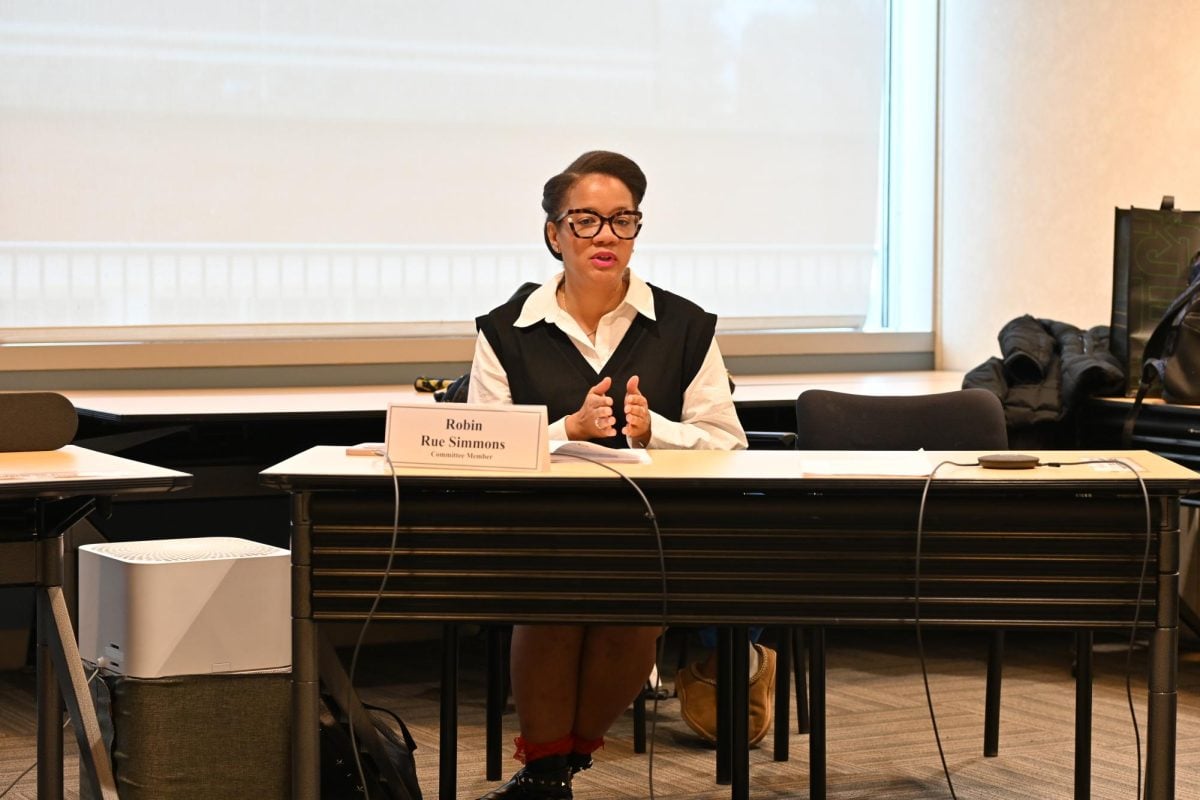
The event, “Venezuela and the Crisis of Democracy in the Americas,” was sponsored by the Latin American and Caribbean Studies Program and co-sponsored by the Roberta Buffett Institute for Global Affairs. It featured a conversation-style panel and Q&A between Zubillaga and Britto.
On Jan. 3, President Donald Trump ordered Operation Absolute Resolve, which captured then-President of Venezuela Nicolás Maduro and removed him from power. The operation also included striking boats and several locations in the nation’s capital, Caracas. It killed at least 40 people Jan. 3, according to The New York Times.
Zubillaga highlighted Trump’s explanations for the invasion. She said the president claimed that Maduro was “sending criminals to the U.S.” and that the nation was “flooding” the United States with drugs.
She said such claims lack substantial evidence and suggest broad generalizations, citing that only a small portion of the Venezuelan population has criminal records in the United States. She added that, while the Venezuelan military has participated in military trafficking, “there is not such a hierarchical, coordinated organization sending drugs.”
She also highlighted Venezuela’s role as a hub of transit for drugs, rather than the direct source of trafficking. Zubillaga noted the nation does not produce or offer transit for fentanyl, which she said was reportedly the most problematic in the United States.
As the conversation progressed, Britto discussed the historical origins of the Jan. 3 invasion, citing the detente between the U.S. and the Soviet Union under former U.S. president Richard Nixon.
According to Britto, this period allowed the U.S. to focus its efforts on escalating confrontation of the Global South in the U.S. “war on drugs.”
“But in actuality, (it) is a toolkit for the administration of state violence in regions or against peoples and communities that were conceived as challenging the legitimacy or the governance or the authority of a particular power,” Britto said. “Whether it is the national government of that country, whether it is the U.S. and the federal government.”
Zubillaga explained the history behind Maduro’s presidency, noting how he replaced Venezuela’s former president, Hugo Chávez.
When Maduro did not recognize his loss in Venezuela’s 2024 presidential election, Zubillaga said citizens protested and were met with “massive” repression from Maduro’s government.
Now, she said Venezuela has been left with a militarized government that lacks legitimacy but retains power by suppressing citizen criticism.
As the panel came to a close, Britto highlighted the concept of the Caribbean as the United States’ “laboratory” to be used as an experiment ahead of the United States’ larger political projects. She said the concept has been revived under the “Donroe Doctrine” — a term inspired by the Monroe Doctrine referring to the Trump administration’s push to expand U.S. influence within the Western Hemisphere.
Spanish and Portuguese and comparative literary studies Prof. Alejandra Uslenghi said she chose to attend the event to grow a collective understanding on U.S. and Latin America relations.
“I wanted to support colleagues that are raising awareness and creating dialogue about very important current affairs that involve us and the relationship with Latin America, so we produce more understanding, more knowledge ways of thinking that are not necessarily reductive or simplified,” Uslenghi said.
During the event, Britto discussed the role of pop culture in labeling marginalized communities as “traffickers” and desensitizing U.S. citizens to the administration’s actions against countries like Venezuela.
She also discussed the media’s role in turning Maduro’s capture into a form of entertainment, which she said blocks the translation of the event’s human tragedy. Yet, on the subject of understanding the relationship between media and narratives surrounding Latin America and the Caribbean, Britto said she still had more questions than answers.
“Part of me is very pessimistic,” she said. “(But) there’s always hope, because the history of the future is not written.”
Email: [email protected]
Bluesky: @lucaskubovchik.bsky.social
Related Stories:
— Professors talk U.S. military strike in Venezuela at Buffett event
— ‘Another war for oil’: Local Democrats denounce Trump’s surprise attack on Venezuela
— U.S. attack inspires relief, sparks concerns among North Shore Venezuelan community