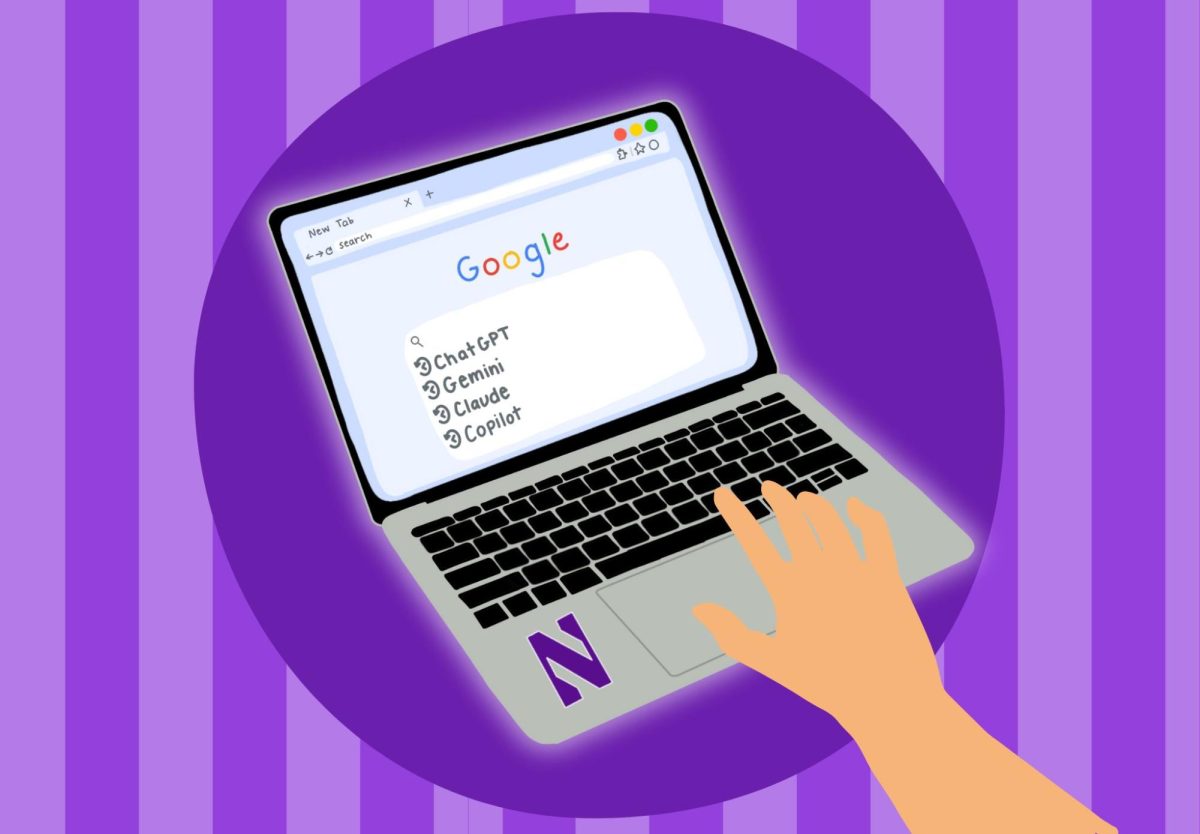
It’s almost unavoidable now. Sitting at the top of search engines or operating digital assistants on social media apps, artificial intelligence is silently permeating into our phones, computers and other devices.
On Tuesday, three librarians hosted a workshop at University Library focusing on generative artificial intelligence, its strengths and limitations, and how students should use it for research
Distance Learning and Professional Studies Librarian Tracy Coyne shared that several students have used sources they found through AI. When using AI, however, sources are hallucinated and citations are incomplete, she said.
User Experience Librarian Frank Sweis helped host the event. While someone may have to re-evaluate their methods or end up somewhere completely different from where they started in the research process, he said AI can be a shortcut to avoid that struggle.
He also observed that the rigorous grading style at a higher education institution like Northwestern can affect AI usage.
“You’re determined by grades. That’s what your success is,” he said. “There is room to struggle in higher education, and oftentimes these AI tools are advertised or marketed as shortcuts to that.”
The debate about students’ use of AI is ongoing, even outside University Library. For Communication sophomore Henry Blocksidge, AI acts as a shortcut to summarize his homework readings in a timely manner.
As an aspiring screenwriter, however, Blocksidge said he prides himself on brainstorming creative ideas on his own and that other people should do the same. He also highlighted the divides in AI stance between areas of study. Compared to STEM professors, humanities professors often have an anti-AI stance, Blocksidge said.
“Last quarter, my English teacher said do not give your ideas away to a machine, and a lot of humanities people feel the same way,” he said.
Weinberg sophomore Defne Onursal studies data science and economics. She said her classes and assignments even encourage her to embrace and understand the intersection of data science and AI. In a recent data science class, she had a coding assignment that encouraged generative AI use to show its benefits.
“The assignment was focused on how to use generative AI and the fact that you should use it, because ultimately if you don’t, you’re going to fall behind,” Onursal said.
Onursal said she is still cautious about overreliance on AI, and makes sure that when the time comes, she can solve problems by herself for her midterms and finals.
Medill senior Kederang Ueda said he holds a complex stance on AI usage as a biology and journalism major. Biology professors don’t tend to care about AI use, as long as it’s not used to fabricate scientific claims, he said.
Ueda said he was surprised that his journalism professors do not tend to be explicitly anti-AI, and that instead their policy usually states to simply cite AI if it was used.
There are some “heinous” uses coming from it, Ueda said. He referred to the recent controversy surrounding Flock Safety, the surveillance company that uses AI-powered cameras for license plate scanning to aid traffic law enforcement agencies. Despite its intended use for law enforcement agencies, Immigrations and Customs Enforcement has reportedly used the company’s data to track people who are undocumented.
Interactions with AI pose an ethical challenge because it can be used for good, but can also be used for bad, Ueda said. In general, AI is something to be careful around, especially because we are still in its developmental stages, he said.
Similar to Blocksidge, it is important to Ueda that users remember that AI is a machine and a corporation that wants to grow. And like Onursal, Ueda does feel wary about overusing AI, as it can be a cognitive shortcut that changes the way we think and engage with the world.
“When interacting with AI, you should almost have a voice in the back of your head that’s telling you this is not a person,” Ueda said. “This is a machine that has put things together for me, and it’s based off of somebody’s code, at some place in Silicon Valley in some data center.”
Email: [email protected]
Related Stories:
— ‘AI & The Future of News’ event explores personalized and AI-generated news content
— Evanston small businesses incorporate artificial intelligence into their operations
— Institute for Artificial Intelligence in Medicine focuses on ethical data use