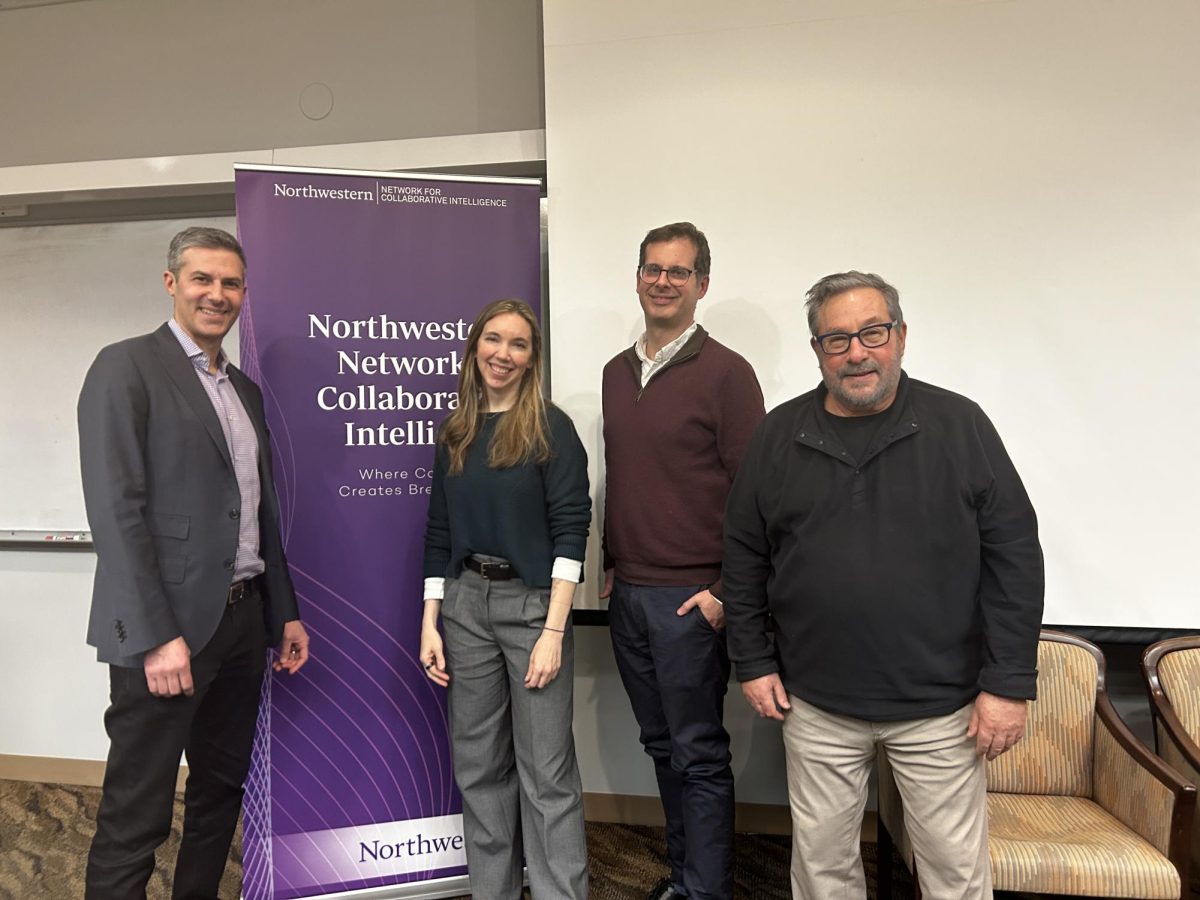
Speakers in journalism and technology discussed personalization and AI-produced media at the “AI & The Future of News” event hosted by the Northwestern Network for Collaboration Intelligence as part of its Distinguished Panel Series on Monday.
Computer science Prof. Larry Birnbaum led the discussion.
Emily Withrow, senior vice president at The New York Times, speaking in her own capacity, said her team looks to use large language models to comb through articles and determine what topics, people or things readers might have further questions about.
However, she said they don’t use LLMs to write articles. Withrow said her team is still working on evaluation tools and a set of standards for work done by AI. Furthermore, she said using AI to assist in article writing can also limit a journalist’s skill set.
“One of the things I think about a lot when I think about the introduction of these tools as an assistant is what skills are going to atrophy when you start doing this,” Withrow said.
Communication and computer science Prof. Nick Diakopoulos said AI can help journalists aggregate news, monitor information ecosystems and analyze documents.
The panel discussed using AI to personalize the content consumers see, tailoring an algorithm to individual news consumers. Withrow said this could positively affect news consumption by meeting consumers where they’re at.
“We’ve done studies, experiments with personalized news articles,” Diakopoulos said. “They can increase the relevance of information for people who may not find the topic relevant to begin with.”
The speakers also discussed personalized headlines, newsletters and images as ways to draw in consumers.
However, Diakopoulos said this personalization could confuse journalists’ goal of informing society by casting their work as a product rather than a societal goal.
“Journalism should be considered a public good, it shouldn’t be only a capitalist product,” Diakopoulos said.
Still, Withrow said some personalization may be necessary for the future of journalism.
“AI, and in particular LLMs, over the past year or so have made (personalization) a baseline consumer expectation,” Withrow said.
The speakers also discussed how to verify that articles and visual media were not created by AI. According to Diakopoulos, research shows 9% of online news content is AI.
Medill Prof. Jeremy Gilbert said individual power grids have sub-audio tones that can be used to detect real video or audio. However, he said current and future AI innovation makes this detection more difficult.
Diakopoulos argued for more thorough fact-checking and surveillance of writers’ typing keystrokes.
“Every time that we encounter new technologies, whether it’s mobile phones or the web, we realize that new things are possible,” Gilbert said.
Email: [email protected]
Related Stories:
— Medill hosts screening, panel to showcase student documentaries about incarcerated individuals
— Northwestern professors explore recent protests in Iran in panel hosted by MENA Studies
— Buffett Institute hosts experts at winter symposium, explores online disinformation