Students entered the O.T. Hogan Biological Sciences Building and were immediately greeted by a video projection of a watering hole in preparation for Tuesday evening’s discussion.
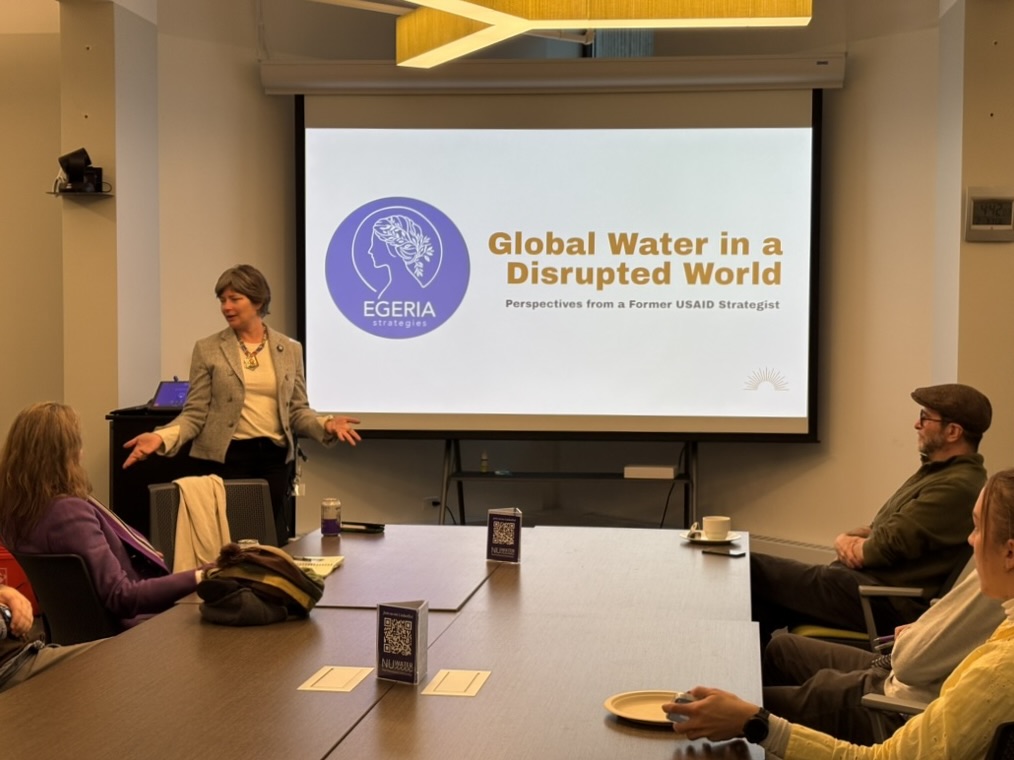
Lisa Schechtman (Weinberg ’99) is the former senior strategy advisor at the United States Agency for International Development’s Center for Water Security, Sanitation and Hygiene. She spoke at NU Water’s monthly “Watering Hole” series about the role of U.S. foreign policy in the global water crisis.
“For too long, water has been viewed as a single solution set, and that’s what risks us getting stuck,” she said.
Sera Young, co-director of NU Water and anthropology professor, said Schechtman was “water at NU before Water was at NU.”
Schechtman focused on her work with the United Nations, which stopped when the Trump administration shut down USAID and merged its limited final operations with the State Department.
That merger has led to a 64% drop in obligated funding to water assistance projects, according to the Center for Strategic and International Studies. While Schechtman cited multiple factors behind the drop, she emphasized the U.S.’s withdrawal of support as the primary one, causing other countries to follow suit due to the infeasibility of taking on the U.S.’ entire financial burden.
In the process of dissolving USAID, the Trump administration also shut down almost 90% of its clean water programs across the country. Only 10 total projects remain in seven countries.
The low number of remaining projects restricts the world’s ability to complete one of Schechtman’s goals.
“I want this community, every single person in this community, to be able to get water that is safe for every person to drink whenever they want it,” she said.
Schechtman said that the lack of U.S. funding is a “massive threat” to water programs in general.
She also said that shutting down USAID cost over 250,000 people their jobs, from experts like Schechtman to people on the ground building the clean water systems USAID funded. Schechtman said she was especially concerned about the lack of new jobs for those on the ground.
“(Schechtman) is unemployed right now, and she’s a genius,” NU Water Wave Leader and fifth-year Ph.D. candidate Emma Shapiro (McCormick ’22) said. “She knows everything about her topic, and she’s essential in this area. It’s depressing.”
Approximately 30 people attended the presentation, including many students from Young’s Biocultural Perspectives on Water Insecurity class.
Medill junior Eliav Brooks-Rubin was one of those students. Following the presentation, he said he believes the water crisis is a universal, nonpartisan issue.
“Among all the problems in the world, this is one of the most indisputable: ‘Everyone should be on the same page about it,’” he said. “Even with the worst political policies, there are people out there who believe them. But, I can’t imagine there are people out there who’re like, ‘I don’t think we should get clean drinking water for people.’”
The monthly discussions are one of two primary events NU Water organizes each month, Shapiro said.
A 2025 study by the World Health Organization revealed that one in every four people lacks access to safe drinking water, and 3.4 billion people also live without access to basic sanitary facilities. Additionally, 50% of the world’s population lives in water-stressed places for at least one month a year.
Schechtman told the Daily after the event that it would not be easy to just restore all the funding and projects after the Trump administration is out of office.
“I do think it’s possible, but I don’t think it will look the way it did for a very long time,” she said.
Email: [email protected]
X: @YoniZacks
Related Stories:
— Postdoc examines how Global Gag Rule, USAID shutdown affects Kenyan NGOs
— Northwestern profs. talk uncertainty of U.S. foreign aid at World Affairs Group event