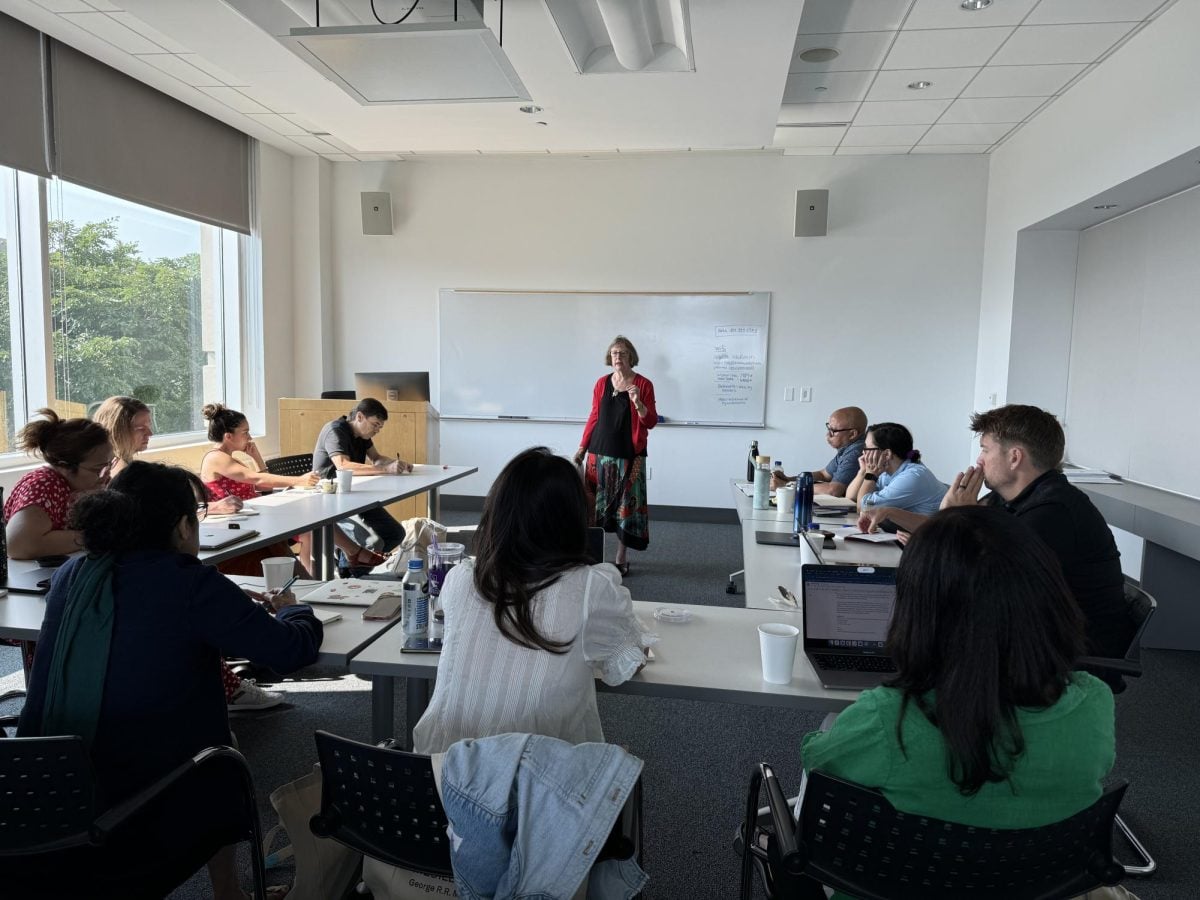
Northwestern’s Center for Legal Studies hosted its annual Law in Motion event, which explored Supreme Court cases, decisions and the broader question of the courts’ legitimacy, Thursday evening.
The panel featured three law professors from across Chicago and was moderated by Director of Legal Studies and Prof. Joanna Grisinger.
The roundtable centered on the legitimacy of the Supreme Court at a time when Grisinger said the American public’s faith in the court is at an all-time low, and tensions between higher and lower courts are rising.
“We’re trying to get at the question of overall legitimacy of the court today, both legitimacy in the general public and the tensions between the Supreme Court and the lower courts,” Grisinger said.
Pritzker School of Law Prof. Paul Gowder said the Supreme Court is in a state of “free fall,” facing issues of blatant partisanship and excessive use of the emergency docket. The emergency docket is an expedited process for the Supreme Court to handle procedural matters and emergency applications without holding oral arguments or in-depth rulings.
However, Gowder said the increased use of the emergency docket under the Roberts Court has raised controversy because it erodes the system of transparency and reasoning that legitimizes the Supreme Court.
“To carry out so many consequential rulings unnecessarily in this unreasonable way is really to shatter the basic function of a constitutional court,” Gowder said.
The “secrecy and passivity of these procedures” not only brings into question the legitimacy but also the independence of the court at a time of overbearing executive power, said speaker Leigha Crout, a professor at the DePaul University College of Law.
Gowder said President Donald Trump has engaged in broad breaches of executive jurisdiction this past year, such that he is “making policy almost unilaterally,” and added that the Supreme Court has done little to stop him.
Part of this, Gowder said, is due to the Supreme Court’s expansion of executive power over the last century. He added that this trend has been supercharged by Trump’s claims to executive control over bureaucracy, the economy and immigration.
“Trump has claimed kinds of executive power heretofore not effectively claimed by any (other president),” Gowder said.
Chicago-Kent College of Law Prof. Chris Schmidt, who also spoke on the panel, said the Supreme Court’s limited action to restrict these unconstitutional policies challenges the court’s independence.
Schmidt said this tension will culminate in the birthright citizenship case, Trump v. CASA, for which the Supreme Court will hear oral arguments in early spring. Schmidt said the blatant unconstitutionality of Trump’s executive order to limit birthright citizenship, issued on his first day of office, makes this an easy win “for the country and the court.”
He said the case violates textual and historical interpretations of the 14th Amendment, as well as court precedent, giving the Supreme Court extensive grounds to stand up to the Trump administration.
“This seems like low-hanging fruit for a court that’s trying to establish itself as an independent part of the government that does have a role to play in limiting clearly unconstitutional actions by the executive branch,” Schmidt said.
This upcoming case has the potential to reshape the Supreme Court’s relationship to the executive branch and the American people’s faith in a judicial system intended to uphold ideals of objectivity and justice, Schmidt said.
“In a democratic legal system, the baseline question is this, ‘Why do we allow these unelected people to exercise power?’” Gowder said.
Email: [email protected]
Related Stories:
— Pritzker professors question legality of Northwestern funding deal with Trump administration
— Legal experts say upcoming Supreme Court decisions could threaten diversity in universities