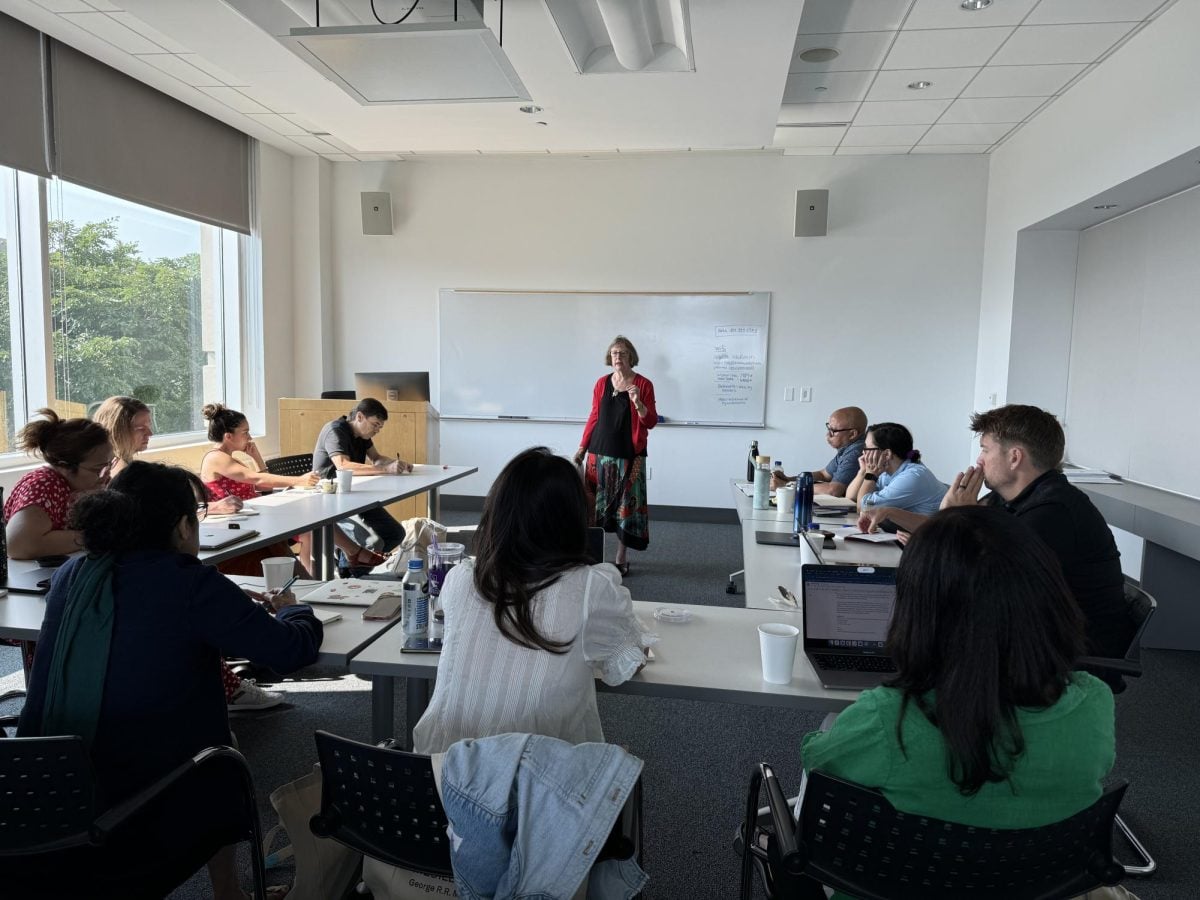
University of Michigan Prof. Sarah Koch talked about the math behind the classic card game Spot it! in a Wednesday speaker event at Lunt Hall.
Koch taught around 40 attendees about the game’s relation to deeper questions in combinatorics, a mathematical field that studies combinations, as part of the math department’s Undergraduate Colloquium.
As the event began, Koch handed each attendee Spot it! cards to play with the person sitting next to them. She outlined the game’s “defining features:” Every pair of cards contains one common symbol, and every set of distinct symbols is contained on only one card.
“How would you make a deck of cards like that?” Koch said. “There’s a lot of math in how this game is constructed. It’s pretty miraculous actually.”
Spot it! tests memorization skills by having players flip through cards filled with symbols — from turtles to baby bottles — and quickly identify and name the shared common symbol between any two cards. The goal is to be the first person to name the common symbol.
Koch transitioned the game into a math lesson. She presented a slideshow and wrote examples on the blackboard about how the number of symbols on Spot it! cards determine the total number of symbols in the game and the maximum number of cards that can be in the deck.
For example, if there is just one symbol on a card, then the deck cannot have any more cards in it. But if there are two symbols on a card, two additional cards can be added in order to follow the rule that every pair shares one common symbol.
By inviting attendees to ask questions and share observations, she discussed the “mystery” of why a Spot it! deck cannot be built with cards containing exactly seven symbols.
Koch said the Spot it! cards and decks represent this larger, unresolved question about why it is mathematically impossible to recreate the game with seven symbols.
“The problem was not phrased in terms of Spot it! decks, it was phrased in terms of something else,” Koch said. “I will tell you that mathematicians today still do not understand how to complete this. You’re bumping into unknown stuff, and what is cool is that you can phrase it in terms of this game.”
Quinn Salix, a graduate student in the one-year Causeway Postbaccalaureate Certificate Program, said Koch’s delivery was engaging.
“I think that Prof. Koch has an energy that makes the talk more interesting,” Salix said. “She did a good job of putting together a story of ‘you try it out,’ and bringing in some history and pointing out how it all connects. Her delivery of the talk made me more interested in the subject for sure.”
Weinberg freshman Nova Travis attended the event after its advertisement by the Northwestern Undergraduate Math Society, which he joined earlier this school year.
Travis said he was impressed by how the lecture took a basic children’s game and expanded it to subjects he is interested in academically.
“The fact that you could start off with something that, in general, seems simple, but then you can extract these complex properties from it and lead to something that is unknown to mathematicians today,” Travis said. “I feel like anyone who were to come here, even with no background in mathematics at all, they could be engaged by the presentation.”
Email: [email protected]
Related Stories:
— Harvard professor talks asteroids, supernovas and dark matter at CIERA event
— Northwestern’s SkAI brings astronomy and AI experts together to advance understanding of the cosmos
— TEDxNorthwesternU invites speakers, attendees to take ‘small steps, giant leaps’