The Medill School of Journalism and Buffett Institute for Global Affairs co-hosted an event titled “Press Freedom Under Fire: Threats to Journalism and Democracy,” which included a medal presentation, keynote speech and reception Thursday evening and discussions Friday.
During his opening remarks, Medill Dean Charles Whitaker warned of a widespread assault on the media, but clarified that the event was not intended for commiseration but as a catalyst for change.
“We want not only to identify the challenges of the present moment but to pursue solutions,” Whitaker said.
Following his opening, the James Foley Medill Medal for Courage in Journalism, which recognizes journalistic bravery, was presented to Reporters Without Borders and the Committee to Protect Journalists for their advocacy.
Clayton Weimers received the medal for Reporters Without Borders and said he accepted it on behalf of the journalists in danger, including those behind bars.
Lucy Westcott obtained the medal for the Committee to Protect Journalists and said there has never been a more dangerous time for journalists, highlighting the story of Mariam Abu Dagga, a photojournalist who was killed in Gaza while trying to help a colleague.
“History is told by those who report it, but all too often, those who report it are killed while doing so,” Westcott said.
During her keynote speech, Wendy McMahon, former president of CBS News and Stations, emphasized local and global challenges including the use of pepper balls and tear gas against journalists at the Broadview ICE facility and the Israel-Hamas war, which has been the deadliest in history for media workers.
McMahon also referenced the recent Medill State of Local News Report and said that local news outlets are lifelines in crisis and critical watchdogs despite the decline in their prevalence.
“Truth is fighting for its life and fighting to stay above the fold,” she said.
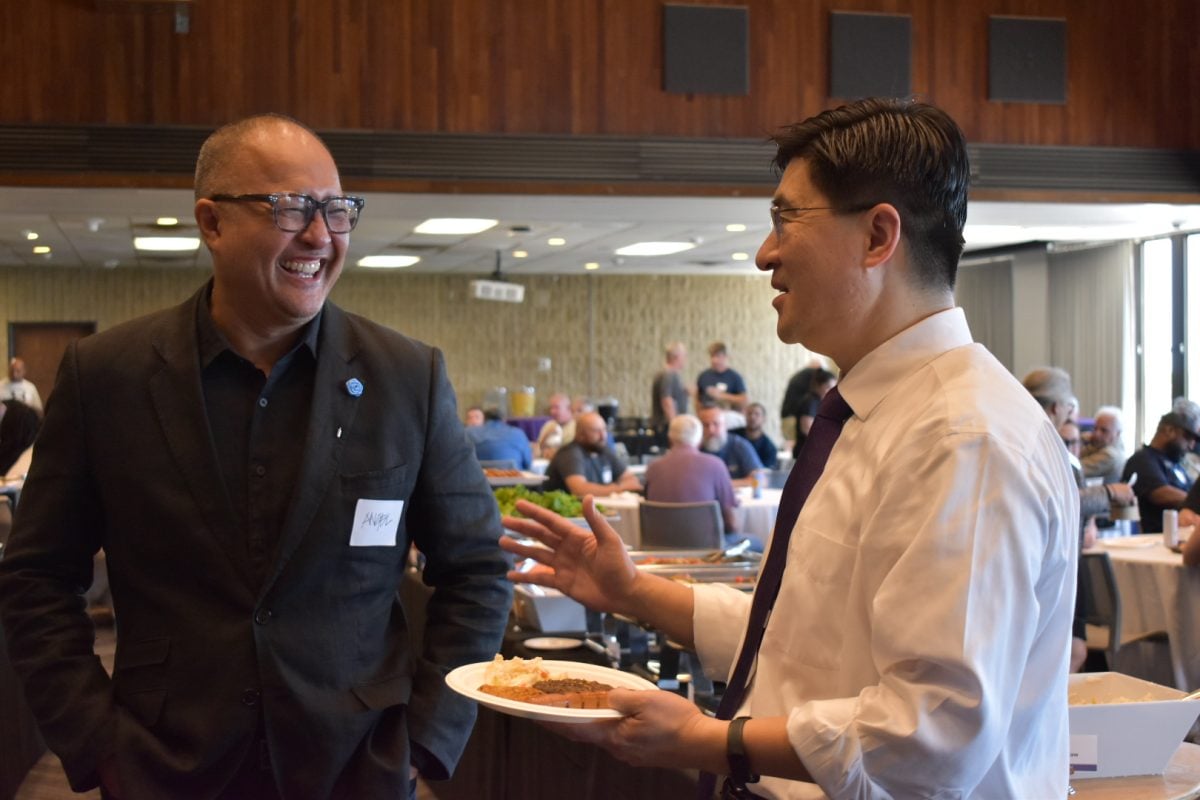
A reception concluded Thursday’s programming, giving attendees the opportunity to connect with the featured journalists.
The Friday discussions were a more in-depth forum attended by high school and college students, professors and professionals.
Weimers moderated the morning panel, in which Westcott and three other journalists discussed how they experienced and dealt with physical and digital intimidation in their careers, such as Roberson Alphonse, who survived an assasination attempt in Haiti.
During lunch, attendees were asked to discuss their experiences with journalism and brainstorm solutions to its current challenges within their tables.
The afternoon panel was moderated by Pritzker and Medill Prof. Doreen Weisenhaus and centered on legal and financial threats to journalism. The talk included issues such as the Associated Press’ restricted access to the White House and Pentagon, an executive order that affected hundreds of Voice of America employees and the shutdown of Radio Free Asia’s services in Tibet.
“For audiences in these regions, services like RFA (and) VOA were a lifeline to receive uncensored, true and accurate information,” Tenzin Pema, director of Radio Free Asia, said.
According to Pema, Tibetan people would use code words like “morning tea” and go into the mountains to receive the broadcast so they could escape surveillance. They even called it “medicine for the soul,” she said.
Regimes celebrate when independent media struggles because without it, Pema said, people are more susceptible to government regulations. Tibet’s name is gradually being replaced by the Mandarin name “Xizang,” which to Pema indicates a shift towards the erasure of media seen in Myanmar, Cambodia and Laos.
Chris Casquejo (Medill ʼ95), a correspondent for English to Asia for Voice of America, echoed Pema’s concern, adding that global perspectives are crucial in countries where the state media is fully controlled by the government.
The panelists voiced pressure caused by the Trump administration but also expressed hope for the future of media.
Julie Pace (Medill ʼ04), the executive editor of the Associated Press, said it was inspiring to see news organizations across the political spectrum moving out of the Pentagon instead of agreeing to new regulatory requirements.
“If we don’t stand together, why should we expect anybody else to stand with us?” she said.
Dean Whitaker concluded the event by encouraging the audience to support local media and expand the press freedom conversation outside of people involved in the field.
He also suggested that the discussion relates to freedom on a broader scale.
“Freedom of the press is not a journalism issue,” Whitaker said. “It is a democracy issue.”
Email: [email protected]
Related articles:
— Local news coverage continues to shrink, Medill State of Local News report finds
— Two decades later, Medill alum Julie Pace’s education still guides her fight for press freedom
— Medill School to house Illinois Journalism Education Association