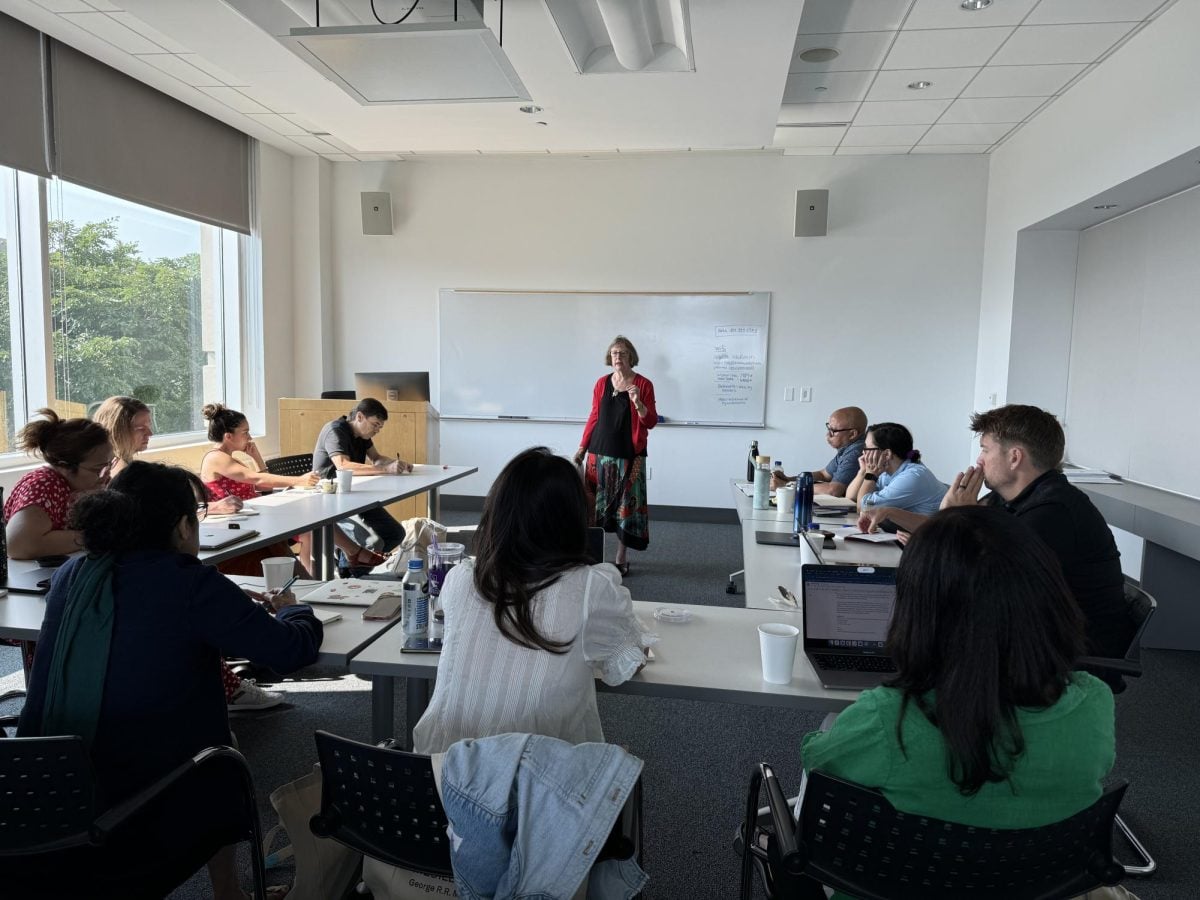
University of Washington Prof. Karam Dana presented his book “To Stand with Palestine: Transnational Resistance and Political Evolution in the United States” on Monday. The event, held in University Hall, drew around 20 attendees.
Religious Studies Prof. Brannon Ingram introduced Dana, describing his extensive work as a Palestinian scholar, including his post-doctoral fellowship at Harvard University’s Center for Middle Eastern Studies.
Dana said his eight years of research on Palestinian activism concluded on Oct. 1, 2023, prior to the start of the Israel-Hamas war.
The book’s research was on civilian Palestinian activism that centered on inclusivity, global solidarity with other marginalized groups and non-violent resistance, Dana said.
In his research, he said, he found three factors that contributed to the global growth of pro-Palestinian activism.
Dana said these included Palestinians’ advocacy to externalize their struggle with the Boycott, Divestment and Sanctions Movement, transnational Palestinian activism for solidarity and increased connection because of social media.
“Traditional warfare, like armed struggle, is not going to do it,” Dana said. “Different types of pressure needed to be introduced in the formula to resisting Israeli occupation.”
Jewish American and Israeli academics were also important contributors to the growth of pro-Palestinian ideology, he said.
Describing a phenomenon called the “New Historians,” Dana explained how Israeli historians began to present counter-narratives in Israeli academia surrounding the Nakba, which refers to the mass displacement of Palestinians in 1948 and other aspects of the broader Israel-Palestine conflict prior to Oct. 7.
“Israeli historians started speaking in ways that didn’t align with the way the Israeli government was speaking,” Dana said.
Palestinian solidarity with other organizations across the world was also a major factor in the growing support for the Palestinian movement, Dana said.
He drew comparisons between the Palestinian experience and racialization and dehumanization faced by people of color in the U.S., and said the Global South understood the “colonial situation” of Palestine.
“The racial hierarchy that defines the United States of America is significant in the conversation with regards to Palestine,” Dana said. “It’s no secret that you’ll find BIPOC folks — Black, Indigenous and people of color in the United States — understanding the struggle in Palestine.”
Audience questions centered on the class-action lawsuit by Northwestern Graduate Workers for Palestine, the role of the U.S. in the conflict, changing language use from “diaspora” to “refugee” or “exile” and commercial neutrality toward the conflict.
Several students and professors stayed after the event officially concluded to discuss with Dana and each other.
“University professors and leaders are beginning to realize how significant their roles are in making sure students are protected and their voices are heard,” said Salma Moustafa, a third-year Ph.D. student in the sociology department. “A lot of that is reviewing what the role of (a) university is in publishing and disseminating information about the struggle against colonial violence.”
Moustafa said she believed protests have strengthened people’s sense of solidarity for Palestinians.
Weinberg senior Evgeny Stolyarov said the message of intersectionality in the pro-Palestinian movement resonated with him as a Jewish student.
“It was so beautiful the way he brought together the various Jewish values that tell us that making a better world for our communities is also making a better world for all communities,” Stolyarov said. “If we want a world free of antisemitism, we also need a world free of anti-Palestinian racism, free of homophobia, free from violations of indigenous rights and so on.”
Email: [email protected]
Related Stories:
— Class-action lawsuit challenges Northwestern bias training
— Northwestern Graduate Workers for Palestine hold news conference, sit-in to protest bias training
— New required bias training met with boycotts from SJP and JVP, approval from others