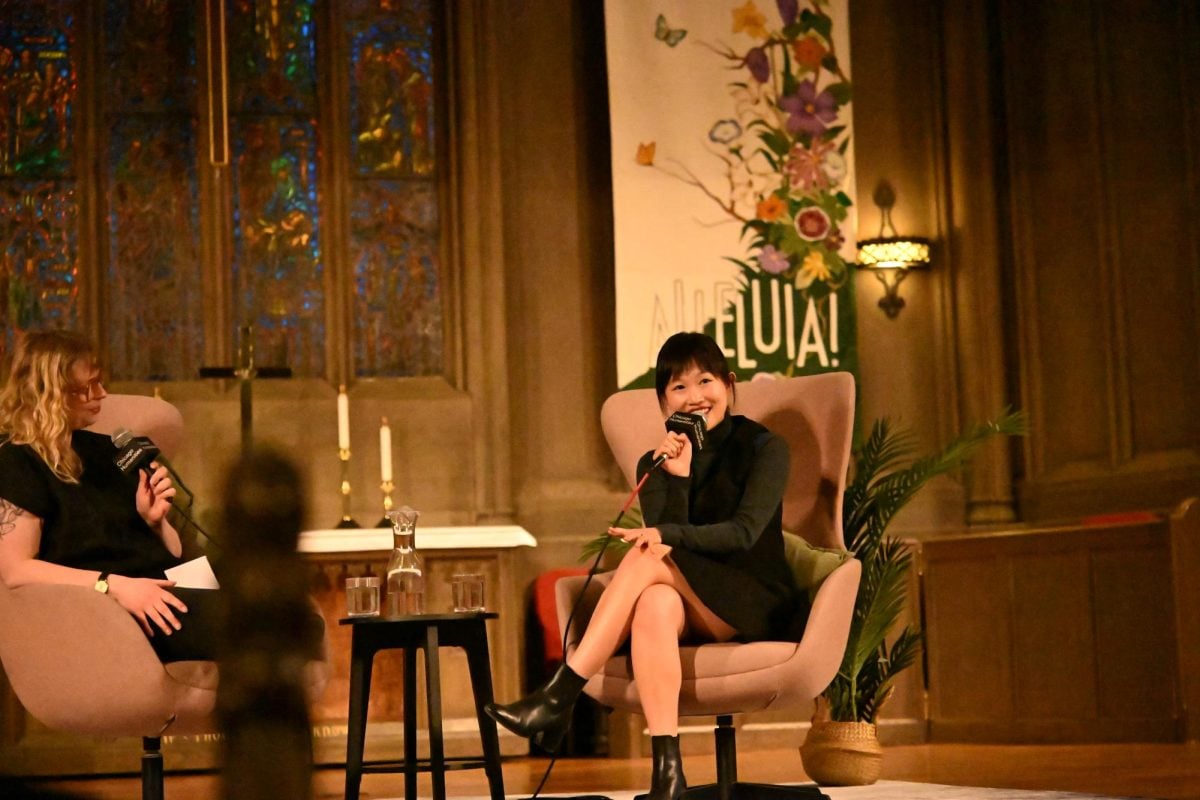
Northwestern’s Department of English hosted three authors for the Colombian Writers Symposium in the Block Museum of Art on Wednesday. Julián Delgado Lopera, Gloria Susana Esquivel and Melissa Lozada-Oliva read excerpts of their work, then answered audience members’ questions about their inspirations and process.
English Prof. Daisy Hernández moderated the Q&A after the readings. In her opening remarks before the excerpts, she emphasized the importance of creative writing, drawing parallels between the 1980s political turmoil in Colombia that would define her family’s conversations as a kid and the political state of the United States today.
“I’m so grateful for novelists,” Hernández said.
The first writer, Delgado Lopera, read an excerpt from their forthcoming 2026 novel, “Pretend You’re Dead and I Carry You.”
The excerpt followed the story of Ignacio, who contends with his past in Bogotá’s queer club scene and struggles with his identity. Delgado Lopera drew the audience into their reading, enthusiastically flipping each page as they recited an intense segment of the novel. Their words drew attention to Ignacio’s escapism and explored the relationship between violence and insecurity.
When asked what supported them through their project, Delgado Lopera lightheartedly responded: “deadlines.” But, they also described the process of writing as a self-discovery journey.
“It’s a matter of getting to know yourself,” they said. Delgado Lopera also mentioned that while they gained a voice as a writer from reading, they also credit the spoken words of people present in their childhood.
Susana Esquivel, who Hernández thanked for flying from Bogotá for the event, read from her book “Animales del fin del mundo,” which was translated into English (“Animals at the End of the World”) by Robin Myers.
The excerpt was rich with poeticism and metaphors, detailing the perspective of a young girl in the 1980s who experiences an explosion in Bogotá.
“Writing takes me back to when I was a kid and was telling stories to my dolls,” Susana Esquivel said. “I let myself play and have fun.”
The final writer featured was Lozada-Oliva, a lecturer at Columbia University whose book “Candelaria” was named one of the Best Books of 2023 by USA Today and Vogue.
Lozada-Oliva read an excerpt from her short story collection “Beyond All Reasonable Doubt, Jesus Is Alive!” about a hospital waitress whose eccentric step-aunt magically causes her to grow a tail. Her reading included accents, jokes and physical movement, while still delving into serious topics.
Although her excerpt certainly has fantasy elements, Lozada-Oliva criticized the limiting, binary Western perspective of viewing Latin American literature either as part of the “magical realism” movement that originated in the region in the 1940s, or as “non-magical realism.”
During the audience Q&A, all three authors shared their perspectives on what it means to be a Colombian writer. One attendee mentioned that all three excerpts struck a balance between a serious topic and a lighthearted viewpoint, and asked how they were able to accomplish this.
Lozada-Oliva referenced her family’s way of discussing trauma amid humor.
“I almost feel like it’s a very Colombian thing to have darkness and levity exist at the same time,” she said.
She also said that this upbringing influenced her work, which can be clearly heard in the sarcasm of her writing.
Susana Esquivel described fiction as a way of countering some of the dark elements of reality, adding that it can be thought of as a writer’s responsibility to do so.
“Fiction always tries to make amends for the world,” she said. “If the world is bleak, maybe there is some light shining, and if I feel powerless, maybe my character can have power.”
Correction: A previous version of this story misstated the name of Melissa Lozada-Oliva’s project. The Daily regrets this error.
Email: [email protected]
Related articles:
— Poet Claudia Rankine discusses inspirations for unreleased book in poetry reading and Q&A