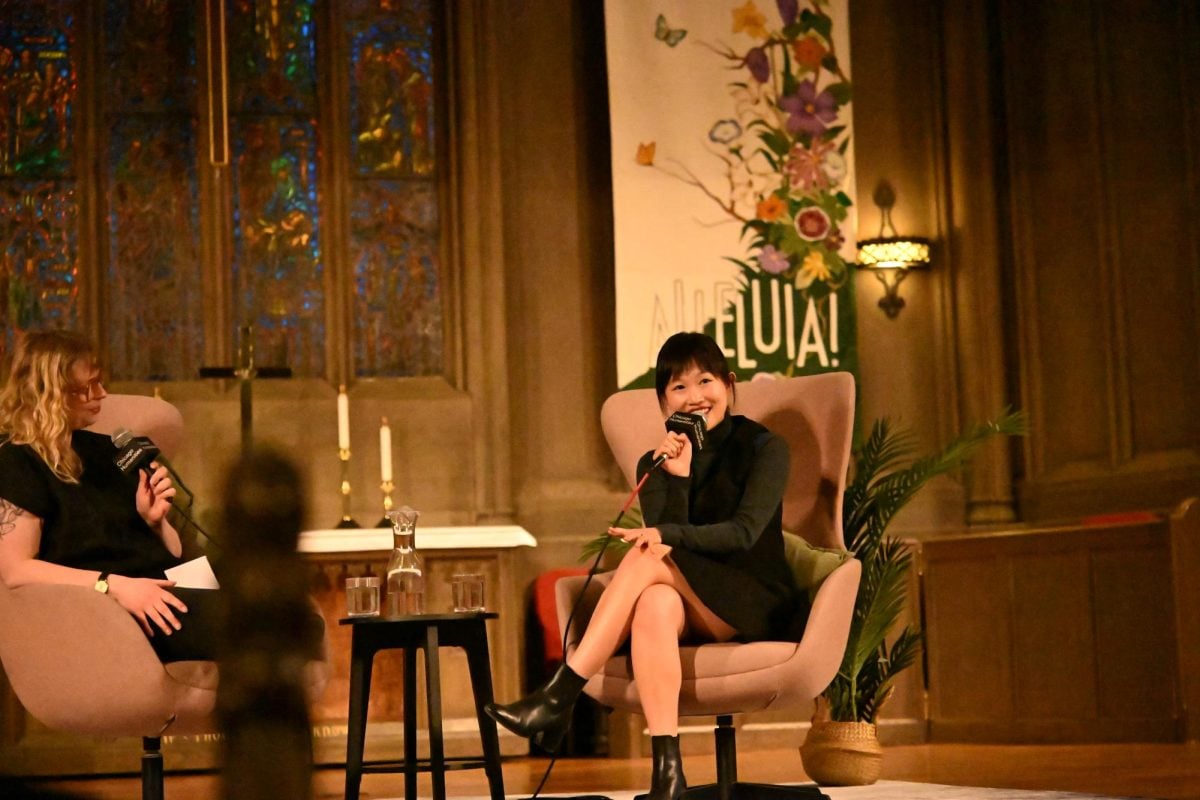
Author R. F. Kuang discussed her latest novel “Katabasis” with podcast host and moderator Greta Johnsen before a sold-out audience April 11 as part of the Chicago Humanities Festival at First United Methodist Church.
Kuang published “Katabasis,” which debuted at the top spot on The New York Times bestseller list, on Aug. 26. The novel follows graduate students Alice Law and Peter Murdoch as they journey to hell to rescue the soul of their professor, who was recently killed in a gruesome accident. The story takes place in a fantastical reimagining of the University of Cambridge in the 1980s, where Alice and Peter are rival scholars at the school’s imaginary department of analytic magick.
Johnsen kicked off the event by asking the author to define katabasis, a word derived from Ancient Greek meaning a descent or journey to the underworld. Kuang also described katabasis as a “metaphysical, spiritual journey” in which a story’s hero “reaches their lowest point.”
However, Kuang said she used katabasis primarily as a plot catalyst. The majority of the novel focuses instead on her characters’ escape from the underworld.
“The book is actually less about katabasis,” Kuang said. “Going to the underworld is easy. It’s the climbing out that’s the hard part.”
“Katabasis” draws inspiration from Kuang’s personal life. In addition to obtaining her MPhil in Chinese Studies from the University of Cambridge, Kuang is currently pursuing her Ph.D in East Asian Languages and Literatures at Yale University. During her first year at Yale, Kuang said she and her husband, Bennett Eckert-Kuang (Weinberg ’20), faced many personal challenges related to Eckert-Kuang’s health. The experience served as the novel’s foundation, with Alice and Peter’s relationship arc mirroring Kuang and Eckert-Kuang’s.
The novel also delves into characters’ mental health challenges and Peter’s struggle with chronic illness, which Kuang said was inspired by her husband’s experience with Crohn’s disease.
For Bienen sophomore Nolan Fallon, this aspect of the novel resonated. Fallon said the event was the first author visit he’d attended. He finished reading five of Kuang’s books in the last four months, including “Katabasis,” during which he developed a strong admiration for her work, he said.
Although he said he wasn’t “super familiar” with Crohn’s disease, Fallon appreciated that Kuang included “a character who has an invisible disability” in her novel.
“Seeing stuff like that, where you have characters who have similar struggles or issues that you can relate to … seeing that being represented in the literature … and hearing her thought process behind it — how it was a real experience that she had to also navigate with her husband — was super interesting,” Fallon said.
Johnsen then asked Kuang about her exploration of the “myth of genius.”
“There’s so many themes to come back to in (“Katabasis”),” Johnsen said. “The myth of genius, especially that of male genius and then especially white male genius — what attracted you to that idea?”
Kuang said she was fascinated by the concept of “genius” and what it excuses. Throughout “Katabasis,” she explores the discrimination Alice faces as a woman in her field, touching on the shortcomings of academic institutions in maintaining equity and accessibility. Kuang said she intentionally set her story in the 1980s — between the second and third waves of feminism — to examine the specific social conditions that perpetuate settings like the one Alice finds herself in.
Leading up to its publication, “Katabasis” became a viral internet fixation for many critics and social media content creators, partially due to its long list of historical and cultural references. Fans of Kuang’s previous novels welcomed the challenge of engaging with a variety of classical and modern texts to prepare for the book’s publication.
For “Katabasis,” Kuang said she drew inspiration primarily from Dante’s “Inferno” and the Greek myth of Orpheus and Eurydice, which both explore a hero’s descent to the underworld.
While “Katabasis” critiques many academic systems, Kuang underscored the continued importance of education and the need for increased support for academic opportunities. As an educator, she said she is optimistic that subsequent generations of students will continue to shape the academy into a more just institution.
Kuang and Johnsen rounded out the night with an audience-led Q&A session, during which the author shared her perspectives on linguistics and translation, the historical writing process and future projects.
Fallon said Kuang’s versatility as a writer was what initially made him interested in hearing more about her writing process.
“All her books are so unique and so different that you really are able to immerse yourself in a different world,” Fallon said.
Email: [email protected]
Related Stories:
— Author R. F. Kuang talks writing, inspirations with NU AASP
— Former Poet Laureate Natasha Trethewey reflects, explores recent book at Chicago Humanities Festival