Guest Column: Sand Creek Massacre a moral stain on Northwestern's past
January 23, 2013
Each year on Jan. 28, Northwestern University gathers to honor its founders. On that date in 1851, the Illinois Legislature approved Northwestern’s Act of Incorporation. Soon it will be Founders’ Day 2013, and we will celebrate with cake and self-congratulations.
Despite these festivities, Northwestern has a shameful past for which it must atone. In order to grow, institutions must remember their past, but this University has chosen amnesia. We must not forget that John Evans, the man who established this University and served as the chair of the Board of Trustees, was morally and politically culpable for one of the most despicable acts of genocide in American history: the 1864 Sand Creek Massacre.
In 1862, President Lincoln appointed Evans the territorial governor of Colorado, a land in which white settlers were intent on conquering native lands for their own benefit. Evans, a railroad magnate, was one of those who believed the “Indian problem” could be solved through violence. He wrote a proclamation declaring that “all hostile Indians would be pursued and destroyed,” claiming that “most of the Indian tribes of the plains are at war and hostile to the whites,” and authorizing all citizens “to kill and destroy, as enemies of the country, wherever they may be found, all such hostile Indians”.
The native peoples – the Cheyenne and the Arapahoe – were camped at Sand Creek under an American flag and had been promised peace; they hoped to negotiate with the white settlers under their leader, Black Kettle. Evans, on the other hand, allowed his military commander, John Chivington, to accomplish their aims by means of a massacre of the Native peoples. The details are gruesome. John Smith subsequently told Congress, “I saw the bodies of those lying there cut all to pieces, worse mutilated than any I have ever saw before; the women cut all to pieces ... With knives; scalped; their brains knocked out; children two or three months old ... By whom were they mutilated? By the United States troops.” Estimates placed the number killed in the hundreds, mostly women and children. The crime was so obviously deplorable that Congress held hearings, and President Andrew Johnson removed Evans from office for covering up the massacre and decorating Chivington and his soldiers.
However, this story is truly about Northwestern University. After being indicted and removed from office, John Evans was welcomed back as the chair of our Board of Trustees throughout his life. This act of extermination, benefiting Evans’ railroad interests, built this University. After the massacre and because of Evans’ declaration that all Indians be considered hostile — and all peaceful Indians demonstrate this by relocating to camps under U.S. observation — Indian land in the Colorado Territory was opened to the railroads and sold to white settlers. Throughout his life John Evans remained our chief benefactor, making this University one that was built on the blood of native peoples.
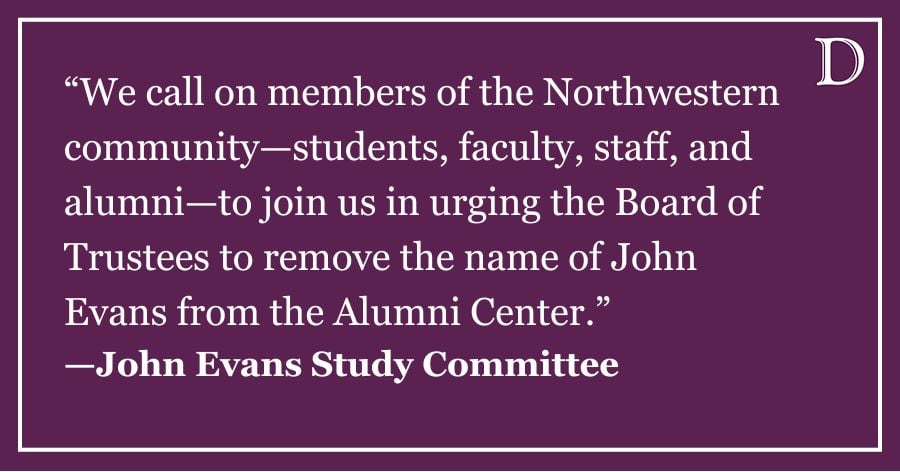
On this 162nd Founders’ Day, we call upon President Morton Schapiro to establish a Commission on Truth and Justice that will have as its task the unearthing of the history of the Sand Creek Massacre and the extent of this University’s benefit from John Evans. This commission must be composed of administrators, trustees, faculty, students, alumni, and, crucially, representatives of affected native and indigenous communities. We demand a full accounting without fear and without deception. With this detailed historical record, we then call upon the president and the Board of Trustees to take steps to remember our history and to ensure that the University is committed to justice, through memorials, commemorations, lectures, scholarships, and support of the affected community. We do not prejudge the outcome but insist on an open and generous process.
In 2003, Brown University was faced with the recognition that parts of its campus were built through their founder’s connection with the slave trade. The investigation, sponsored by President Ruth Simmons, agonizing though it was, did not weaken Brown but made it stronger and more inclusive. Knowledge, even painful knowledge, frees us as scholars and as students and will guide us in the development of a more ethical community.
With respect, with dignity, and with determination, we call on President Schapiro to announce this commission on Founders’ Day. This is the moment for Northwestern to confront its past. It’s about time.
Gary Fine, sociology professor
Adam Mendel, Weinberg senior
Heather Menefee, Weinberg sophomore
Forrest Bruce, SESP freshman
Wilson Smith, Bienen and Weinberg freshman

Want some cheese to go with that w(h)ine?
[Reply]
GBD Reply:
January 24th, 2013 at 11:41 am
Oh God, I know man. Criticizing genocide is definitely whining!
[Reply]
dees Reply:
January 24th, 2013 at 1:31 pm
you're a terrible person.
[Reply]
Mauricio Maluff Reply:
January 24th, 2013 at 4:06 pm
So... brave!
[Reply]
fk Reply:
January 25th, 2013 at 2:02 am
woah if that h wasn't there in parenthesis I wouldn't have gotten the joke THANKS BRO
[Reply]
This piece is highly misleading. Evans' relationship to the Sand Creek Massacre is loose and circumstantial at best -- which I assume is why you say he was "morally and politically culpable," typical leftist code for "not actually culpable but we want to blame him anyway."
Evans wasn't leading or commanding the troops that attacked the Indians that day. He didn't order the attack. He merely took a strong stance as the governor of the territory against the violence perpetrated by Indians against the white settlers. Sure, there's an argument to be made that the settlers were "intruding" or "stealing" the land. But that's not what this article purports to be about. It's a veiled attempt to take the vague political statements of John Evans and then blame him for something that there is no evidence he was involved in, without mentioning that his culpability would be premised on statements and policy positions that may or may not have influenced the events that occurred that day.
My understanding is that quite a few Northwestern professors have attempted in the past to tie John Evans more distinctly to the "massacre" and failed. A version of this article ran last year. If anything of note actually turned up, I'm assuming we'd have heard about it. Let's remember, Northwestern's reputation is that it's perhaps the most radically left-wing of the top tier. I have a feeling the administration would bend over backwards to twist history so they could apologize for our supposed history of profiting off the subjugation of minorities, if such a history truly existed.
Also, seriously, we need a commission set up for this? What would be the gain of having non-historians sit around and chat about Sandy Creek? It'd be one thing to task select members of the History department or relevant scholars with doing the necessary research to establish whether or not Evans was actually involved, but what's the gain of having students and random descendants of Indians sit on the panel if they have no insight to offer other than their feelings? Outside of ensuring that the outcome is an apologize and admission of guilt, that is.
[Reply]
AJM Reply:
January 24th, 2013 at 5:03 pm
Way to turn what could have been a well-grounded counterargument into an expose of anti-liberal prejudice.
[Reply]
Wesley Reply:
January 24th, 2013 at 5:12 pm
How dare I point out that "morally and politically culpable" is meaningless and misleading political jargon! And mention Northwestern's long reputation as a strange combination of Berkley's hippies and Yale's left-wing elitists? Horrific!
This whole article is an expose on the outrageously left-leaning nature of university professors. No one would sign their name to this absurdly misleading letter, given the sparse historical information on the actual massacre itself and the clear disconnects between the massacre and John Evans, unless they were a radical leftist looking for another way to cash in on white guilt.
[Reply]
Wesley Reply:
January 24th, 2013 at 5:49 pm
First, I suggest anyone reading this article also read this piece from History.com: http://www.history.com/this-day-in-history/colorado-governor-orders-indians-to-sand-creek
It's far less biased than this hogwash and actually explains what happened at Sand Creek.
Second, after reading that article, I've realized that this piece is full of historical inaccuracies. John Evans resigned, he was not removed.
Third, "estimates placed the number killed in the hundreds." Why "estimates"? We have a presumably accurate record. History notes that 108 women and children along with 28 men were killed. But I'm guessing you reasoned that an ambiguous "hundreds" might lead the uninformed reader to believe that far more than 136 people died that day. I say this not to diminish the significance of those 136 lives, but to highlight just how biased and emotional, rather than reasoned this article is.
Finally, how did this massacre in any way benefit Evans? He sought to rid the Colorado territory of Indians, yes, but those Indians killed that day were there in response to Evans' offer of peace to those who would surrender. At that moment, they posed no threat to Evans. They were simply (as the article above explains) the unfortunate prey of drunk army men hoping to see action before their term was up. Even if there were evidence Evans was a conspirator of sorts in the massacre, the University certainly did not profit from it. In fact, Evans' tarnished reputation from the incident likely hurt the University more than helped it. Without this incident, Evans' political clout and economic capital would likely have continued to increase, benefiting the University. The massacre, from the moment it was revealed to the public, hurt the University more than it ever helped it.
[Reply]
S. Reply:
January 24th, 2013 at 8:10 pm
Props to Wesley for being intelligent enough to critique an article drenched in bleeding heart liberal sentimentality with relevant claims based on fact.
[Reply]
Heather Menefee Reply:
January 25th, 2013 at 3:56 pm
Hi Wesley. I would like to address your response to the Letter.
Please note that our goal is to establish a Commission to fully research the history of the Massacre and in particular the involvement of John Evans and, as he was its chief benefactor, Northwestern University. Unearthing this history, which has been absent in many "official" accounts of the life of John Evans, will require extensive research.
The evidence is not "circumstantial", but rather plentiful. John Evans was the Governor of the Colorado Territory, and he had financial investments in the railroad industry. The means of extending the railroad was clearing the land of Native peoples, which was done by declaring them "hostile" despite the well-documented fact that accounts of Indian-initiated violence were exaggerated at the time and that most frontier warfare was initiated by white settlers.
Evans established the Indian policy as Governor, and his Second Proclamation (which you can read here: http://www.kclonewolf.com/History/SandCreek/sc-documents/sc-evans-second-proclamation.html; also, his first proclamation can be found here: http://www.kclonewolf.com/History/SandCreek/sc-documents/sc-evans-first-proclamation.html) characterized Native peoples as hostile and established a policy of genocide, even offering to compensate colonists for their efforts. It was issued on August 11, and it voided his first proclamation (issued 45 days before, promising friendly Indians safety) without notifying the Indians. Evans appeared in public dressed in full arms to exaggerate the need for violence.
Stan Hoig, is his book on the Sand Creek Massacre, writes: "On August 18 it was reported in Denver that a man and a boy had been killed by Indians on Running Creek south of Denver a few days past. Evans obviously used this as a basis for his exaggerated wire of the same date: 'Extensive Indian depredations with murder of families, occurred yesterday thirty miles south of Denver. Our lines of communication are cut, and our crops, our sole dependence, are all in exposed localities, and cannot be gathered by our scattered population. Large bodies of Indians are undoubtedly near to Denver, and we are in danger of destruction both from attacks of Indians and starvation. I earnestly request that Colonel Ford's regiment, Second Colorado Volunteers, be immediately sent to our relief. It is impossible to exaggerate our danger. We are doing all we can for our defense.' He followed this up on August 22 with, 'Unlimited information of contemplated attack by a large body of Indians in a few days along the entire line of our settlements'" (page 69).
Several Universities in Colorado also have ties to John Evans and have been engaging with their history as well. A recent article states: "General John Evans has never been implicated in the Sand Creek affair in the way Chivington (the Colonel who led the attack) was, but several historians have pointed out that Evans had advocated war with the Plains Indians from the time he took office and was not an innocent bystander in the affair. He had long wanted to force a situation that would enable him to banish Indians from Colorado. Dee Brown in "Bury My Heart at Wounded Knee" wrote about the land question; 'Cheyennes and Arapahos abandoned all claims to the Territory of Colorado. And that of course was the real meaning of the massacre at Sand Creek."" (Journal of the West, October 1995, page 89: "Sand Creek Massacre-A Dilemma at the University of Colorado" by Joanna Sampson).
In addition, your contention that Evans resigned and was not 'removed' per se is true, with the understanding that he was asked to resign by President Andrew Johnson in order to save face (see the letter here: http://www.colorado.gov/dpa/doit/archives/evans/ff9.htm). On August 1, 1864 President Johnson removed Governor Evans from office on the recommendation of the Committee on the Conduct of the War, which following three congressional investigations criticized John Evans for his involvement in the massacre.
Please also recognize that our reference to "hundreds" killed reflects the actual lack of decisive knowledge of how many were killed in the massacre. While I commend your efforts to learn more, History.com does not give you the primary source information from which information like that can be deduced. You can read the statements by General Chivington and some of his soldiers present at the massacre who testified the number killed as variously over 500, 110, 137, or 133. The number dead is contentious even among eyewitness testimonies. The "presumably accurate historical record" you identify is problematic to its core, and inspires us to seek the truth through a dedicated research Commission. (http://www.pbs.org/weta/thewest/resources/archives/four/sandcrk.htm#chivtest).
To your final point about the Massacre tarnishing the reputation of the University, this is proven false by the historical record we have available. His investment in the railroad industry (read about this here, on the State of Colorado's web page: http://www.colorado.gov/dpa/doit/archives/govs/evans.html) was not checked by the ruination of his political career, and he remained the chief benefactor of Northwestern until his death (information which, interestingly, could be found on Northwestern's own website until they recently took it down after we brought this issue to their attention).
Hopefully, with this plentiful information available to you, you will agree that Northwestern has the ethical responsibility to uncover its connections to the Massacre and to right the historical wrongs done to the men, women, and children who were slaughtered as well as to the communities that persist in the face of that dark history.
Sincerely,
Heather Menefee
[Reply]
Will a push to rename the John Evans Alumni Center quell a bit of both sides?
[Reply]
If one wants to be respected by the Cheyenne people with respect to the Sand Creek Massacre, then, when writing or doing interviews regarding them, include them in your stories. Get their point-of-view. This will balance the article by giving both sides of this horrific story and it will gain respect by the Cheyenne people.
Two "factoids" that have not involved the Cheyenne people are the number of Cheyennes murdered at Sand Creek. The other factoid, according to Southern Cheyenne Chief Laird (Whistling Eagle) Cometsevah, who is now deceased, and actively worked with my to make our award-winning documentary film, "The Sand Creek Massacre", which won 3 film festivals and was recently cataloged into Smithsonian Institute Libraries, said that Arapahoes always followed the Cheyenne. They always camped about 8 miles away from the Cheyennes. This means the Arapaho were not at Sand Creek.
This information for this article could've been acquired if the mentality was good journalism, talk to both sides involving the story. I spent a long time in the trenches with the Cheyenne people, and never once did I hear any demands with the exception of one, respect. Respect for the land. Respect for people. Respect, period.
Donald L. Vasicek
Olympus Films+, LLC
The Zen of Writing
http://www.donvasicek.com
dvasicek@earthlink.net
[Reply]
Does this newspaper publish anything other than left-wing twaddle, beetle tracks and pablum? A commission? Do you people work for a living?
Frankly, I'm a helluva lot more concerned about our recruiting a lockdown CB and a deep threat wide receiver. This hysterical so-well-intentioned self-parody only provides yet another reason for blowing up the sociology department. I always knew the place was filled with drones, and here's more evidence of infertility.
[Reply]
Evans tried to help cover up the crime after he discovered that some citizens didn't quite agree with his extreme philosophy regarding the native "problem." A lot of people need to share the blame for Sand Creek, not just Chivington. Evans is absolutely one of them.
[Reply]
Wesley Reply:
January 25th, 2013 at 11:14 pm
How? All signs suggest that Evans was (perhaps begrudgingly) genuine when he offered peace to the Indians who Chivington and his band of drunken men slaughtered. There's absolutely nothing, as far as I can tell, to suggest that Chivington's behavior was at all in line with Evans' policy. It isn't as though Evans, or Chivington's superiors, had any ability to check and prevent Chivington's unsanctioned behavior that day. They didn't have cameras streaming them real-time action. Evans was a thousand miles away when Chivington explicitly disobeyed his orders.
It isn't as though the University has tried to cover the massacre, and Evans' second-hand association with it, up. Does every institution really need to apologize for every potential infraction made by a past founding or board member? Will all universities associated with Nixon have to apologize for Watergate? And with Clinton apologize for Whitewater? Obama for Bengazi? Gore for overstating his importance in the creation of the internet?
It would be one thing if Chivington's actions were ordered by Evans. Or even if they were in line with the official or unspoken policy. But every article on the issue that I've found -- with the exception of those appearing in The Daily -- makes it fairly clear that Chivington's attack on the Indians at Sand Creek was entirely out of line, and Evans' only misdeed was attempting to cover it up -- not a particularly noteworthy faux pas for a politician, all things considered. And Evans was rightfully punished for his involvement in the coverup -- he was pressured to resign and lost his political clout. That doesn't mean that Northwestern should have to make some broad apologize to the native peoples for its association with a man who was involved in trying to hide the unsanctioned actions of a man who was, to some extent (I'm not entirely sure if Chivington was a federal army man or state militiaman), his underlying who drunkenly violated the expressed wishes of his superiors. If that's the standard for when a university must apologize, universities around the world will be stuck spending absurd amounts of time apologizing for insignificant slights.
[Reply]
Well, if we're to denigrate Northwestern, then let's denigrate the town of Evanston, Illinois as well for whom this town is named after. And let's not forget Evanston, Wyoming which is also named after John Evans. Let's go even farther and castigate anybody named Evans, surely they must be related. Oh, and let's go after God for allowing this to have happened.
[Reply]