


Search for missing Northwestern student Harsha Maddula intensifies as new details emerge
September 26, 2012
The search for missing Northwestern student Harsha Maddula intensified Tuesday as FBI officials arrived on the scene and search parties scoured campus and downtown Evanston.
Family and friends of the McCormick sophomore, many flying in from the East Coast, congregated throughout the day in front of University Police headquarters.
Maddula, 18, was last seen early Saturday morning leaving a party in the 2000 block of Ridge Avenue. His friends first told UP of his disappearance later that day and the University sent out a campus-wide alert Monday night.
University spokesman Al Cubbage told reporters Tuesday morning that the administration has taken steps to expand the investigation into Maddula’s disappearance. Previously, the missing person case was handled internally by UP.
UP officials met with members of the FBI on Tuesday, and the Evanston Police Department has assigned detectives to the case as well, Cubbage said. State and county law enforcement agencies have also been notified of the situation.
The U.S. Coast Guard, which was involved in the most recent high-profile search for a missing NU student, is not currently participating in this investigation, according to a Coast Guard official who oversees operations around Lake Michigan.
During the investigation, UP repeatedly searched Maddula’s one-person room in Public Affairs Residential College, reviewed security camera footage from the dorm and checked his electronic key and cell phone. Police concluded he has not been in the dorm since he left Friday night and that the searches turned up no new leads about his current whereabouts, Cubbage said.
“This is the start of our school year, so it’s really a tough time for the family and a tough time for the university,” Cubbage said. “It’s a matter of great concern.”
The student’s parents, Prasad and Dhanalakshmi Maddula, arrived in Evanston late Monday night. They met Tuesday with University President Morton Schapiro, as well as officials from UP and the Division of Student Affairs.
“Everybody is upset and sad that we cannot find him after almost three days now,” Prasad said. “This is the fourth day and we want them to get him — that’s the bottom line.”
Holding back tears, Dhanalakshmi said her son is a quiet boy with only a small group of friends.
“He likes to study and he worked so hard to come here," she said.
Surekha Maddula, Harsha’s aunt, left her medical residency at Lenox Hill Hospital in New York on Tuesday to be with the family in Evanston and help organize search parties at NU.
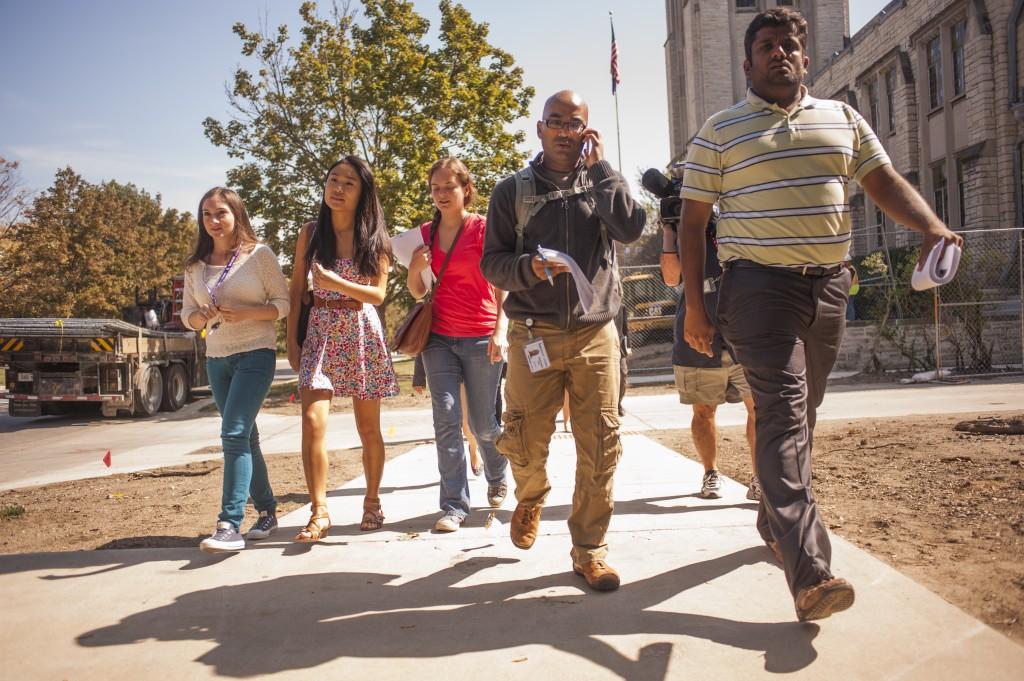
In all, about four groups of 20 people each searched both on and off campus, posting flyers and looking for traces of the missing student, Surekha said. Students, alumni and Evanston residents, as well as Harsha’s family and friends, were all part of the effort.
Members of the South Asian Student Alliance, which Harsha was involved with last year, participated in the searches Tuesday. Students from the Muslim-cultural Student Association and the International Student Association also contributed.
“Anyone who could just dropped whatever they were doing and helped out,” said SASA co-president Nikhil Bhagwat, a Weinberg junior.
In addition to promoting the search effort, Surekha has acted as a family spokesman for the reporters that descended on campus Tuesday. News of Harsha’s disappearance spread quickly beyond Evanston to Chicago’s main newspapers, television networks and radio stations. New York media picked up on the story, as did some national news outlets, including Fox News and the Huffington Post.
“If the media is going to be the people on our side then so be it — I would like to believe Northwestern is on our side,” Surekha said, questioning the timing of the campus-wide emergency alert sent to students. About 50 hours elapsed from when UP first heard of a missing student until the NU community was informed via email Monday night.
Patricia Telles-Irvin, vice president for student affairs, sent an email to the NU community Tuesday with a plea for student volunteers to join the search effort. More searches will leave from Seabury Hall between 9 a.m. and noon Wednesday, and the University will provide flyers, maps of Evanston and tape, she announced in the email.
Telles-Irvin also helped organize a standing-room only gathering Tuesday night in Allison Hall. Vice president of student engagement Burgwell Howard, UP Chief Bruce Lewis and Telles-Irvin represented the NU administration at the event. About 100 others also attended, including Harsha’s extended family and PARC residents.
"This is my son,” Harsha’s father said to the crowd. “It's been four days. I don't know what happened to Harsha. My hopes are fading."
Lewis said UP has sent bulletins to the Chicago Police Department, Chicago Transit Authority, other nearby universities and law enforcement agencies across the country.
A clearer picture of the details surrounding Harsha’s disappearance emerged after The Daily interviewed friends who were with him on the night he went missing. These students did not want to be identified due to the sensitivity of the situation.
Harsha left PARC around 10:30 p.m. Friday with about eight friends. The group first went to an off-campus party near Garnett Place but eventually made their way to a house party in the 2000 block of Ridge Avenue.
With three or four friends, Harsha walked in around 11 p.m., but they all left shortly thereafter. It is unclear where the group went after leaving, but they eventually returned together to the party on Ridge Avenue. After about 30 minutes, Harsha left with three or four friends, according to a student who spoke with Harsha as he left.
That student, who said he was sober because he was monitoring the door, said Harsha was coherent, wasn’t stumbling and did not appear drunk. Other friends said Harsha is not a heavy drinker, especially because he is a diabetic. Harsha's aunt Surekha said her nephew no longer needs to inject insulin but takes medication daily.
The group eventually arrived at another off-campus party before realizing they lost Harsha on the way. It is not clear how Harsha separated from the group while traveling between the two locations, which are less than eight minutes apart by foot.
Harsha called Weinberg sophomore John Kim at 12:10 a.m. Saturday and asked where Kim was. Kim replied he was still at the party on Ridge Avenue and Harsha said he was “going to see if he could make it over there,” Kim said.
Friends say PARC president Linzy Wagner, a Weinberg sophomore, called Harsha at about 12:35 a.m. and asked where he was. Harsha told her that he was back in his room at PARC, which was not true according to UP. This was the last known contact from Harsha. The friends contacted UP around 6:45 p.m. later that day.
Lauren Caruba contributed reporting.




Northwestern reaches $2 million settlement with Sunshine family
As part of agreement, the administration agrees to review and revise parts of its alcohol policy
By Brian Rosenthal
Published: Tuesday, September 21, 2010
Updated: Tuesday, September 21, 2010
sunshine
No closure: Jeffrey Sunshine, father of Matthew, said that the settlement he signed with Northwestern will never heal the pain of his loss.
Sunshine Lead Image
Vigil: More than 60 students attended a candlelight vigil eight days after Matthew Sunshine died. (Daily File Photo)
Two years after Matthew Sunshine died of alcohol poisoning in his Northwestern dorm room, University administrators have agreed to a legal settlement with his family, according to court documents provided exclusively to The Daily Northwestern.
The settlement, which does not constitute any admission of wrongdoing, grants $2 million to the family of the 19-year-old SESP freshman who died in June 2008. But the agreement also includes 10 non-economic terms which could drastically change NU's alcohol policy in the years to come.
Those provisions, laid out in a rider to the settlement agreement, call for NU to renew its commitment to existing campus alcohol rules and review its policy regarding students who call for medical help in alcohol emergencies. Among other terms, the university would also increase funding for academic research on binge drinking and host conferences with leaders from other universities in order to form a unified effort to fight excessive drinking by college students.
(Read the entire rider here).
"Hopefully it'll be a start," said Sunshine's father, Jeffrey, "a start of some sort of change in attitude on college campuses so that what happened to our son never happens again or is so infrequent that it almost never happens again."
During an hour-long interview in a downtown Chicago office building, the 58-year-old Jeffrey Sunshine carefully explained each piece of the settlement, occasionally veering into impassioned asides on the latest statistics about the dangers of drinking (1,825 college students die each year in alcohol-related incidents and another 599,000 are injured, according to the National Institute on Alcohol Abuse and Alcoholism).
He called University President Morton O. Schapiro "courageous" for agreeing to the "unprecedented" non-economic part of the settlement and said he hopes it will affect change at universities across the country.
He added that because NU students are the primary beneficiaries of the agreement, they have a legal right to demand that it is followed. Associated Student Government President Claire Lew, the student body's official representative, said she intends to work with the administration to do just that.
"I definitely feel that it's my obligation on behalf of the students to make sure these things are carried out," the SESP senior said.
University spokesman Al Cubbage released a seven-sentence statement about the settlement and declined further comment.
"As it has on previous occasions, the University extends its sympathies to the family and friends of Matthew Sunshine," Cubbage said in the statement. "Through its ongoing efforts, including those contained in the agreement with the Sunshine family, Northwestern will continue to work to prevent similar tragedies in the future."
Cubbage stressed that NU has "for years" employed programs to address alcohol and drug abuse. He said that the University has already started implementing some of the terms of the settlement, but he declined to mention specifics.
The statement represented the administration's first on-the-record comments about the death since the day after it happened, when Bill Banis, vice president for student affairs, blasted the death as "a tragic example of the dangers of excessive alcohol consumption."
That "tragic example" started with a drinking game in Foster House on the night of June 9.
According to police reports and interviews with witnesses, Sunshine apparently drank 17 shots of vodka before being helped to his room. When another student discovered his unresponsive body the next morning, Sunshine had a blood alcohol level of 0.396.
The death came less than six years after Music junior Joseph Doyle died of alcohol and cocaine intoxication in the Phi Kappa Psi fraternity house.
When Schapiro and Jeffrey Sunshine signed the settlement in May, after more than a year of negotiations and almost exactly two years after Sunshine's death, they each pledged allegiance to the same goal: never again.
Positive steps
But how effective are the changes prescribed in the settlement, and will they be successful in slowing binge drinking at NU?
Several alcohol policy experts, after being told the specific provisions of the agreement, praised the measures as positive steps toward addressing a complex problem that will require a mix of solutions.
Dr. Steven Galson, a former acting U.S. surgeon general, called each of the components of the settlement "very, very strong."
The key, Galson argued, is that administrators at various universities need to meet together, acknowledge that excessive drinking is a serious problem and commit to take concrete steps to address it.
Jeffrey Sunshine called the collaboration clause the most important aspect of the agreement because "no school will be able to do this alone."
But John Knight, director of the Center for Adolescent Substance Abuse Research at Children's Hospital Boston, said discussion between universities will have a limited impact.
"I think the colleges already pretty much know how they can limit underage drinking, and a lot of them have it in their policies," Knight said. "They just have to enforce it."
In Knight's latest study, released last month, he and his colleagues reviewed alcohol policies at 11 Massachusetts colleges and found that enforcement is an important element in fighting binge drinking. Most experts agree.
But while the settlement asks NU to "reinforce its commitment to enforcing Illinois Law and campus rules," it's unclear what impact the language will have.
Most of the other terms of the agreement are supported by experts, including requesting NU to provide at least $150,000 over three years for academic research into binge drinking at college campuses, to establish an educational website about the dangers of alcohol and to continue to support alcohol-free housing and alcohol-free evening activities.
The settlement also asks NU to establish an annual $5,000 scholarship for an incoming SESP freshman in Matthew Sunshine's name,and to support the Red Watch Band program, a national initiative launched in response to Sunshine's death that trains students in how to deal with alcohol emergencies.
‘Expectation' vs. ‘duty'
But the most contentious part of the settlement is sure to be the provision that calls for NU to review its Responsible Action Protocol.
The policy, implemented last fall, says that students are "generally expected" to call for medical help in alcohol emergencies and that the University "will consider the positive impact of taking responsible action" in those situations.
NU students have for years requested an amnesty policy which removes any possibility of consequences for students that call for help, even if they themselves were drinking underage or had provided alcohol to underage students. The truth is that, in the Responsible Action Protocol, they basically have just such a policy.
"This amnesty that everybody talks about — it's semantics," Dean of Students Burgwell Howard said. "If you do the right thing by taking care of members of our community, the consequences for you are going to be almost nil."
Administrators are reluctant to move to a full amnesty policy because empirical research supporting such a policy is scant and consequences are necessary for some repeat offenders, Howard explained.
The Sunshine family strongly opposes amnesty. Instead, the settlement advocates tweaking the Responsible Action Protocol in a different direction — changing the language from students being "expected" to call for help to them being "obligated" to do so. That is, making not calling for help a reason in and of itself for punishment.
Jeffrey Sunshine believes that if students had a "duty" to call for medical help, his son would be alive.
"I think it is really important. It's moral. It's right. It shouldn't be an expectation. It should be a requirement," he said. "You see a kid passed out and you don't call for help, you should be tossed the hell out of this school."
But Toben Nelson, an assistant professor of public health at the University of Minnesota, said such a policy would have little impact because it means "relying on people who are intoxicated to make good decisions." Other experts said there is not yet empirical evidence to prove whether the policy would be effective.
The review of the Responsible Action Protocol will be completed by the end of the month, Howard said.
Long road to settlement
Many of the settlement's provisions will not be implemented by the end of this month, or even the end of this year. Most deliberately extend over several years, seemingly as a way to keep Sunshine's memory alive.
The agreement itself was the product of a long negotiation prompted by a long investigation, initiated by the Sunshine family just days after the death.
By the end of the summer of 2008, the family had retained the Chicago powerhouse firm Clifford Law Offices. According to its website, the group won more than $121 million in settlements in 2008, the most of any firm in Illinois.
The two partners representing the Sunshine family did not return repeated requests for comment.
Jeffrey Sunshine readily admitted that in the days after the death, he "wanted to take (NU) for every penny" he could. It was his wife, Stony Brook University professor Suzanne Fields, who had the vision to use the settlement as a means of changing NU's alcohol policy.
The negotiations, launched in the beginning of 2009, focused on the non-economic portions of the settlement, said Jeffrey Sunshine, who refused to comment on the monetary aspect of the agreement except to say that most of the money will be given to charity.
As the talks progressed slowly through the winter and spring, Evanston police arrested two former NU students in connection to the death. Alexander Krzyston and Rohith Banerjee were each charged with providing alcohol to a minor, a felony charge when it results in death.
Prosecutors later dropped the charges against Banerjee in exchange for his testimony against Krzyston, who eventually pleaded guilty to reduced charges in an emotional hearing attended by Sunshine's parents.
Meanwhile, settlement negotiations picked up dramatically when Schapiro took over for retiring president Henry Bienen in the fall of 2009, Jeffrey Sunshine said.
"No progress was made until Schapiro arrived," said the father, who enthusiastically praised the new president but declined to comment on Bienen.
The final agreement reflected almost all of the initial requests of the family, Jeffrey Sunshine said, adding that he believes the family could have gotten much more money if it wanted.
While it's difficult to determine how large a verdict a jury would have delivered, the $2 million settlement is far from the largest in recent NU history. In March 2006, the administration gave $16 million to the family of 22-year-old Rashidi Wheeler, who died on the football practice field in August 2001.
Jeffrey Sunshine said to him, the policy changes in the agreement are far more important than any money gained.
But he added that even knowledge that his son's death may lead to life-saving policies could not reduce the pain or bring any closure to the ordeal.
"It never closes," the father said. "It's not how it's supposed to happen. Nineteen-year-old boys aren't supposed to be dead. Our family's supposed to have four members, not three. His sister is supposed to have a sibling when she grows old, not be an only child."
b-rosenthal@northwestern.edu
This article was sent as a breaking news alert. To be the first to know about what's happening on campus, sign up to receive breaking news alerts here.
Related Articles
Read the rider to the Sunshine/Northwestern settlement
[Reply]
RIDER TO THE SETTLEMENT AGREEMENT AND RELEASE
1. Joint Participation with Other College and University Leadership. The President of Northwestern, or his designee from Northwestern’s senior administrative staff, agrees to participate with leaders from other universities in attempting to address the problem of Binge Drinking on campuses, as well as other problems associated with excessive consumption of alcohol. Among other things, reasonable, good faith efforts will be made to seek agreement on codes of conduct and other programs that are effective so that the problem of Binge Drinking may be addressed jointly. The Sunshine Family has attended meetings with, read the writings of, and spoken to many persons who have studied the Binge Drinking problem, including the former Surgeon General of the United States who stated he believed that any solution to the Binge Drinking epidemic will need to be addressed jointly so that colleges and universities present a united front.
2. Implementation of and Support for the Red Watch Band Program. Northwestern has begun implementation of the Red Watch Band (“RWB”) program and shall make the Program available to its students and lend support to the Program starting in the Spring quarter of 2010. Training in the Red Watch Band program will include an emphasis on the importance of calling 9-1-1 in case of any emergency. At the end of the Spring 2011 quarter or later, Northwestern will evaluate in writing the effectiveness of the Red Watch Band program to determine future support and potential changes to the program. Northwestern will forward its evaluation of RWB to RWB and provide the same to Donald P. O’Connell as mediator who will apprise Clifford Law Offices of the finding.
3. Establishment and Funding of Academic Scholarship. Northwestern agrees to establish and fund a scholarship in Matthew Sunshine’s name in the School of Education and Social Policy. The scholarship in the amount of $5,000 will be awarded annually to an incoming freshman starting with the class entering Northwestern in the Fall of 2011. Northwestern shall fund the scholarship for four years for a total commitment under this paragraph of $20,000. After that, Northwestern shall extend the scholarship to the extent external funding is available on a yearly basis to sustain it. The criteria for the award of the scholarship will be determined by Northwestern, but recognize leadership and a commitment to public service. The selection of the recipients of the scholarship shall be at the sole discretion of Northwestern. Northwestern shall notify the Sunshine Family of the identity of each recipient of the scholarship.
4. Funding of Academic Research. Northwestern shall provide a total amount of at least $150,000 over three years starting, if practicable, in the Fall of 2010 (and if not so practicable as soon as is practicable thereafter) for academic research into Binge Drinking and related problems on college and university campuses. If the money is awarded to one or more Northwestern faculty members, it shall be used to support research, for example, as “seed money” for new studies and not to replace existing funding for such research. Northwestern has already identified the following area of study: evaluating the most effective means of adequately educating students about the deadly danger of binge drinking, including physician advice and other evidence-based outcomes research. Northwestern will also consider additional suggestions
1 of 3
made by the Sunshine Family. Northwestern, prior to the first award of funding and yearly for three years thereafter, shall provide a written report to the Mediator, Donald P. O’Connell, on how it proposes to spend the money and the amount awarded. Thereafter, for the three year term, Northwestern shall provide an annual report to the Mediator on the amounts actually spent and the status of the research. The reports may be brief and are not expected to exceed a few pages and the Mediator shall provide copies and an oral report to the Sunshine Family’s counsel, Clifford Law Offices. The Sunshine Family requests that during this three year period, the awards made under this paragraph be named after Matthew Samuel Sunshine.
5. Best Practices Meeting. Northwestern agrees to provide a total amount of at least $50,000 to convene two conferences separated by about a year to address Binge Drinking and related problems on college and university campuses. The conferences will be designed whereby professors and guest lecturers representing multiple disciplines gather for a colloquium to discuss binge drinking and related problems on college and university campuses from a multi-disciplinary perspective, representing professionals from relevant fields such as medical, public health, legal, communications, behavioral science and journalism, and student leaders and parents. The first conference will be held as soon as practicable but no more than 18 months from the date of this Agreement. Northwestern shall use reasonable efforts to include recognized experts in the study of Binge Drinking among college and university students. Topics that may be addressed include, but are not limited to, “bullying behavior”, dealing with peer pressure, standards of behavior in general, and ways to encourage students to act responsibly and watch out for each other, especially when faced with Binge Drinking. Conference participants will be encouraged to publish their presentations and research. The second conference will include an evaluation of progress in addressing Binge Drinking and related problems, new research areas related to the problem and the effectiveness of programs at Northwestern and elsewhere in addressing the problem. Any such conferences shall be consistent with Northwestern’s standards and reputation in the academic community. Northwestern will inform the mediator, Donald P. O’Connell, regarding the progress of the conferences and he shall in turn, inform the Sunshine Family’s counsel, Clifford Law Offices, and provide recommendations and suggestions regarding presenters and topics based on his own views and those he may learn from the Sunshine Family’s counsel. Northwestern, in its discretion, may sponsor and plan additional conferences to address the topic of Binge Drinking on college and university campuses and related problems based on its assessment of the value of the two conferences called for under this paragraph and any additional information relevant to these issues. The Sunshine family requests that the conferences called for under this paragraph be named in honor of Matthew Samuel Sunshine. The Sunshine Family has informed Northwestern that it does not consider conferences that address alcohol and substance abuse in general to address the Binge Drinking issue on university and college campuses, which the Sunshine Family believes does not involve physical or psychological substance abuse dependency but which involves a social culture and standards of behavior.
In the event that Northwestern, after further study believes that one or both of the aforesaid mandatory conferences will be repetitious of existing efforts, or will not attract sufficient participation to meet Northwestern’s standards and reputation in the academic community, Northwestern shall offer the funds to SUNY Stony Brook which has expressed an interest in conducting such conferences. Upon any determination to make the aforesaid offer, Northwestern will inform the Sunshine Family's counsel, Clifford Law Offices, of the
2 of 3
determination. If SUNY Stony Brook declines the offer, Northwestern shall expend the funds for other efforts chosen by Northwestern to increase awareness of the issues of Binge Drinking and related problems including support to SUNY Stony Brook for the Red Watch Band Program. If Northwestern determines in good faith that this is the best use of the funding that would otherwise be spent for the mandatory conferences, it shall report the same to the mediator, Donald P. O’Connell, who may evaluate whether the determination was in good faith and whether the proposed alternative use of the funds meets the intent of this agreement. If this paragraph applies, then Northwestern shall pay the costs of the mediator for making these determinations.
6. Review of the Responsible Action Protocol. Northwestern currently has in place the Responsible Action Protocol for addressing, among other things, alcohol and other drug related incidents. Northwestern agrees to evaluate the effectiveness of the Protocol no later than the Summer of 2010. The Sunshine Family requests that any such evaluation pay special attention to the provisions of the Protocol concerning a student’s obligation to call for emergency help for a fellow student who may require such help and that alcohol intoxication to the point of stupor be defined as an emergency. The Sunshine Family believes that the obligation to call for help should be a duty not an “expectation” and the failure to call for help should be an independent basis for disciplinary action, not just an aggravating factor if the student already is subject to discipline, as is currently the case. The Sunshine Family believes that if such an obligation had existed in June 2008 their son would be alive since they believe that numerous Northwestern students not involved in the drinking observed their son’s condition yet failed to call for help.
7. Support and Promotion of Alcohol and Other Substance Free Housing. Northwestern agrees to continue to support and publicize the availability of alcohol- free and other substance-free housing options for students of Northwestern.
8. Support and Promotion of Evening Hour Activities. Northwestern agrees to commit resources and funds, as Northwestern deems appropriate, to support evening hour alcohol-free and drug-free activities for students, with particular focus on the Thursday, Friday and Saturday evenings.
9. Illinois Law and Campus Rules. Northwestern will reinforce its commitment to enforcing Illinois Law and campus rules relating to alcohol and other drug distribution and use.
10. Enhanced Website. Northwestern shall support an enhanced website accessible through Northwestern’s primary website (www.northwestern.edu), focused on resources and educational material available at Northwestern for alcohol and other substance abuse problems (including Binge Drinking), e.g., contact information for counseling, the alcohol and other drug coordinator, and referencing the Responsible Action Protocol. The website shall prominently display the contact information for the physician on emergency call and shall encourage students to call such physician whenever they have doubt regarding whether another student needs emergency medical care, particularly at times when other University resources, such as Student Health, are not open.
CH1 5296303v.1
3 of 3
[Reply]
To Trans Parent (the commenter):
Your insensitivity is jarring. If you'd like a podium, find one, but don't inject your agenda into this evolving story. At best you are leaping to conclusions about events and responsibilities; at worst you are obfuscating and distracting an audience eager to help find this young man -- and traumatizing the community to boot.
McCormick students, this alum implores you to help in the search -- as independent as we "techies" are, this is a moment that requires solidarity and resolve. You'll grow from it.
My sincere hope is that this young man is found safe -- and soon.
Todd Curry
McCormick '90
[Reply]
Trans parent Reply:
September 26th, 2012 at 9:03 am
If this was a white female, how would the world have responded?
[Reply]
Trans parent Reply:
September 26th, 2012 at 9:45 am
"The Statewide Terrorism and Intelligence Center has been notified of the case." FoxNews
[Reply]
Trans parent Reply:
September 26th, 2012 at 10:32 am
http://northbynorthwestern.com/story/letter-the-racist-olympics/
Lewis: The "Racist Olympics"
By Letters
12:12 a.m. April 24 2012
Northwestern Family,
On April 21, I saw something I was not supposed to see. As I was walking down Foster Street to hang out with a friend and do some homework, I heard a foul noise fall on my ears from the sidewalk. As I enter into my friend's apartment I see in the backyard of the neighboring house a game being played by a group of white NU students; I later learned these were the "Beer Olympics," which typically involve teams of kids representing some nation-state, wearing a flag or sports jersey of some sort, playing some silly drinking games.
But what I saw Saturday afternoon was really just the "Racist Olympics." In this backyard were at least 50 kids dressed up as some particular ethnic group or nationality. There were 6 teams: Canada, Ireland, Bangladesh, South Africa, Uganda, and Navajo Nation. All teams but Canada and Ireland signified via horribly racist and offensive mock-ups of these cultures. The noise I had heard came from the "Navajo Nation," although almost every student in this yard participated in the "Indian call." Moreover, these students are dressed up in headdresses, leather vests and other stereotypical indigenous garb.
Uganda was represented by students wearing tribalized Kony 2012 shirts. Students representing South Africa seemed to take a much simpler approach. In my presence, a passerby asked why the group chose to wear white t-shirts and black jeans. The response: "We're South Africa! White on top, black on bottom!" Finally, the Bangladesh group simply dressed themselves in beads and painted red dots on their foreheads (the overwhelming majority of the population in Bangladesh aren't Hindu, but Muslim). These chants, the minstrelsy aimed at the expense of the dignity of non-Europeans and the sheer ecstasy of the partiers was sickening and traumatizing.
The party could be viewed from the street, and the Indian calls could be heard down the block. This cannot continue. It will not. The students have written a statement, which you will find in full below:
On April 21st our organization held an event during which actions of the people participating were entirely inappropriate and racially and culturally insensitive. We regret that these actions occurred and are carefully reassessing the values of our organization as we attempt to move forward from this inappropriate display. We met with multiple campus leaders on the 22nd to discuss the incident and how it could be used to motivate and educate the Northwestern community. Our discussion with them and our reflection upon the events that occurred have made it clear that inappropriate displays such as those on April 21st can happen far too easily with little to no resistance from those involved, and without regard for the offensiveness of the actions. The Northwestern community needs to take a lesson from this horribly inappropriate event. To facilitate this, our members plan to actively support campus change in the future and move forward from this in a positive direction.
Sincerely,
President & Events Chair
This is a brutal incident that has imposed upon the various Black and Brown communities on campus. This was an act of violence. Violence directed toward the dignity and histories of students, their families and their entire cultures. This is yet another addition to the list of racial harassment cases that are symptomatic of and fostered by the cultural, educational and socioeconomic environment this administration has allowed to exist, develop and, unfortunately, grow.
I am writing this to implicate students who did not know any better, because honestly we've tried that, and it just seems that there are way too many to investigate! When will the University take the responsibility to educate its ignorant and misinformed students? When will the university release the Diversity Report, which analyzes in detail the state of diversity, in full and unedited, to the public? Incidents like these terrorize students. This is an opportunity for the administration to take swift, decisive, positive action and back up the long-made promises to cultivate an environment that defends the humanity of all its students (who, mind you, are also customers).
Kellyn Lewis
Note: An original version of this letter used the term Hindi instead of Hindu. The statement has been corrected.
[Reply]
Is it customary in stories about a missing person to describe the clothing the individual was wearing the last time he was seen?
If he hasn't returned to his dorm to change clothes, this information might be helpful to University community members and Evanston neighbors who may have seen him in the event that he was lost, sick, or disoriented after the party.
[Reply]
Rick Reply:
September 26th, 2012 at 9:48 am
See here: http://dailynorthwestern.com/2012/09/24/campus/northwestern-student-missing-since-saturday-morning/
[Reply]
NU Continuing Ed Student Reply:
September 26th, 2012 at 2:22 pm
Rick, thank you for the correction. I see now that NU's emergency info notice also mentioned his clothes, but I read this story first. Hoping the best for him.
[Reply]
I pray this young man can be found soon! So many questions... Can his cell phone be tracked by pinging/triangulation? ... I agree with the commenter above who suggested that it would help to know what the student was last seen wearing...
[Reply]