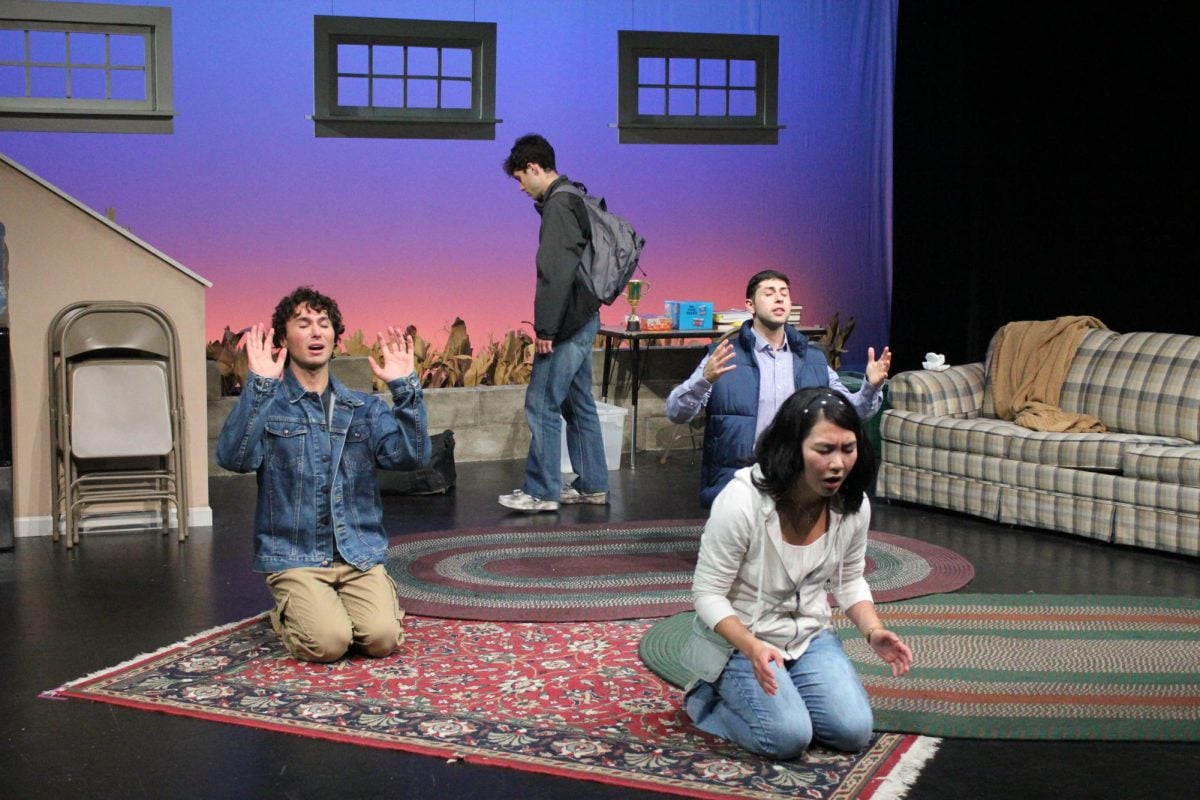
The Virginia Wadsworth Wirtz Center presented “David’s Redhaired Death,” a play written by Sherry Kramer and directed by Rosalind Faires, this weekend. The show ran four times, telling the story of two redhaired women as they explore love and struggle with grief.
Communication seniors Ani Kabillio and Mia Van De Mark played redheads Jean and Marilyn. The two women meet and find that they have everything in common, until the death of Jean’s brother forces them apart. Two stage technicians, played by Communication juniors Henry Jones and Alex Arinkin, physically aided the story through sound and movement.
Faires pitched the play as one of three options for her first full design production as a second-year in the MFA program.
“It’s a play I’ve been obsessed with since I was like 16,” Faires said. “I’ve been wanting to direct this play for all of my adult life, so it’s really, really exciting to get to do it now.”
Faires and Kramer are family friends, and Faires described Kramer as a “non-biological aunt.” When she first read the play as a teenager, Faires recalled being “floored” by it.
Kramer was inspired to write “David’s Redhaired Death” after a trip to a library, when she said a book about death and burial rituals found its way to her. For her, she said, the play is a “grieving ritual.”
“When you write something, the thought of writing something that matters to other people, that’s a compelling thing,” Kramer said.
For Van De Mark, Kramer’s writing style was both “poetic” and “colloquial,” which she appreciated. She said the play wove parallels, themes and motifs together beautifully in a way that captured poignant, real love.
She added that every time she returned to the script, she learned something new.
“One thing I’ve learned in four years of theater school is you can’t beat the script,” Van De Mark said. “If the script is good, it will just be good. Even if you’re having a bad day, the script will save you.”
Van De Mark said the writing was so good that it wasn’t hard to act. She said that her character, Marilyn, was unlike her in certain ways, but they also shared traits and “some essence of soul.”
Kabillio also saw some of herself in her character, Jean. She said Faires encouraged her to infuse a lot of her own humor and sensibility into the role.
Kabillio also noted that her character was a version of Kramer’s younger self, though she said it wasn’t intimidating to portray the playwright herself.
“Because I was fortunate enough to relate to the character and therefore relate to this version of Sherry, it wasn’t a scary thing to find out that I was playing her,” Kabillio said. “It was quite exciting.”
“David’s Redhaired Death” is part stand-up comedy and part stand-up tragedy, and the former aspect drew Kabillio to audition, since she has been doing stand-up comedy for the past four years.
Still, the play wasn’t what she’d initially expected. It wasn’t what Arinkin expected, either.
He remembered seeing a description of the production as a two-woman show and not thinking much of it. However, Arinkin later learned there were two additional characters in the play: the stage technicians.
The idea of two characters that were onstage the whole time, but had no lines, seemed interesting, he said.
“Like any other character, you figure out where they sit in the world of the show and what the rules they follow are,” Arinkin said.
However, this role required a different type of focus. It was purely physical, Arinkin said, adding that he and Jones felt empowered to figure it out.
Jones said determining what to do in the role was “daunting” at first. The two worked closely with Faires to figure out the rules of their characters, and ultimately went back to the foundational principles of movement to do so, Jones said.
“It allowed me to really focus and lock in on those foundational movement, breath parts of character without having to worry about, ‘What’s my next line?’” he said.
Faires said the production process involved much collaboration, from exploring roles to designing the show.
For her, one of the most valuable experiences happened early on. She and the production’s three designers sat together and went through the script, making sure they were all on the same page.
“That has been one of the most special things about the room for this process, is that it’s been a space where it really feels like anyone has the freedom to speak up and make this a more powerful, meaningful play,” Faires said.
She said throughout the process, she often returned to her notes from that day. She had been familiar with the play since she was a teenager, but this time spent analyzing the play was time most well spent, she said.
For her, there were two key aspects of the play. She appreciated both how the play grapples with grief in the contemporary era and also how it explores queer desire, she said.
While it explored heavier topics, the production still included more playful elements. Repeated mentions of McDonald’s french fries, red wigs and a blue car rolling across the stage all combined to create the play’s world.
“The language of the play is that it lives inside the ‘redhaired world,’ and I just really want people to see the redhaired world,” Faires said.
Email: [email protected]
Related Stories:
— Waa-Mu Show ‘Dillo Day Disaster’ is vibrant, ridiculous adventure into Northwestern social life
— A generation in ‘Shreds’: Inside Northwestern’s verbatim theater experiment
— Reel Thoughts: Self-produced film ‘Busboys’ serves trashy comedy, superficial scripts