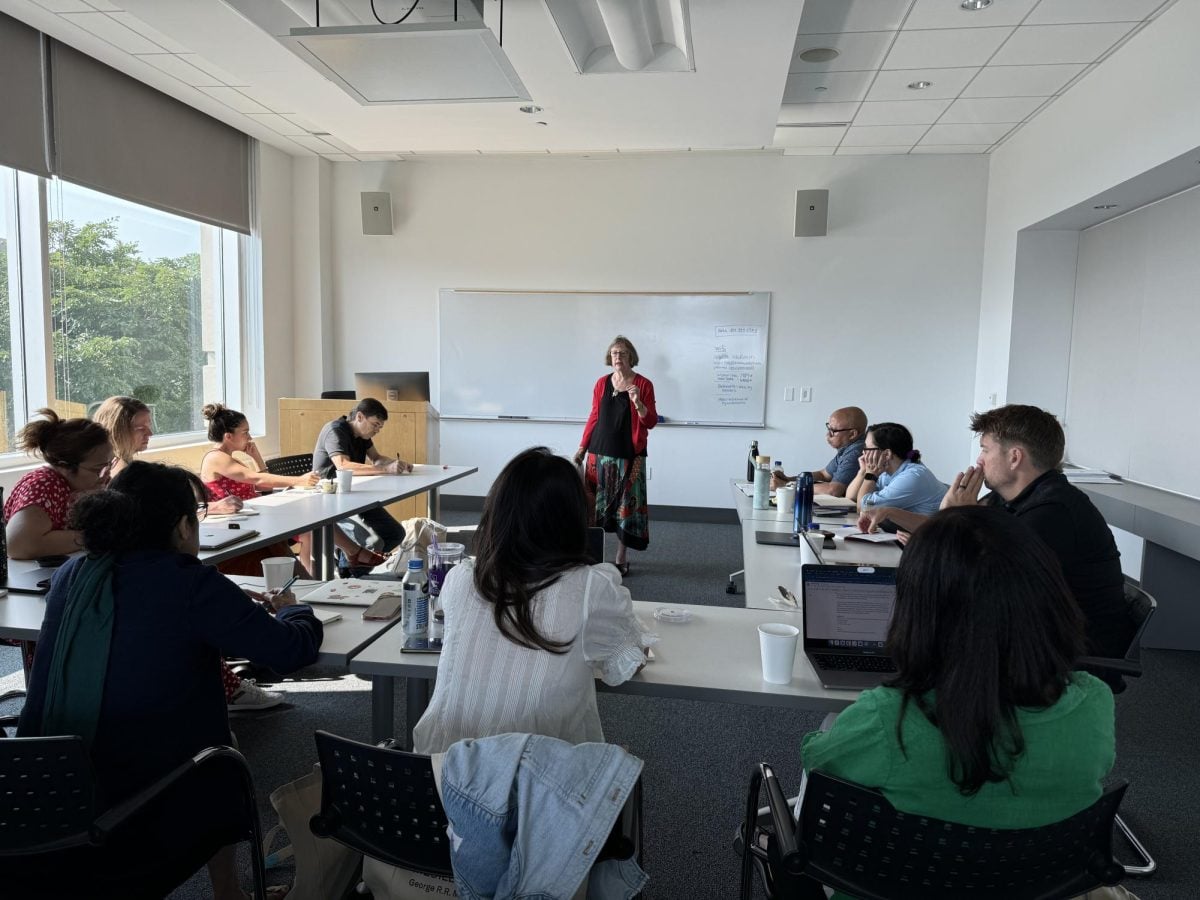
Northwestern’s Undergraduate Prison Education Partnership and Menstrual Equity Activists co-hosted a speaker panel titled “The Domestic Violence Survivor to Prison Pipeline” in Harris Hall Tuesday.
The panel featured legal studies Prof. Abigail Barefoot, Loyola University Prof. Amanda Ward, University of Chicago doctoral student Carly Murray and Maggie Bourke (Pritzker ’25), an equal justice works fellow at Uptown People’s Law Center.
“It’s important to think about how our assumptions about mass incarceration in the prison system, and our assumptions about domestic violence, intersect and then reinforce who is left out of these conversations,” Barefoot said.
Moderated by UPEP Programming co-Chair and Weinberg junior Harin Jeong and MEA Education Chair and Weinberg junior Yujin Tatar, the panel began by looking at how domestic violence survivors can be more vulnerable to incarceration.
Bourke said the majority of people in custody have experienced gender-based violence, which can look different for different people, she said.
Murray said a lack of institutional support for minority groups, such as different treatment when accessing social services, accumulates over time and can be linked to criminalization.
“I think about it in this compounding way that you’re already starting with greater surveillance,” she said. “Then you look at arrest rates. You’ll look at sentencing.”
Barefoot spoke about how assumptions of “the perfect victim” – or how people’s biases can lead them to assign traits to victims or abusers – creates a binary that prevents people from examining deeper reasons for abuse.
The panelists also spoke about ways to advocate for incarcerated survivors of domestic violence.
In prison environments that can be dangerous and volatile, Bourke said the emphasis should be on measures to prevent people from going to prison in the first place.
“It is hard once you have gotten into that revolving door, and now it’s replicating those harms that even if you are released, the damage has been done and you might come back again,” she said.
Communication senior Aashna Rai said she works as a correspondence writing tutor with the Northwestern Prison Education Program and is interested in learning about “systems of repair in the city.”
She said she appreciated learning from the panelists about Chicago organizations in the field, and how a “rotating door” can trap people in the system.
“Once you’re entangled with the system, it’s really hard to get out of it, and the system keeps you in,” Rai said. “It keeps you leashed in, almost.”
Barefoot told the audience to think about how their passions intersect with these issues, and to collectively work together to come up with solutions.
She added that audience members should start small by practicing the skill of responding to conflict, such as facing uncomfortable conversations with roommates.
“You never have the conversation about the dishes, right?” Barefoot said. “Have the conversation about the dishes.”
UPEP co-President and Weinberg junior Joyce Wang said she took “Gender, Sexuality and the Carceral State,” a course with Barefoot that touched on topics at the intersection of domestic violence and incarceration.
This course inspired her to organize Tuesday’s panel, she said.
“We wanted to focus on this issue because it tends to be overlooked in dominant discourse,” Wang said. “A lot of the times women who are incarcerated have experienced violence previously and were often forced into situations of crime.”
Email: [email protected]
Related Stories:
— NPEP students’ artwork showcased at public exhibition
— Northwestern Prison Education Program honors second graduating cohort at ceremony
— Northwestern Prison Education Program celebrates inaugural commencement